Showing posts with label Walney Pond. Show all posts

Thursday, July 17, 2025

WALNEY POND - LAST POST UNTIL THE NEXT VISIT

I am always drawn to the water lilies. There is a large carpet of them on the pond and you can see those photos here if you missed them.

I found this graphic online.

More facts can be found here at the Kenilworth Park and Aquatic Gardens in Washington DC. We were here once and are way overdue for a visit. It's a marvelous place!


The next photo is called the Tulip Tree (Liriodendron tulipifera). There is a lot of information here. It is one of the tallest and most beautiful eastern hardwoods, with a long, straight trunk, a narrow crown that spreads with age, and large showy flowers resembling tulips or lilies. It is a tall straight, deciduous tree that grows to 150 feet tall (sometimes taller), has a medium to narrow crown and distinctive, star-shaped foliage. The yellow-orange, tulip-like flowers are often missed because they are up to 50 ft. or higher in the tops of trees. Their cone-shaped seedheads remain after leaves have fallen.


The trees are native to eastern North America. Specifically their natural range extended from southern Ontario and possibly southern Quebec, south toe Florida and Louisiana, and west to Illinois and Michigan. They are a common sight in the eastern United States, thriving in various habitats like woodlands, protected by hillsides and wooded valleys.


Introduced into Europe from Virginia by the earliest colonists and grown also on the Pacific Coast. Very tall trees with massive trunks existed in the primeval forests but were cut for the valuable soft wood. Pioneers hollowed out a single log to make a long, lightweight canoe. One of the chief commercial hardwoods, Yellow Poplar is used for furniture, as well as for crates, toys, musical instruments, and pulpwood.


I was too late to see it blooming on this particular visit, but I went on a hunt through my old blog and found the following two photos taken in 2009.


I got the settings wrong on this photo as it was a bit washed out to look at. I tried to darken it a little but need an expert. I need to find the book! It's a Pickerel Weed and I go into more detail at this post if you scroll down.


Shared before but wanted to include this pretty pink Swamp Rose. This link will give more info where I go into more detail.


I first shared the photo (taken at Walney) and the quote here, but felt it worthy of doing so again


We have been coming to Walney Pond for many years, and if you want to see those posts you can click here. Much too many to see in one sitting but you may enjoy one or two.

Thanks so much for visiting, and a thank you to all those who comment. I hope everyone has a great day!


Wednesday, July 9, 2025

BACK TO WALNEY POND

 I am concentrating only on a few things today. Two are the dragonfly photos Gregg took. We are thinking the red-beading effect on its wings in the first photo, was the reflection from the sun bouncing off its wings? Maybe?

And this in another spot. It may have been the same one as we were waiting for it to stop plant-hopping long enough to take its photo. I identified it as the male Blue Dasher Dragonfly. Experts, let me know if you disagree please.
Next is the female Redwing blackbird who was in a tangle of branches.
In the next tree, we found the male Redwing blackbird.
The photo above shows the clearest picture of his striking red and yellow epaulette. You can read all about them here. The bird photos were also taken by Gregg.

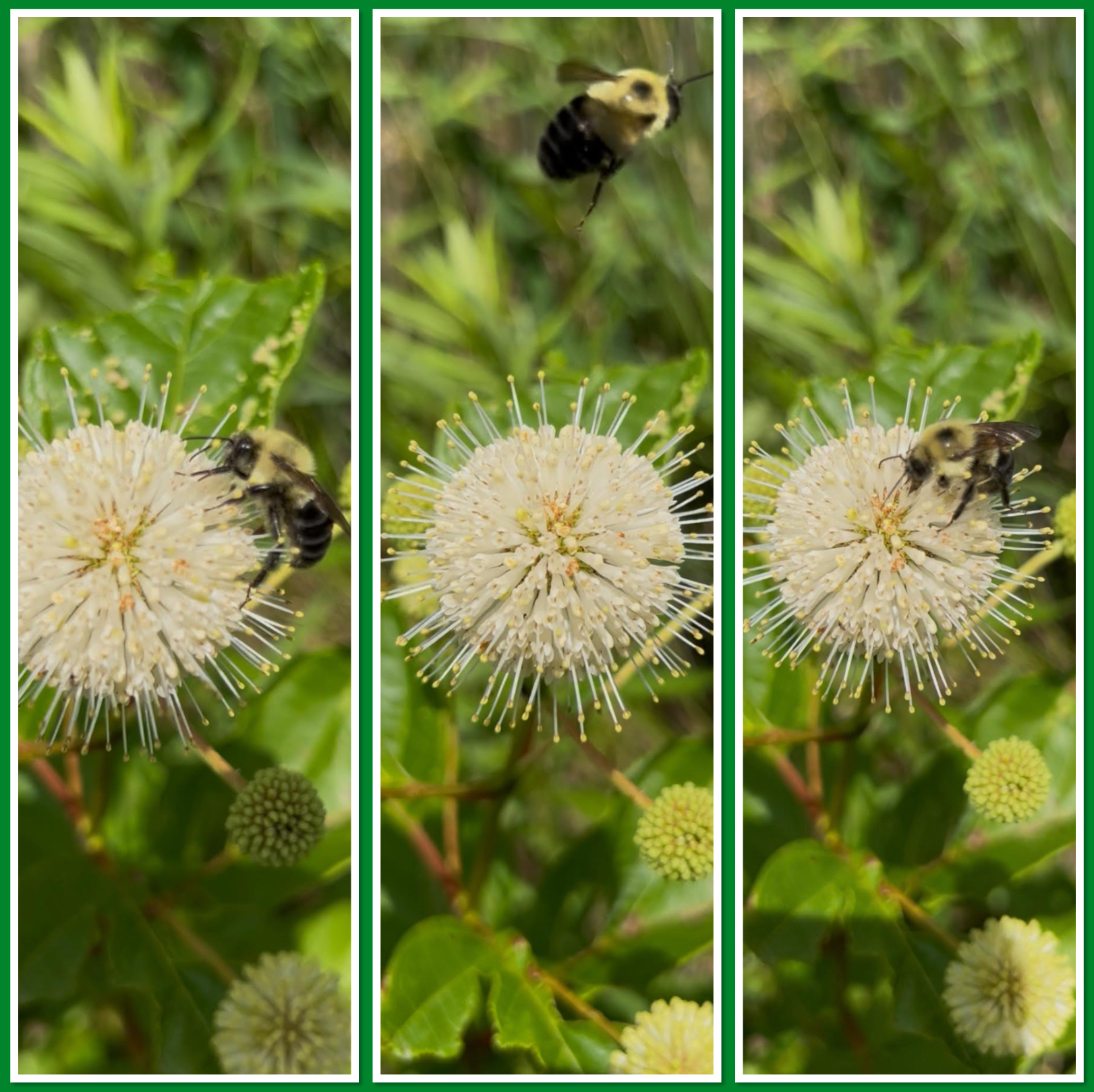
Lastly, the Bumblebee on the Common buttonbush, which on the day we were there, held my fascination for some time. I couldn’t get it as sharp as I would like it to be, but I was happy. There are several species of bumblebees that are native to Virginia. If you missed the first part of our visit, you can find it at this link. My post today is Part 2. I found a splendid website with the title, "For Wild Bees, these Native Plants are the Superstars."


I am now on the hunt for local honey. There is a beekeeper who sells it locally. I just need to do a search as it’s not in the local supermarkets and it is outstanding honey, my all-time favorite. I can't remember what kind it is now (when I see the bottle I will know). I ran out ages ago and bought a jar of regular. It is very nice but I try to give my business to the smaller family run local businesses when I can. I might have gotten it originally from a weekend farmer's market.

Thanks for looking and I hope your day is a great one.


Tuesday, March 18, 2025

AROUND AND ABOUT FROM 3-10-25 TO 3-2-16, 2025

Hello Family and Friends, once again here is the weekly around and about. Thank you for reading them and I have been enjoying the emails and comments you send me.


This week's weather from 3-17 to 3-24-25.

Monday, March 3-10-25 and Tuesday, 3-11-25: the same as last week basically. Enjoyable but quiet and I forgot to write anything down more’s the point.  

Wednesday, March 3-12-25 at 10.47 p.m: We went over to Walney Pond today. I have already shared those photos at this link, but I found two old ones from August 2012. One shows you how pretty it is in the height of summer, when everything is lush and green, and the irises and waterlilies are blooming. The photo above shows my reflection in the water as I leaned over the old overlook.


We passed by a few days ago and I said we should go as even though it is not a paved footpath around the pond, it is nice and flat. We drove over a little after 3.00 a.m. There were only a few people enjoying the area. In addition to the pair of ducks and tortoises I mentioned before, there was a father with his young daughter carrying a fishing net on a pole as they looked into the water. It doesn't appear they found anything and went home soon after. They were probably there a while before we arrived. There was a man sitting on a bench talking on his phone, and a lady sitting on another bench enjoying a book and that was it. There is also a gazebo nearer the parking area, and there appeared to be a small gathering of people having a barbecue. We had a nice leisurely walk with a couple of sit-downs as we made our way around the pond. Very pleasant!


finished a new puzzle. No idea where this is, it reminds me of a town in Germany but the architecture is different.

We had chicken salad sandwiches tonight on toasted sourdough bread. A light supper and something we had not had in a while.


Thursday, 13th, 2025: I chatted with my niece in Germany. We had a wonderful and lengthy conversation. Gregg had just missed her as he had left to meet up with our son less than five minutes before. 

A lovely day but if I don't write it down, it's in the wind lately.


Friday, March 14th, 2025: same here. I need to be more diligent. Gregg has been recording three short sentences on his phone for years. I should try recording key info and go on from there. Now that's a thought, if I can remember to do it!


Saturday, March 15th, 2025: Gregg went to the supermarket for our usual donut, that I do remember!  

Lunch was cheese on toast and a bowl of tomato soup.

My dear other half has now gone off to the store to pick up some gorilla glue. I looked out this morning and saw that one of my lovely plant pots had a large piece broken out of one side!  I'm not pointing fingers but the Mourning Dove knows and is looking down at the culprit.

Naughty boy! 


I keep the pot on the ground to avoid catastrophes. I think the culprit knocked the smaller bird feeder off the top of the feeding bench. There was a very loud bang, which I think was the pot as it broke. It's quite a sturdy looking pot too! It must have hit it in just the right spot as those feeders are not very big, or very heavy for that matter.

Dinner tonight was one of Gregg's cheeseburgers with sliced pickles and tomatoes, lettuce with lots of other veggies on the side.


Sunday morning, March 16th, 2025: breakfast today coffee and a lemon poppyseed muffin, which son picked up at our local coffee shop, with a pop-in to the supermarket next door for the donuts.

Lunch: a simple chicken and vegetable stir fry.

Dinner: for a change of pace, we had breakfast for our dinner. Gregg fixed bacon, egg and toast.

Snacks: veggie sticks.

Son came over for our usual Sunday morning get together. Later our son left but then brought our daughter-in-law back for another hour. They had more time to visit today. It was a lovely ending to the morning, and always a highlight of our day being with them.

Later on in the day I did a couple of scribble sketches. I picked a Chihuahua this time. I did two because I wasn't satisfied with the first one. It looked more like a cat to me. 


Is it a bear, a Wookiee, definitely not a Chihuahua...


but the important thing is I enjoyed scribbling. I loved the original drawings. I have a soft spot for the Chihuahua, but if someone gave me an Old English Mastiff, I would be happy. The man is giving me the side-eye as there are no sweet pups in our future. I will use a favorite saying of his, "Never say never!" and if we did get a dog, it would be a rescue.

Nothing else to write about as we spent the rest of it very quietly.


And that's all for this week. I will try to write more regularly the next time.  

Thanks for reading and have a great day!


Thursday, March 13, 2025

DUCKS AND TORTOISE AND A POEM


A duck with a dream and a makeshift raft,  

Set off on a journey that made others laugh.  

"Tortoises aboard!" the duck did declare,  

"Across this grand pond, I’ll get you there!"  


The tortoises climbed, with patience galore,  

Each slower than the one just before.  

"Can we go yet?" quacked the duck in dismay,  

"At this rate, we’ll leave by the end of the day!"  


With a flap of her wings, she gave the raft a pull,  

While the tortoises chuckled, their shells looking full.  

"This is quite nice," said one with a yawn,  

"I could sit here till the break of dawn!"  


The duck rolled her eyes but kept pulling strong,  

While the tortoises hummed their own little song.  

Across the pond, through ripples and weeds,  

She tugged her slow crew with admirable speed.  


When they reached the far bank, the tortoises beamed,  

"A duck with such grit, we never dreamed!"  

But the duck just sighed, her feathers askew,  

"Next time, I’ll stick to just paddling for two!"  


Have a great day!


Friday, July 8, 2022

A LITTLE BUNDLE OF FLUFF...

An old favorite from Walney Pond.  We came across these little darlings just clambering all over each other, ending up in a little ball of cuteness. Their parents were watching over them and we did not get any closer than our zoom allowed us.  Like all the wildlife we see, we are very happy to be given this gift.


Tuesday, June 14, 2022

WALNEY POND WALK IN MAY

After we had been surprised by our non-Swans (decoys) shared in this post, we did what we usually do, continue our walk around the pond and enjoyed all the other sights.  
If you wanted to get some really good exercise, you would have to walk at a brisk pace along the circular path several times, as I have seen people do.  The pond is relatively small compared to others we have come across.  But there are trails and one we know leads to the visitor center through the woods.
  We noticed the Yellow Flag Iris' were blooming.  They are a lovely sight at the edge of the water.
Yellow flag iris, botanical name Iris pseudacorus, also goes by the following names: Yellow Iris, Water flag, Dragon flower and Paleyellow iris.  
I found a blog at this link, called Botany Karen, where she adds other common names which are very interesting.  One is 'Yellow fleur-de-lis', and she states this name points to the possibility that Iris pseudacorus is the historical inspiration for the heraldic Fleur-de-lis (or Fleur-de-lys), that there is a passing resemblance to the flower’s 3 standards and 3 falls, allowing for some artistic licence she says.
Karen continues, “The Fleur-de-lys’ historical usage is not confined to a single country. Its strongest associations are undoubtedly with France and French royalty through the ages. It traditionally appeared as a yellow symbol on a blue background in France."  And this from me, I can highly recommend taking a look at Karen's blog as there is so much to see, to explore and to learn.
Yellow flag is a flowering perennial plant native to Europe, Asia and Africa.  In temperate climates throughout the globe, yellow flag is cultivated as an ornamental plant, but is considered an invasive aquatic species.  In some regions it can be very invasive and harmful to native species.  It spreads easily due to its floating masses of seeds and long rhizomes, making it very hard to control.  It can also block water flow, affect bird nesting sites, and fish habitats, disrupting and changing entire ecosystems.  

Oh dear!  Well, it didn't seem to be out of control at the pond.  I daresay it is well managed, and I have always loved its presence in blooming season, but certainly these facts should be taken note of.

Other wildflowers we saw were buttercups...along with a couple of bicyclists.  A good day for getting the bikes out.

When I was a child I always loved buttercups, and I still find them pleasing.  When you are a child you don't have a care in the world and certainly don't think of things like how invasive they are.  Before I go on I would like to share another blog I found.  One called Lizzie Harper where you will find various illustrations, one of which is this buttercup.  You can see it here and then if you like, explore further and see the others.   Also more information at this link.
I am finding out about invasive plants today, and this is another one.  They are called Creeping buttercup, botanical name Ranunculus repens.  Common names are also Sit-fast, Creeping crowfoot and Double meadow creeping buttercup.  It is native to Europe, Asia and Northwestern Africa.  These glossy-petaled yellow flowers of the creeping buttercup do, however, aid in the attraction of pollinating insects.
The following is Common vetch, botanical name Vicia sativa.  Its common names are also Garden vetch, Vetch, Garden tare, Summer vetch and Tare.  
It is widely grown as a forage crop or green fertilizer, but common vetch is often considered a weed in garden settings.  However, it seems to be a gardener's friend, as its nitrogen-fixing ability enriches the soil, and it offers food and support for native wildlife.  
The vine-like growth, feathery foliage and purple flowers can be visually attractive.  So, common vetch is ideal for including in native gardens, wildlife gardens and wildlife meadows.  

Hurray for the Common vetch, and a lovely photo can be seen at this link

On that good note and as I don't want to overwhelm, I will finish as I have, surprise, even more photos to share from our time at Walney Pond.  I will be publishing another post tomorrow.


Wednesday, July 7, 2021

NORTH AMERICAN BEAVER AT WALNEY POND - FROM MY OLD BLOG POST DATED 6-5-09

This is an old post from my original blog (long since closed).  I am slowly transferring all my old posts to this one.  Today shows the North American Beaver that we used to see regularly on our visits to Walney Pond.  These were from June 5th, 2009.  The lodge has disappeared since, whether it was dismantled or removed by nature, I don't know.

Described as "Nature's Little Engineer", the North American Beaver is considered to be the second largest rodent in the world (after the capybara).  Beavers are primarily nocturnal, though we saw ours in the early evening and still in the daylight hours.  From what I read, they are split into two extant species of the North American and Eurasian variety, with location of birth being the only real difference between the two.  Beavers generally have a large body and small head (like most rodents), a broad, flat and scaly tail and webbed hind feet.  Due to their small ocular cavities and nocturnal lifestyle, beavers have poor eyesight, but possess enhanced senses of hearing, touch and smell.

Living off an herbivore's diet of wood from quaking aspen trees, cottonwood tree, alder trees, willow trees, birch trees, maple trees, cherry trees, pondweed, sedges and water lilies, beavers can grow up to 55 lbs. (25 kg) before they pass away at around 24 years of age.  Often female beavers will grow larger than the male, which is uncommon amongst mammals.
The person who coined the phrase "Busy as a Beaver" was spot on.  He or she very industriously chewed on the lily pads off their stems and either ate them right there, or swam to shore and took them back to a spot underneath a tree.  He immediately came back and repeated the process dozens of times.
Online I read: "Beavers who inhabit smaller streams or ponds will make lodges so they can be active all winter and as a defense against predators.  The lodge will be made primarily of mud and branches."
"A beaver's front feet have five fingers and are very skilled at manipulating objects.  They can take a twig no bigger than a pencil, and twirl it around like a corn on the cob as they nibble off the bark."
"A semi-aquatic animal, beavers can stay under water as long as 15 minutes when necessary, and often do so when startled or frightened.  When in danger in the water, a beaver will rapidly dive under the surface by slapping its wide tail on the water.  The sound will be audible over a large area, warning other beavers, who will also dive down and avoid trouble.  Despite this amazing defense mechanism, they are far more well known for their natural ability and propensity towards making dams on rivers and steams.  Beavers prefer to live in mini-ponds, so in the absence of these small bodies of water, they will make their own.  Using their powerful front teeth (which grow continuously to avoid being worn down, are self sharpened almost into chisels, and are composed of hard orange enamel in the front and softer dentin in the back), beavers will cut trees and plants to both build and eat.  They will then make two vertical posts in the water, then fill that in with a crisscross of branches, weeds and mud, until the dam impounds enough water to make a "lodge".  Beavers are also known to make canals in the water in order to transport materials that they otherwise couldn't move over land."  Below is a diagram I found of what a lodge looks like inside.
If you want to learn more how the beaver builds its lodge and dams, there is a great YouTube video called "Beaver Lodge Construction Squad" from David Attenborough's BBC Earth.  Link here if you would like to take a look.
"The front teeth (incisors) of a beaver, or any other rodent, grow throughout the life of the animal.  The front surface of the incisors is made of a very hard enamel that is dull orange in color.  Since the back part of the tooth is not as hard, it wears off first, resulting in a chisel-like shape which for a beaver is perfect for the task of felling trees and stripping their bark.  A lone beaver can fell an 8-foot tree in 5 minutes."
"Beavers are highly social animals.  They live in family groups consisting of the parents and young of the year and two-year old offspring.  Litter sizes average three, so a family of eight beavers would not be uncommon."
Finally, our beaver retreated to shore.  We watched as it stood on its hind legs and chewed off a few lower branches off the tree, and then disappeared out of sight.