Showing posts sorted by relevance for query walney pond. Sort by date Show all posts

Friday, June 11, 2021

WALNEY POND - PART 2

The reflections in the pond were really beautiful that day.

Walney Pond is down the road from the visitor center.  We had parked at their lot and driven down.  You can't walk safely along the road as it is narrow, there are curves, no sidewalk and it gets very busy with traffic. However, there is a trail between the two, which we have used when we have started off from the pond.  It takes us over a small bridge and through the woods.  We didn't do that this day.

Swallows have often taken up residence in the bird box shown above.  I have watched busy parents going back and forth in years' past but it was quiet on this visit.  There is also a resident beaver.  I thought it had moved on as we haven't seen one in a very long time.  I was looking through our neighborhood page online, and someone had taken very good photos of him.  I'm glad he is still here.
Here is another photo of the Canada Goose couple.
There were several areas where the Yellow Flag Irises were blooming.
Always enjoyable to look at the wild flowers growing here.  Below is the Common vetch.
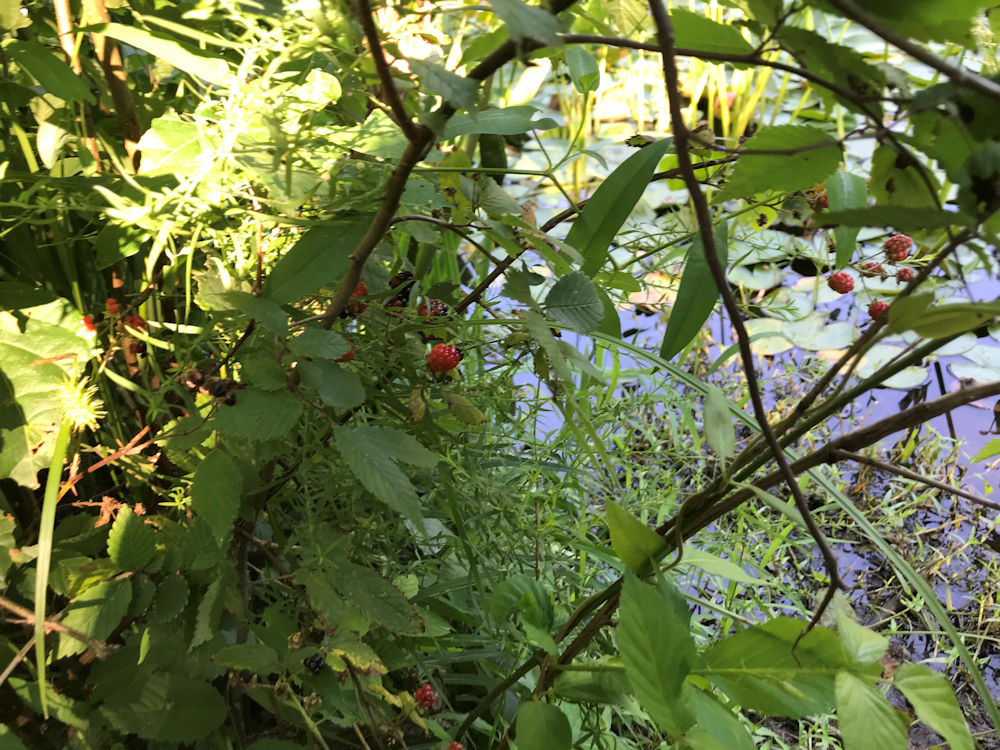
And next we have the Sawtooth Blackberry.  It is native to the United States and produces edible blackberries.  The leaves can also be used to make blackberry tea, a popular drink in some regions.  Technically part of the rose family and is thorny like other rose plants.
I am not confident enough to try eating either the blackberries or making the tea. There are more knowledgeable and braver people out there than me, but I can enjoy looking at them and take photos.  I believe that is a carpenter bee in the one below.  I have noticed this type of bee has bored a couple of holes in our mail box post, and in one of the posts on our deck.  However, they are not as bad as termites and we are keeping an eye on those holes.  They have been there a while and I haven't seen any of these bees around our home lately.  I recently learned that the female carpenter bee only lays between five and ten eggs in her lifetime.
Several of the trees around the pond had vines growing up their trunks.
This is the Virginia Creeper and is a North American vine from the grape family.  It grows vigorously, has fragrant flowers, decorative blue-colored berries and leaves that turn crimson in the Fall.  I would never advise people to touch any of these plants.  The sap of the Virginia Creeper can cause skin irritation and blisters in sensitive people if it punctures the skin.   
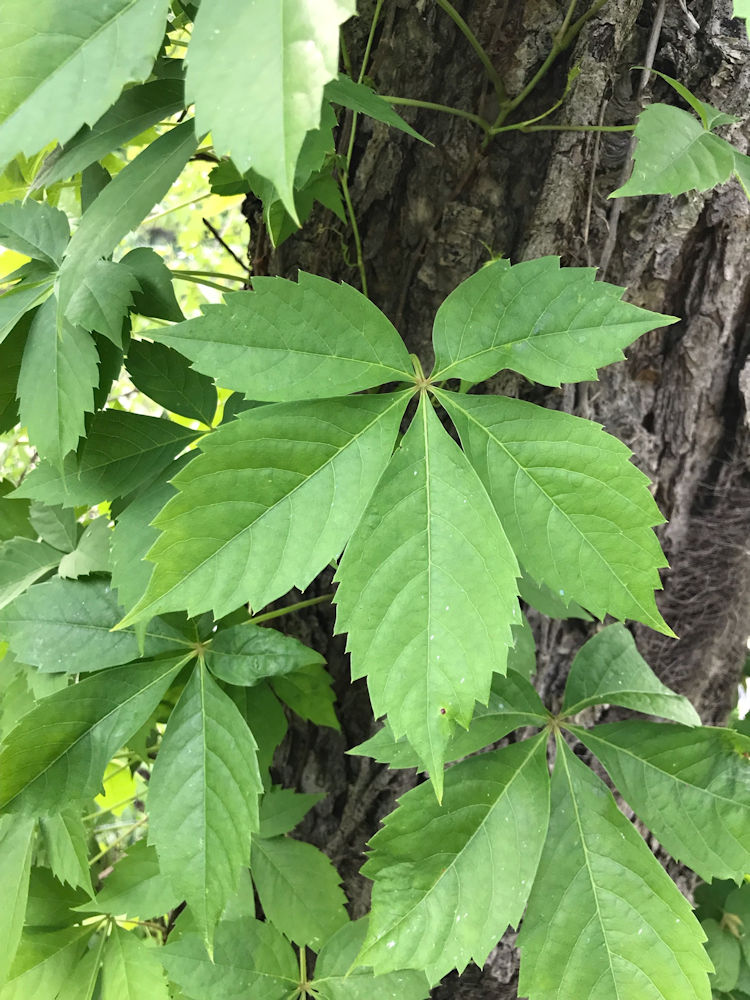
And talking about things you should stay away from, the next climbing plant is Poison Ivy.  We had it growing in our garden and after one visit to the doctor after pulling 'weeds', we got a specialist to remove it for us.  It still grows in the garden but we have it under control now, touch wood!  
When dealing with this awful stuff, it is advised to wear gloves and protective clothing, both of which should be washed thoroughly, and even wash and clean the tools used.  They cause the most dreadful rashes on the skin that can be extremely painful, and the symptoms can hang around for a few weeks.  A doctor's visit is also recommended, we have had experience.
It is almost time to leave now.  A photo taken at the other side of the pond...

and one last shot of the geese as they take off.  I took this with my cell phone and cropped so it's not that clear but it's a memory.


That's all from Walney Pond, until the next time we go.
Thanks for looking and enjoy your weekend.


Friday, August 13, 2021

CONTINUING MY SERIES OF POSTS ON WALNEY POND - EASTERN TIGER BUTTERFLIES.

There were more Common milkweeds next to the pond, and I saw a lady taking photos in this area.  I was hopeful for butterflies or dragonflies.  By the time we had walked around the pond, the lady had left and Gregg and I took our own photos of an Eastern Tiger Swallowtail (Papilio rutulus).  It was dining on the nectar from the blooms of a Pickerelweed.

Adult Eastern swallowtails have a wingspan as small as 3 inches, but they can grow up to 5 1/2 to 6 inches across. They also have four black parallel stripes at the top of each wing and a solid black stripe along the base. Female Eastern swallowtails tend to have more blue on the hindwings than the males.  This website has photos which will show you the differences.  You will find the Eastern tiger swallowtails from the East Coast to the Great Plains.  
You can click here to see what the caterpillar looks like.  It is also a site that shows you how to raise them.  I often think of Debbie at It's All About Purple when I see a butterfly.  She has the most gorgeous photos of them, and this link will take you to one of her posts where she has raised her own.  Thanks Debbie!  
I read here, and much more, that in the eastern half of the country, females lay yellow-green eggs singly on leaves of willow, birch, black cherry, ash and the tulip tree." 
We were getting ready to leave the pond and our butterflies, but this Blue dasher dragonfly was very cooperative and landed long enough for us to take a photo.  Dragonflies were some of the first winged insects to evolve, some 300 million years ago. Modern dragonflies have wingspans of only two to five inches, but fossil dragonflies have been found with wingspans of up to two feet.
This is a Sawtooth blackberry and can be found in many of our states, including Virginia.  
In the next photo the plants growing out of the pond among the lily pads are Pickerel weed, the blooms of which you can see in the butterfly photos.  It is also known by other names, Pickerel rush and Heart-leaved pickerel weed.  Its botanical name is Pontederia cordata.
No ID for the following but I looked up and thought it worthy of a photo, especially as the sunlight was shining through the leaves.
Next you will probably recognize the Cattail plant.  It provides a safe haven for tiny fish and attracts many of the smaller aquatic creatures that birds and other wildlife feed on.  They create a shelter from winter cold and wind for mammals and birds, and are a source of nesting material with their leaves and seeds.  
Humans have always benefited from the cattail. The plants have been used for rush bottom furniture, baskets, and mats, and their downy seeds have been used to stuff pillows and mattresses.  During World War II they were used to stuff life jackets.  It really is amazing what you can find out online.  I also read that many native peoples around the world wove cattail leaves and flower stalks into roof thatch, sleeping mats, duck decoys, hats, dolls and other kids' toys, to name a few of its uses.  Fresh leaves and roots were pounded and used as poultices.  Cattail fluff was also used in diaper linings, moccasin insulation and wound dressings.
Next photo shows the Winged sumac, botanical name Rhus copallina and also known as Shining sumac, Flameleaf sumac, Mountain sumac, Wing-rib sumac, Black sumac and Upland sumac.  It has some nice ornamental features (flower panicles in the spring, shiny dark green summer foliage, fruiting clusters in the fall and excellent fall foliage color).
That's all from our latest trip to Walney Pond. It is part of the Ellanor C. Lawrence Park which you can read about at this link.
Have a great weekend everyone.  I will be back on Monday with my weekly recipe.


Thursday, August 3, 2023

SERAPHINA AT WALNEY POND - DOGGY FIX FOR TODAY


Let me introduce you to Seraphina.  I met her at Walney Pond the other day.  She was sitting on the boardwalk with her human, and they were looking in the same direction, very focused on something they had seen in the pond.  I had a feeling I knew what it was, as we had come for the same hopeful sighting.

Her lady human looked up at me and smiled.  Without me saying a word my expression must have asked the question. She volunteered what they were looking at.  But first I asked lady human permission to say hello to her dog, who was already making her way over to me for a head rub and an ear scratch.  I readily gave her those. 

I learned this sweet little dog had not been very well of late. Lady human told me they had just come back from the vet.  After chatting for 10 minutes or so, we said our goodbyes. Feel better soon Seraphina, and I gave her another gentle hug and an ear scratch.  I took this photo when they were leaving. We then walked down the path to a bench shaded by lots of overhanging, leaf-laden branches.  An idyllic spot to look at all the activity on the pond.  We sat and waited.

I think the name Seraphina is beautiful by the way. It fit our new furry friend like an old-fashioned lace glove.

And from this website called nameberry.com I learned “Seraphina is one of the most-searched for names on nameberry, destined for even greater popularity. 

The highest-ranking angels, the six-winged seraphim, inspired the lovely name Seraphina, which was brought into the contemporary spotlight when chosen by high-profile parents Jennifer Garner and Ben Affleck for their second daughter, following the influential choice of Violet for their first.” 

Our Seraphina from the pond was definitely a little Angel.

What do you think we saw?  I will be sharing those photos the day after my recipe post, or thereabouts.


Thursday, June 10, 2021

WALNEY POND - PART 1

When we first arrived there were two Canada Geese swimming among the lily pads.  
I didn't see a nest and they seemed well-content and calm, not worried about us or the other visitors.
On first look it is hard to tell the difference between a male and female Canada Goose, but I found out how at this website, and also lots of interesting information at the Beauty of Birds.  The females have pointed tails, while males possess rounded tails. Sub-adults have rounded tails too but a notch is usually present that can distinguish them from mature males.  Additionally, males have larger, wider head crowns than females.
The term "sub-adult" describes a plumage that occurs after the juvenile (1st-year) plumage but before the adult plumage.  (Birds that take several years to acquire their adult plumage such as eagles, Swainson's Hawks, White-tailed Hawks and several others, have one or a few sub-adult plumages.)
Gregg found the other bird, a female Red-winged Blackbird.  I saw her mate on the other side of the pond.  It flew into a tree nearby.  Their trill is very distinctive.  I am no expert but once I hear it I know its identity immediately.  
She was very cooperative while Gregg took her photos.
The oldest recorded Red-winged blackbird was 15 years, 9 months old.  
It was banded in New Jersey in 1967, and found alive but injured in Michigan in 1983.  It was able to be released after recovering from its injuries.
Red-winged blackbirds roost in flocks in all months of the year.  In summer small numbers they roost in the wetlands where the birds breed.  Winter flocks can be congregations of several million birds, including other blackbird species and starlings.  Each morning the roosts spread out, traveling as far as 50 miles to feed, then re-forming at night.
This cute Red-eared slider swam up to us when we were standing on the overlook.  I suspect it was hoping for a morsel or two, but we have a rule about not feeding wildlife.  We have never come across a desperate case and if that ever happened  we would call a wildlife center to get help.
Our shadows can be seen here at that same overlook.
Red-eared sliders are native to the Southern United States and northern Mexico, but are now inhabiting other places because of pet releases.  I see them in almost every pond I have ever visited.  Sadly, and through no fault of its own,  this poor creature is considered an invasive species.
The Red-eared slider gets its name from the small, red stripe around its ears, or where its ears would be, and from its ability to slide quickly off rocks and logs into the water.  I have often watched them slip back into the water as we approach when walking along one of our favorite walking paths.  
Water-lilies are slowly covering the pond.  
We are looking forward to coming back to see them blooming.
Last photo of one of the geese taking off, and its mate wasn't far behind.
 As I usually do, I have more photos to share from Walney Pond.  Next time there will be wildflowers.

Thanks for looking and enjoy your day.


Tuesday, June 14, 2022

WALNEY POND WALK IN MAY

After we had been surprised by our non-Swans (decoys) shared in this post, we did what we usually do, continue our walk around the pond and enjoyed all the other sights.  
If you wanted to get some really good exercise, you would have to walk at a brisk pace along the circular path several times, as I have seen people do.  The pond is relatively small compared to others we have come across.  But there are trails and one we know leads to the visitor center through the woods.
  We noticed the Yellow Flag Iris' were blooming.  They are a lovely sight at the edge of the water.
Yellow flag iris, botanical name Iris pseudacorus, also goes by the following names: Yellow Iris, Water flag, Dragon flower and Paleyellow iris.  
I found a blog at this link, called Botany Karen, where she adds other common names which are very interesting.  One is 'Yellow fleur-de-lis', and she states this name points to the possibility that Iris pseudacorus is the historical inspiration for the heraldic Fleur-de-lis (or Fleur-de-lys), that there is a passing resemblance to the flower’s 3 standards and 3 falls, allowing for some artistic licence she says.
Karen continues, “The Fleur-de-lys’ historical usage is not confined to a single country. Its strongest associations are undoubtedly with France and French royalty through the ages. It traditionally appeared as a yellow symbol on a blue background in France."  And this from me, I can highly recommend taking a look at Karen's blog as there is so much to see, to explore and to learn.
Yellow flag is a flowering perennial plant native to Europe, Asia and Africa.  In temperate climates throughout the globe, yellow flag is cultivated as an ornamental plant, but is considered an invasive aquatic species.  In some regions it can be very invasive and harmful to native species.  It spreads easily due to its floating masses of seeds and long rhizomes, making it very hard to control.  It can also block water flow, affect bird nesting sites, and fish habitats, disrupting and changing entire ecosystems.  

Oh dear!  Well, it didn't seem to be out of control at the pond.  I daresay it is well managed, and I have always loved its presence in blooming season, but certainly these facts should be taken note of.

Other wildflowers we saw were buttercups...along with a couple of bicyclists.  A good day for getting the bikes out.

When I was a child I always loved buttercups, and I still find them pleasing.  When you are a child you don't have a care in the world and certainly don't think of things like how invasive they are.  Before I go on I would like to share another blog I found.  One called Lizzie Harper where you will find various illustrations, one of which is this buttercup.  You can see it here and then if you like, explore further and see the others.   Also more information at this link.
I am finding out about invasive plants today, and this is another one.  They are called Creeping buttercup, botanical name Ranunculus repens.  Common names are also Sit-fast, Creeping crowfoot and Double meadow creeping buttercup.  It is native to Europe, Asia and Northwestern Africa.  These glossy-petaled yellow flowers of the creeping buttercup do, however, aid in the attraction of pollinating insects.
The following is Common vetch, botanical name Vicia sativa.  Its common names are also Garden vetch, Vetch, Garden tare, Summer vetch and Tare.  
It is widely grown as a forage crop or green fertilizer, but common vetch is often considered a weed in garden settings.  However, it seems to be a gardener's friend, as its nitrogen-fixing ability enriches the soil, and it offers food and support for native wildlife.  
The vine-like growth, feathery foliage and purple flowers can be visually attractive.  So, common vetch is ideal for including in native gardens, wildlife gardens and wildlife meadows.  

Hurray for the Common vetch, and a lovely photo can be seen at this link

On that good note and as I don't want to overwhelm, I will finish as I have, surprise, even more photos to share from our time at Walney Pond.  I will be publishing another post tomorrow.