Showing posts with label Ponds_Streams_Lakes. Show all posts

Wednesday, August 16, 2023

BACK AT THE POND...AMERICAN BEAVER

This photo was taken as we were sitting under the trees.  We have our favorite spots in various places and this is one of them at the pond.  

It also happens to be next to where a lot of activity was going on.  A channel of water had been excavated, and a narrow dam was being built.  I have seen much larger ones elsewhere, but this seemed to suit his needs.
Our beaver is the largest rodent in North America, and here he comes.
At first he was bringing back big mouthfuls of mud to pack down the top of his lodge, as his soggy, wet, muddy face attested to.
After watching him several times press the mud packs down on what would have been his lodge roof, adding caked mud on top of other caked mud, he then started bringing back larger twigs and leaf matter to build his dam. The next photo shows him from a different angle, as we approached on the other side of the pond when we first arrived. You can see his paddle-like tail sticking out of the water.He keeps a wary eye on us at the same time, but we don't move from the bench and we had our zoom lens to take these photos.  We found it interesting that he chose a spot near to where people walked along the path, also excited children who were getting their first look at an American Beaver.  Many of those people, just like us, had come to see him.  We talked to several who were delighted that they were back.  I think the park people are letting them stay for a while.  Several well-established trees around the pond had a frame of wire mesh at their base.  To protect their trunks from sharp teeth no doubt.  There are plenty of trees in the woods on which they can nibble.More back and forth going on, not stopping at all.
At one time we saw him disappear in a sea of green weed.  Before that he was in the middle of the pond nibbling on water lily roots.
It took us a few seconds to realize that the big clump of green floating towards us had something underneath.
Out popped a nose! This plant is called Common pondweed, also called Yankee weed, Canadian waterweed, Water thyme, American pondweed, to name a few.  It is native to North America but considered an invasive species in Europe, Asia, Australia and Africa…
as it has been widely sold in the aquarium industry for its oxygenating properties.  Unfortunately, in the wild it outcompetes native plants, clogs up rivers and streams, and drainage channels, also obstructing boats.  
Not good news at all but the beavers love it here, so in that sense it is helping our environment, I hope? More research on that subject is needed.  You can read more here.  There is also an interesting pdf file at this link on what they eat.
As we observed them during our time spent on the bench, we realized we were actually seeing two, a male and female. We saw them swimming together briefly.  Someone had also seen two babies but there were none visible to us. As mentioned earlier, our very talented, dam-building Beaver is the largest rodent in all of North America. They have a wide variance in terms of size. They can range from 33 to 75 pounds depending on where they live and what they have to eat. They usually average about 45 pounds and the males are larger than the females. 
Anyway, we could have stayed there for another hour but it was time to move on.  Other people arrived at the pond and sat down as soon as we left.
I found the following illustration online. You can enlarge any of my photos and diagram to see them more clearly.  
This website has great photos and fun facts.  I read the following:

"Beavers are like little submarines.  They can stay under the water for 15 minutes.  Their lips close behind their teeth allowing them to hold a branch with their teeth, swim under water and not drown.  And they have a set of transparent eyelids that cover their eyes as they swim, much like we would wear goggles underwater.  While submarines have propulsion systems to help them move in the water, beavers have webbed feet to propel them."
There was another visit last month that I haven't shared yet, but I will wait awhile before I do.  
I daresay we'll be going back to see how they are in a week or two.  It has been very enjoyable watching their progress so far.


Friday, August 4, 2023

WHAT DID WE SEE AT THE POND?

North American Beaver!

Our little friend Seraphina (from yesterday's post) had been looking in this direction.  Lily pads were covering a good part of the pond.  It grows considerably each year and the petals close up in the evening.  In the center, after adjusting our eyes, we finally saw movement.

Another furry friend was having a feast of water lily shoots.   At other times we have watched them dive and resurface a couple of minutes later, with those shoots between their claws.  
This is the beaver we saw for the first time a few weeks ago.  They had been absent for two or three years, and rumor had it that they had been removed.  I don't know if this was true, but their lodge was nowhere to be seen and every time we visited, we looked for these industrious little animals to no avail.  Other visitors we talked to had wondered the same thing.  In the photo below you can make out that famous 'paddle' tail. There is a reed on it.

Happiness for everyone I spoke to, on our previous visit and this one, to find them back at the pond.  Our North American Beaver had returned, not only one but three others.  There was a mate and two babies.  People told us they had seen the babies, but we saw the parents and that was wonderful.  The mother is considerably smaller than the male we were told by a knowledgeable man who had been taking photos also.
This fellow photographer was very generous with his information.

Thank you so much for stopping by.  There will be another post on our encounter as soon as I can put it together.  Enjoy your weekend!


Wednesday, June 15, 2022

WALNEY POND WALK CONTINUED....

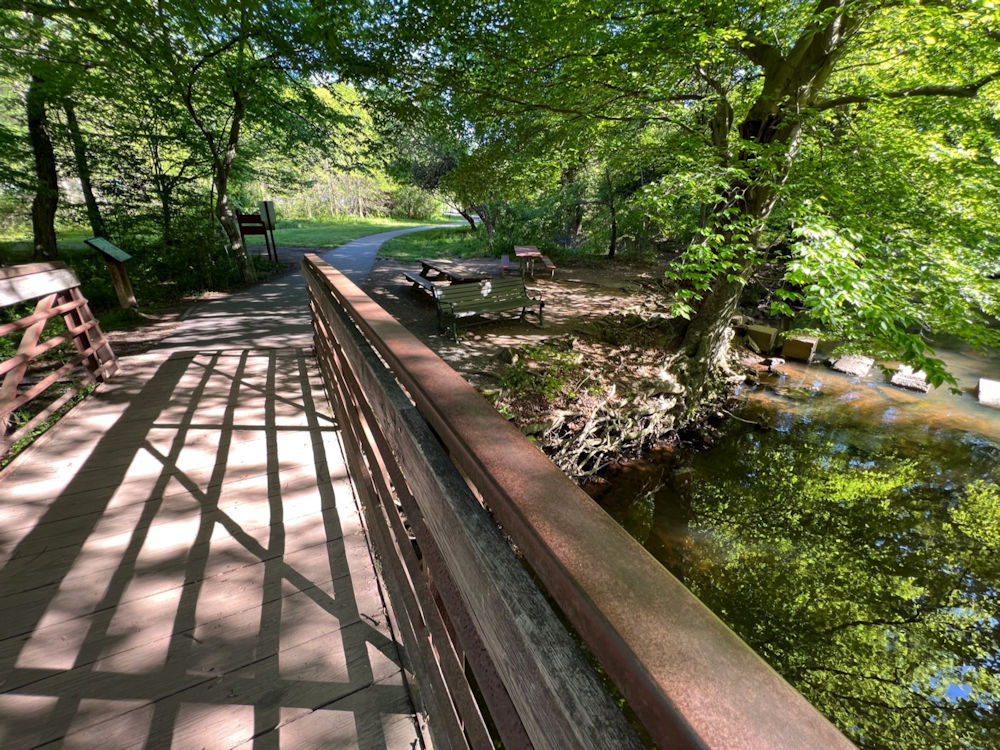
 The tree is across the road from where we parked our car.  We were getting ready to leave and for a short spell, followed this lovely dog enjoying a walk with its family.  She was very well behaved, though her eyes were looking across the pond, maybe seeing those 'swans' or....perhaps the turtles peeked her interest.Interestingly, the sign's illustration shows a Canada goose on what looks like a nest.  The turtles, however, were making good use of Wildlife Island.In the following photo you can see the beaver lodge.  It all looks very quiet.  I wondered if the beavers vacated along with the geese?  Come to think of it, I haven't seen any chewed-on trees for quite a while and there was no activity near the lodge.  Could be the time of day of course.  Perhaps they were asleep?  There is a bridge where the trail continues on to the visitor center I mentioned.  It crosses a small stream.  In years' past we have  hopped over those blocks, when son was young and we were more limber.Gregg and I have walked the trail many times, but not today.  However, we cross the bridge, usually standing at the half-way point for a few minutes to look at the water in both directions.

Look at the root system on that old tree.

It is amazing to me that it hasn't fallen over and made its own bridge.  No doubt it gets checked regularly.
There's a well-trodden path that takes you down one side of the stream, but only a short way.  
The root system from all the trees can be a bit hazardous sticking out of the ground like this.  You really have to watch where you are putting your feet.
There have been benches added, and there are also picnic tables which have been there for many years.
This sign is just before you get to the bridge.  "Wipe your feet!  Please brush your shoes before entering and leaving this area."   We have seen these signs in other parks and nature reserves.  It is hard to read but on the left it says, "Tiny seeds can hide in the soles of your shoes.  Wiping your shoes on the brush at the base of this sign helps prevent seeds from entering or leaving this natural area."  Below that, "Wavy-leaved basket grass is an invasive species from Asia that is spreading throughout Virginia and Maryland. This plant spreads sticky seeds in summer and fall that easily attach to your shoes, socks and pant leg.  It can invade mature forests and blanket the ground in only a few years."  
On the left it reads, "Plant Invaders from Afar. Non-native invasive plants thrive from outside their area of origin and harm the local environment.  These highly aggressive species often spread uncontrollably in natural areas.  Their rapid growth can choke forests, suppressing native plants such as wildflowers, and damaging wildlife habitat." It then shows images of Garlic Mustard with this info. "Garlic Mustard is native to Europe and Asia.  Settlers brought it to the United States to use as medicine and for food.  It is considered an invasive species.  Garlic Mustard contains compounds that make it taste bad to herbivores.  Garlic Mustard also produces chemicals that alter the soil.  The small, dark seeds can germinate for up to five years and are easily spread."  
Coming to these places is always an environmental education.  Can we stem the tide?  I hope so!
Just as we get to our car, Gregg sees a Red-winged Blackbird hopping around in the grass.
It flew up into a tree.
Their red epaulettes with that touch of yellow makes them a very striking bird...
 and its call is very distinctive.  If you would like to hear it, click here.  
A fitting end to our walk.  

Thank you for coming with us to Walney Pond.  I have enjoyed sharing it with you.  

Have a great week! 


Tuesday, June 14, 2022

WALNEY POND WALK IN MAY

After we had been surprised by our non-Swans (decoys) shared in this post, we did what we usually do, continue our walk around the pond and enjoyed all the other sights.  
If you wanted to get some really good exercise, you would have to walk at a brisk pace along the circular path several times, as I have seen people do.  The pond is relatively small compared to others we have come across.  But there are trails and one we know leads to the visitor center through the woods.
  We noticed the Yellow Flag Iris' were blooming.  They are a lovely sight at the edge of the water.
Yellow flag iris, botanical name Iris pseudacorus, also goes by the following names: Yellow Iris, Water flag, Dragon flower and Paleyellow iris.  
I found a blog at this link, called Botany Karen, where she adds other common names which are very interesting.  One is 'Yellow fleur-de-lis', and she states this name points to the possibility that Iris pseudacorus is the historical inspiration for the heraldic Fleur-de-lis (or Fleur-de-lys), that there is a passing resemblance to the flower’s 3 standards and 3 falls, allowing for some artistic licence she says.
Karen continues, “The Fleur-de-lys’ historical usage is not confined to a single country. Its strongest associations are undoubtedly with France and French royalty through the ages. It traditionally appeared as a yellow symbol on a blue background in France."  And this from me, I can highly recommend taking a look at Karen's blog as there is so much to see, to explore and to learn.
Yellow flag is a flowering perennial plant native to Europe, Asia and Africa.  In temperate climates throughout the globe, yellow flag is cultivated as an ornamental plant, but is considered an invasive aquatic species.  In some regions it can be very invasive and harmful to native species.  It spreads easily due to its floating masses of seeds and long rhizomes, making it very hard to control.  It can also block water flow, affect bird nesting sites, and fish habitats, disrupting and changing entire ecosystems.  

Oh dear!  Well, it didn't seem to be out of control at the pond.  I daresay it is well managed, and I have always loved its presence in blooming season, but certainly these facts should be taken note of.

Other wildflowers we saw were buttercups...along with a couple of bicyclists.  A good day for getting the bikes out.

When I was a child I always loved buttercups, and I still find them pleasing.  When you are a child you don't have a care in the world and certainly don't think of things like how invasive they are.  Before I go on I would like to share another blog I found.  One called Lizzie Harper where you will find various illustrations, one of which is this buttercup.  You can see it here and then if you like, explore further and see the others.   Also more information at this link.
I am finding out about invasive plants today, and this is another one.  They are called Creeping buttercup, botanical name Ranunculus repens.  Common names are also Sit-fast, Creeping crowfoot and Double meadow creeping buttercup.  It is native to Europe, Asia and Northwestern Africa.  These glossy-petaled yellow flowers of the creeping buttercup do, however, aid in the attraction of pollinating insects.
The following is Common vetch, botanical name Vicia sativa.  Its common names are also Garden vetch, Vetch, Garden tare, Summer vetch and Tare.  
It is widely grown as a forage crop or green fertilizer, but common vetch is often considered a weed in garden settings.  However, it seems to be a gardener's friend, as its nitrogen-fixing ability enriches the soil, and it offers food and support for native wildlife.  
The vine-like growth, feathery foliage and purple flowers can be visually attractive.  So, common vetch is ideal for including in native gardens, wildlife gardens and wildlife meadows.  

Hurray for the Common vetch, and a lovely photo can be seen at this link

On that good note and as I don't want to overwhelm, I will finish as I have, surprise, even more photos to share from our time at Walney Pond.  I will be publishing another post tomorrow.