Showing posts with label Winchester_VA. Show all posts

Thursday, July 25, 2024

CONTINUING OUR VISIT TO THE MUSEUM OF THE SHENANDOAH VALLEY, WINCHESTER, VIRGINIA 7-16-24

Before I forget, I thought it important to mention that the museum is closed on Mondays.  This is just in case anyone out there is visiting the area and may want to go there. 

Above is an older photo of the museum, from one of our visits shared in this post. The flowers below were found on our recent visit in the flower beds at the side of the museum not too far from where we entered the Glen Burnie Gardens.

This was found right outside of the museum's main entrance. Called Southern Globethistle, other names are Globe thistle and Small Globethistle, with a botanical name of Echinops ritro. Like other thistle plants, it has prickly, weed-like leaves. It is drought tolerant and will grow well in dry soil.
Looking for information on this flower, I came across a new blog to me. The host is a lady called Audrey Driscoll and she also writes stories. I haven't looked into that yet as I was more interested in her flower posts. She has several including this Southern globethistle. If you are interested in taking a look you can go here.

Native to southern and eastern Europe (from Spain east to Turkey, Ukraine, and Belarus) and western Asia. The species is sparingly naturalized in scattered locations in Canada and the United States. It needs a full day of sun, at least six hours to remain compact and grow well. It will grow leggy if shade persists.
Next is the Purple Coneflower, also called Eastern purple coneflower and Hedgehog coneflower. Botanical name Echinacea purpurea. It is an herb native to North America. I have a few of them in my garden and no doubt you are familiar with them as they seem to be everywhere. Its genus name, Echinacea, means 'spiny', because its flowers are especially like a prickly sea urchin, which also has the same genus name. Some people think its flowers resemble petals around pinecones, and so this genus is called the coneflower. Since it has purple petals around the cones, it's called the purple coneflower.
The red flower is Scarlet beebalm. You can see very nice photos of it here, and also other colors plus different types of flowers if you scroll down their page. The ones in the flower bed near the museum were not looking their best, but I still liked them. Shriveled up with the heat probably but still flashy with their red skirts. A few other names are Oswego tea, Crimson bee-balm, Bergamot and Scarlet monarda. Botanical name Monarda didyma. 
It is non-toxic to humans and is a perennial herb. It forms a cluster of bright red flowers atop a 3-foot long stem, which is particularly attractive to hummingbirds. 
The leaves are aromatic with a minty smell, and can also be brewed into a tea. The Oswego people taught the early European colonists to do this in the New York area. Its common name, Scarlet beebalm, refers to the use of a resin which is derived and used for its ability for healing and pain-relieving, and especially from bee stings, hence its name. Most of the flowers are scarlet red-colored, so it is often called scarlet beebalm. You can read more at this link.
I always am curious as to where they originated, and this one is native to Eastern North Amerca and Canada. Its native range is from Quebec south to Maine and down to Georgia, and westward from Ontario to Minnesota, and down to Missouri. It is also native to Washington and Oregon in the west.

Across the road from the museum and up the hill you will see an old silo. It is one of the last remnants of what was once an old working farm here. On this page, it will show you what they have done inside. On the left of the page click on Silo Skyline to see more. It looks very impressive and I would like to take a look next time we go.

I'll end my post here and show you the gift shop early next week. That will be my last share from the museum until the next time we go.

Thanks for looking and 
wishing you all a very enjoyable 
rest of the week.


Wednesday, July 24, 2024

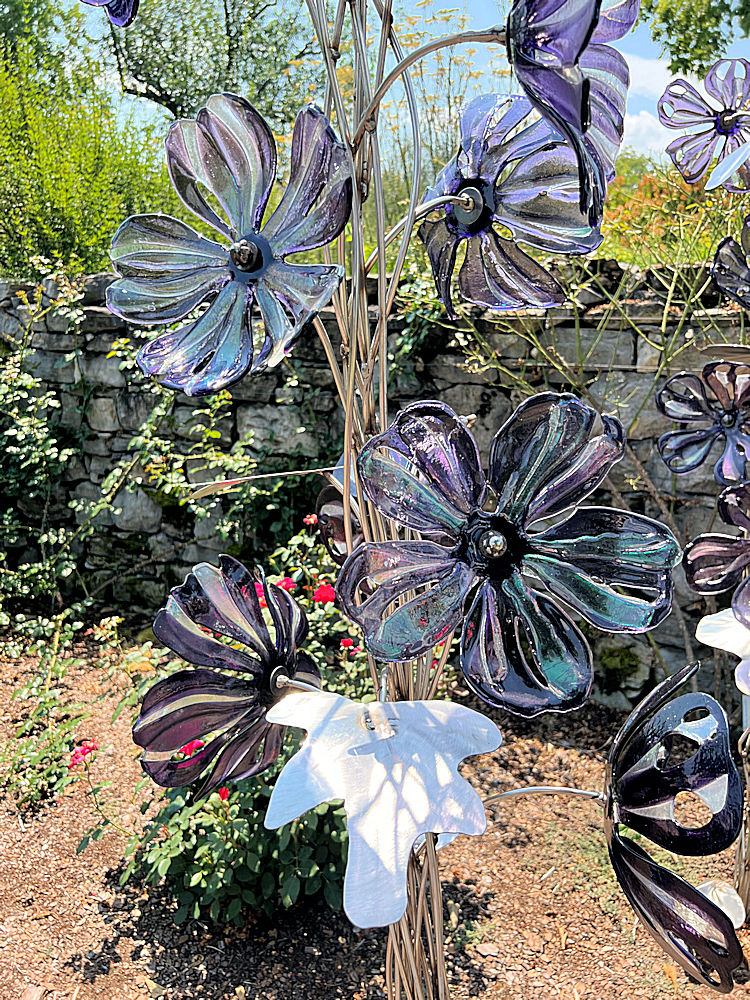
LARGER THAN LIFE GLASS FLOWERS EXHIBIT AT THE MUSEUM OF THE SHENANDOAH VALLEY IN WINCHESTER, VIRGINIA


We were here on July 16th, 2024, but because of the high heat and humidity, we didn't get to see but a very few of the pieces from the Garden of Glass Flowers Exhibit. You can read about that at this link.

Next is information on the artist who made them all. You can enlarge each photo for an easier read. In fact, all the photos can be enlarged if you would like to see more detail.


I saw more sculptures than I had thought. Firstly, there was something over the entrance of the gate, a pretty blue glass display, but I missed the info...


and my photos don't give any of these the justice they deserve. As mentioned in this post, we were in the middle of a heatwave. I found myself rushing through, not giving much thought to how I was taking my pictures, and finally we gave up. But, I think it will give you an inkling. 

 For the next one I read online that this was made in 2021 by Mr. Smith. 


It was inspired by the original celluloid hollyhocks used in the production of the "Wizard of Oz" which he saw during a backstage tour at Disney World.


Glass Wisteria overhanging one of our favorite sitting areas.


We are near the pink house shown in my previous post.


Daffodils


Lily of the Valley


Placed in the middle a produce garden where they were growing cucumber, kohlrabi, squash and leeks, there are glass anthuriums.


That's all the glass pieces for now. I am hoping we will be back but will pick a day when we can walk around the whole garden. With August being the hottest month of the year normally, our next visit may not be until September. We will have to keep an eye on the weather forecast.

I have other photos from the garden, and also inside another gift shop in the museum. Another browsing session which was enjoyable. I will share them soon.

Thanks for stopping by and 
I hope you are all having a great week.


Thursday, May 13, 2021

A WALK AROUND GLEN BURNIE GARDENS IN WINCHESTER, VIRGINIA - PART 1

 The first five photos I am sharing today were taken by Gregg.  I always enjoy seeing his view through our camera lens.  

Towards the end of last month we drove an hour-and-a-half to the garden.  It was our first mini road trip in a very long time.  To reach here you head for The Museum of the Shenandoah Valley, which we have visited only three times over the years.  However, we have never been to the garden next door, and now we are more able to get out and about, I asked Gregg if he would like a road trip.  I don't have to ask twice thankfully, as he is always eager to point the car over the next green hill.

At the other end of this pretty green area, is the Glen Burnie House.  This is what I found on line: "It sits on land that Winchester founder James wood surveyed, claimed and then settled in 1735.  The oldest portions of the house were built by Wood's son Robert in 1794 and 1797."

"In the 1950s the 214-acre property came to be owned by a Wood descendant, Julian Wood Glass Jr.  Glass preserved and renovated his ancestral home from 1958 to 1959.  Then aided by his partner at the time, R. Lee Taylor, he transformed the house into an opulent country retreat surrounded by six acres of formal gardens, and furnished with one of the most remarkable private collections of decorative arts ever assembled in the Shenandoah Valley."

 "After his death a condition of his will stipulated that the house and gardens were to be opened to the public on a seasonal basis in 1997.  They are now an important part of this year-round regional history museum complex known as the Museum of the Shenandoah Valley."

I enjoyed the smartly dressed child scarecrow .  The mother scarecrow was there also.  This is their vegetable garden with a few flowers, like the tulips.
It will be very nice to go back when the seedlings have had a chance to fill in.
The small area below is the Pink Pavilion and the Sunken Garden.  "Julian Wood Glass Jr. designed this building for entertaining.  The windows were made to be raised up to create additional doorways.  On cool evenings, a wood-burning fireplace kept guests warm.  Glass and Taylor also furnished the pavilion from Glass's collection of antique furniture.  A lover of classical art and literature, Glass had at one time studied architecture.  He designed the building in the style of the Renaissance architect Andrea Palladio (1508-1580).  Glass also designed the nearby pool and fountain."
I was at the top of a few steps, having come around a corner to this pretty area.  There were two people deep in conversation and as I didn't want to disturb them, I turned around and continued the walkaround in the other direction, after one quick photo!  Hopefully we will be able to sit where they are next time, and enjoy its peacefulness and solitude.  Forever in your debt Mr. Julian Wood Glass Jr.  You left a wonderful legacy for us all to enjoy.

Their are sculptures placed around the garden.   I thought the following piece was poignant.  We were in Kathie's Spring Garden, and there were three statues given to the museum by Rupert Werner in memory of his wife.  Always curious I searched on line for information, and found a YouTube Video that you can see here.  It is from five years ago and will show you how this wonderful couple gave back to their community.  I wish I could have known them, to say thank you, as they also left an amazing legacy to many. 

On her statue I read: "Kathie, 2019, by Mark Hopkins.  Patinated Bronze.  Acquired for the MSV by Rupert Werner in memory of his wife Kathryn Perry Werner."
"Among Kathryn Perry Werner's many interests was a love of painting.  With palette and brush in her hands, Kathie here tilts her head slightly as she contemplates the subject before her.  For sculptor Mark Hopkins, the challenge of creating a portrait - particularly in a memorial one - is capturing the image people have in their minds of the sitter's personality and appearance.  Added to that is the challenge of working from photographs and translating a two-dimensional image into a three-dimensional sculpture.  

Faced with these hurdles, Hopkins focuses on the essence of the person represented, and seeks to capture her spirit.  Through conversations with her loved ones and careful study of photographs, Hopkins sought to create a work suggesting the determination and confidences of the subject, and the strength and spark in her face."
I shared the statue of the little girl before - here - and is another that was acquired for the MSV by Rupert Werner in memory of his late wife.  There were two of them, one of the little girl and another of a little boy that I missed, so I will just describe the little girl.  I will make a note to find the boy next time.

Entitled Friends in High Places, 2017, and also created by Mark Hopkins in Patinated bronze. The information I found on the little girl said "she has climbed a tree to stand on her tiptoes as she gazes at her two "friends" - birds perched on a branch". 

I think they are amazing and admire Mr. Hopkins sculptures very much.  He has an obvious love and  dedication to his work. 

There are other statues in the garden I will share at a later date.  The two above are the more contemporary ones.  I am grateful for the amazing story of Mr. and Mrs. Werner because of seeing these beautiful statues.
I managed only one relatively decent photo of a mallard.  The others in the water were hard to photograph.  They were bobbing for tasty morsels.
One head came up and one head went down, one head came up and one head went down and so on and so on and so on.  This went on for a long time.  Cute as all get out and I remind myself I don't always have to see them in full profile.  They gave me a chuckle.
Here are those Forget-me-nots I shared before.
We were walking out of the garden when I saw this area.  It was left for next time and looks a nice place for a quiet moment or two.

A close-up of the above stone bench.  
The tulips were still blooming.
Many may already know that the following pretty flower is the Moss phlox, also known as Moss pink, Mountain phlox, Creeping phlox and Britton's phlox.  Its botanical name is Phlox subulata.  It is native to the United States and the Latin name Phlox subulata means needle-shaped, which describes its leaves.  Its symbolic meaning is maternal love and charity.  And I found all of this on my plant app called "PictureThis."  

This is my last photo for today, and I will share others on the garden as soon as I can put a post together.