I have just found a very nice photo of the Fairy Garden at this link. I am not sure how long it will be there, but it will give you a better idea of its layout than the photos I took. Mine were more close-ups, and you can find the post here if you missed it.

This is from our last walk at the garden in the beginning of May. We know every square inch but still, we always see it as though for the first time. It never gets tiring to visit this place.

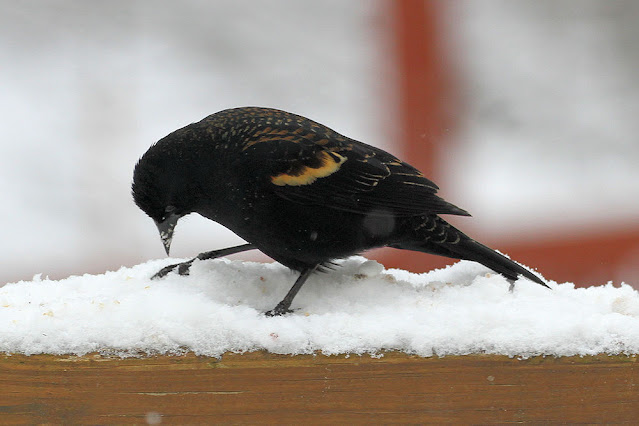
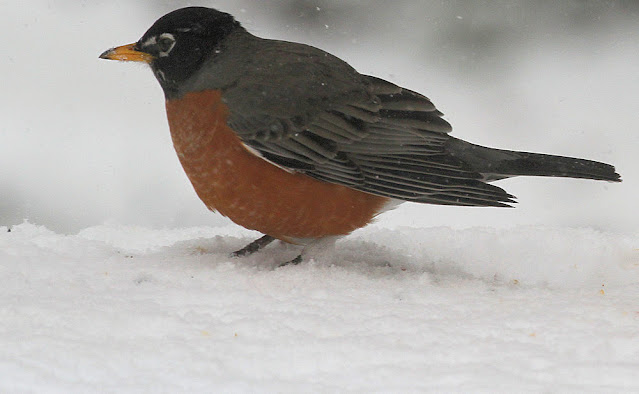
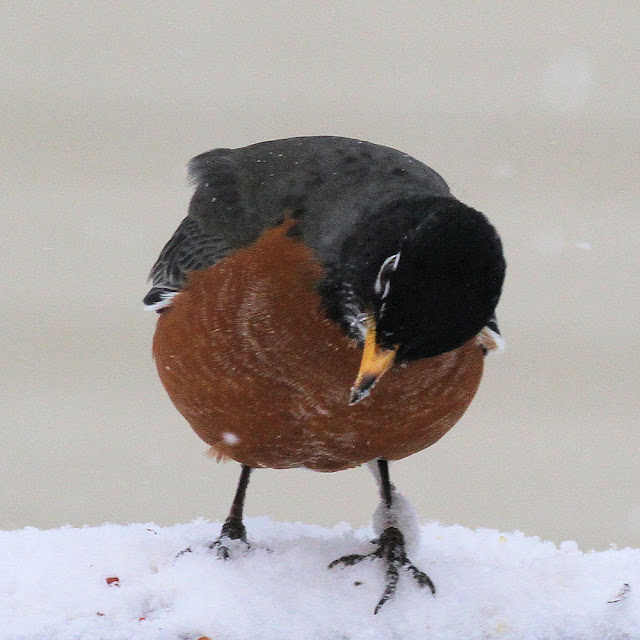
Two birds, the American Robin and below a female Red-winged Blackbird. You will see a small turtle if you go to the waterline and look to the left, before you get to those big leaves. Enlarging the photos will help.

The same bird but a closer view of its profile.

I have always liked this bridge across the lake. We are on the other side at the water's edge. There is a bench so that you can sit and take it all in, and occasionally if you are very quiet (we chat a lot), a bird will come and rest on the branches of the trees each side.

It is the first time I have noticed fish nests below the surface. I knew immediately what they were. Years ago we were at another pond and as we stared at a similar scene, a gentleman, who had been standing not too far away, told us exactly what they were. (I did actually see smaller fish circling inside the nests then and now) I haven't seen these nests since, but then I haven't been looking and wonder if it's only at this time of the year? I couldn't find much information on line. There are a lot of koi in the lake, quite big ones. I didn't see them but they will be showing themselves soon. I found the following information here, as I was curious about what happens to them in the wintertime. It says, "You'll know when your fish go dormant. They won't lie down on the pond's bottom or curl up in their cozy Koi Kastle (yes you can actually buy a Koi Kastle at this link), but they will float upright, tuck in their fins and remain suspended in the water. As the fish hover there, you may still see some super slow movement, and they may also wind up facing in the same direction as if they were heading somewhere at less than a snail's speed."

Our guesses included carp but there was no knowledgeable gentleman around this time. I found info here. It says Koi are actually descendants of carp. I am including an except which I found interesting. "Carp spawn in late May or early June and display unique spawning habits. They thrash and wiggle their way into very shallow, weedy areas, sometimes so shallow that their bodies are completely exposed. Instead of building nests or caring for their young, carp broadcast their eggs. A 20-pound female carp will lay nearly 10 million eggs, though very few survive. Eggs hatch in 2-8 days, depending on water temperature, and the young quickly disperse. Young carp are very susceptible to predation, but adults are too big to have non-human predators." The difference between a koi and a carp can be found here, and is where I found my information about the koi being its descendant. Okay, so all you who are fishing enthusiasts may know all this, but it was a learning experience for me. I hasten to add there is no fishing allowed at the garden.


In the photo below, right off center, you can see the Katsura tree (botanical name Cercidiphyllum japonicum), native to China and Japan. There is a very good website I found here, with more photos. It is also called Katsura Vine and Weeping Katsura Tree.

They grow no more than 45 feet and can live up to 60 years. Male trees will produce red flowers, and female trees with produce green flowers. Butterflies and bees are attracted to the blossoms. It is a fast-growing tree that grows best in full sunlight to partial shade. It prefers rich soil, but tolerates wet, clay or acidic soil. There are two of these close together and we wondered after reading the above, what kind of flowers they will produce.

Interesting facts are that the Katsura tree is a low-maintenance ornamental tree that thrives in temperate regions. The tree produces small and inconspicuous flowers, and is more well-known for its fall foliage fragrance of brown sugar. I am getting all my information from my plant app, Picture This, which I have mentioned before. I have it downloaded on my iPhone. Most of the time if I feel like meandering, I take a photo of whatever I am interested in, and find out right there and then. Other times I will wait until I get home, and get the information in the evening when I am downloading my photos. It's a beautiful tree, one that we have been enjoying for many years.

That's all for today's post. I will be putting another together as we took a lot more photos, as is our way.

Thank you for looking and enjoy
the rest of your week.