Showing posts with label Bluebells. Show all posts

Tuesday, May 14, 2024

THE HONEY-BEES ARE…


 The honey-bees are gumming

On their little wings, and humming


That the summer, which is coming,

Will be fun.


For the spring is really springing;

You can see a skylark singing,


And the blue-bells, which are ringing,

Can be heard.


~A. A. Milne~


Thursday, April 28, 2022

BLUEBELL WALK NEAR THE OLD STONE BRIDGE IN MANASSAS 4-12-22


On the 12th of this month we drove over to the Old Stone Bridge in Manassas. The sun was shining and it was a lovely day.  Our son and daughter-in-law inspired us as the day before they sent us photos from their own walk, and took some very nice shots of the bluebells.  It reminded me that we hadn't been to see ours and I asked Gregg what he thought of going over that morning.  This sign was new, designed specifically with children in mind, sowing those seeds early.
Virginia bluebells (botanical name Mertensia virginica) are also called Virginia cowslip, Blue and pink ladies, Chiming bells and Kentucky bluebells.  It blooms in the spring and is native to eastern North America.  They grow in wooded areas near river and lake banks, or in wetland areas. 

These were growing near Bull Run.  

We had just crossed over the Old Stone Bridge, which is part of the history of this area, relating to the Civil War.  If you are a history buff, you can click on the name to read more information.  I read it was built in 1886 and restored in 1959.
When I first moved here I was very curious about why a body of water like the one above, was called a 'run'.  I read that because our area was settled mostly by the English, back in their homeland the term 'creek' was used when referring to  'streams that were influenced by the tides'.  This was when the first settlers came across these bodies of water in 17th century America and they adopted the same name.  As they moved inland they very quickly encountered very fast-moving streams.  They didn't know what to call them.  There was no word for them, so they used the word 'run'.
The Bluebells were a bit passed their peak, some petals had dried up and some had fallen off, but were still beautiful!

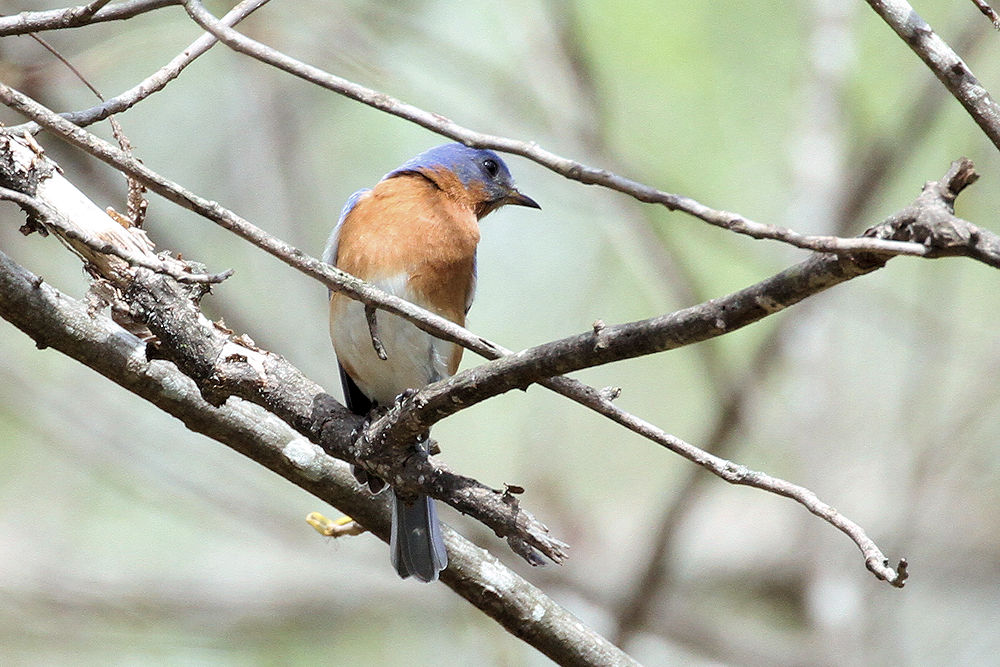
We found an Eastern Bluebird.
Did you know an Eastern bluebird can fly 17 miles per hour?  They lay between 2 to 8 eggs in each clutch and lay two clutches per season.  They have a lifespan of 6 to 10 years.  Male bluebirds sing with their beaks closed. I found my information at this link, a website called World Birds Joy of Nature, with great photos.  If you scroll down a bit, there is a delightful video of one.
Other wildflowers I saw that day, firstly Marsh blue violets (Viola cucullata).  Also known as Hooded blue violet and purple violet.
Downy Yellow Violet (Viola pubescens), also known as Downy Violet, Hairy Yellow Violet and Yellow Violet.
Yellow trout lily (Erythronium americanum), also known as Yellow dog-tooth violet.  I wasn't sure what it was at first, and certainly didn't realize it was a trout lily.  I was looking at it from a different angle.
Garlic mustard (Alliaria petiolata), also known as Poor man's mustard, Hedge garlic, Jack-by-the-hedge, Sauce-alone.
Virginia springbeauty (Claytonia virginica), also known as Fairy spud, Good morning spring, Narrowleaf springbeauty.
Bulbous buttercup (Ranunculus bulbosus), also called St. Anthony's turnip, Bulbous crowfoot, Frogwort and Crowfoot. 
Also seen in the photo above is my last wildflower.  It is Purple dead-nettle (Lamium purpureum).

And that's the end of our walkabout around the bluebells for now, until next year.  It was fun going back.  I have since found other trails that have them, so who knows where we will turn up next year.


Thanks for looking and I hope your day is a happy one.


Friday, April 23, 2021

OUR WALK CONTINUED, NEAR THE OLD STONE BRIDGE TO SEE THE BLUEBELLS

Continuing our walk, I met this young lady and as she could see that I was so taken with her 'back-to-front backpack' that she stopped to have a chat.  There was a compartment - air holes - and inside was her cat lying down very comfortably.  I had never seen one of these before but perhaps if you have a furry-family member, maybe you have.  I found a similar one here on Amazon.  

A great way of taking her cat along and not have to worry about her while she was away.  Not sure it would be a good idea when the weather got hot and humid, but she had so much love for her cat that I doubt she would do that.  Such a nice young lady and one of those pleasant interludes you get on walks occasionally.

We return to our walk by Bull Run, and found the Spring Beauty and Wild Violets, which I mentioned more descriptively here in my post from a previous visit to Green Spring Gardens.  These violets are a darker purple.

Spring Beauty


The following is a Trout Lily.  The name comes from the plant's mottled leaves, which look like the markings on a brook trout.  It is also known as the Dogtooth violet or Adder's tongue.


Some Trout Lily colonies are 200 to 300 years old.


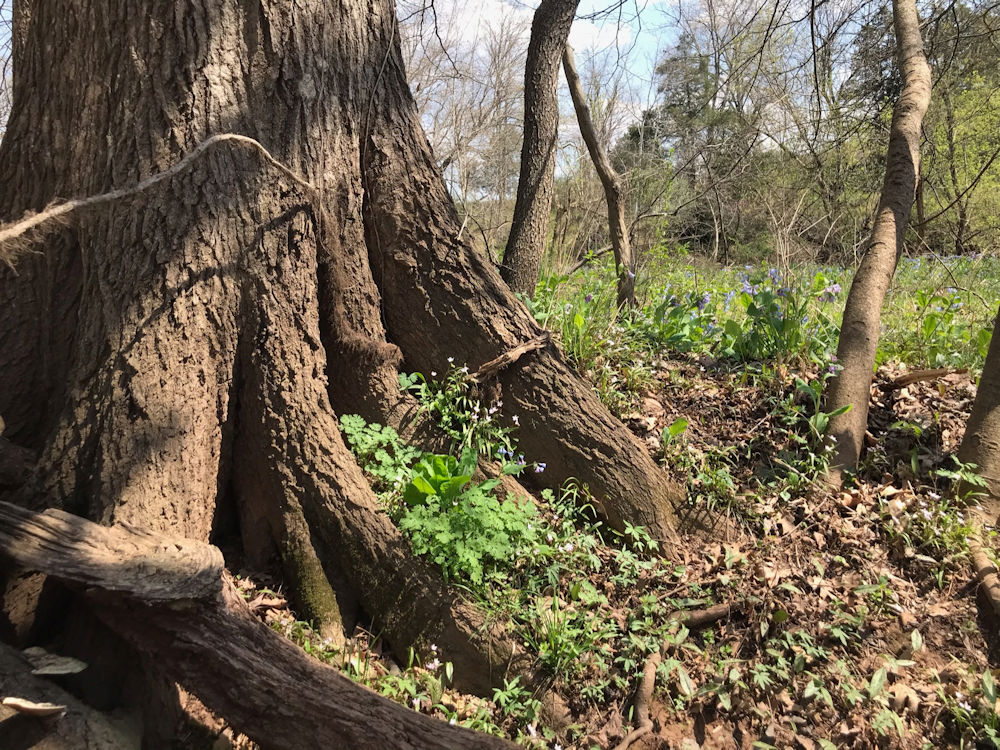
I had such a surprise when I looked at the next picture on my laptop.  I found more Dutchmen's Breeches.  I apparently was so focused on the Bluebells and the Trout Lilies and the Spring Beauty, that I didn't notice those little white flowers in front and on the right hand side of the tree trunk. Rolling eyes to the skies here.


In the next photo you can see hubs pointing across Bull Run, telling me that there are a whole lot more Bluebells on the other side.  Hard to get to though, we don't know a way to get across.  I asked how deep it was and was met with raised eyebrows, oh no, nope, nope, nope!  I was joking, sort of but the grass is always greener on the other side of the hill, or in this case Bull Run.  I was hoping for some stepping stones but had to admit to myself that my hopping-across-the-river-on-the-ever-so-slick-stepping-stone days are done, at least until my next life time.  


And there were plenty of Bluebells on this side of the river.


In the photo below I was staring at what I recently discovered was a Bagworm cocoon.  You can just make it out hanging from a branch at the bottom and between the two tree trunks on the left.


Here's a closer view.  I am used to seeing tent moths in the area, but these are relative new to me and I have only ever noticed them once before on a walk at Chinn Ridge in Manassas.  You can read all about them at this website if interested in such things.  A very destructive little critter!


And talking about critters, I am not sure what this type of ant is.  He was scurrying along near my feet and I didn't see any companions.  I would say he was about half an inch long.  My cell phone impressed me that I could take this photo of the ant.  He was moving fast!


At last we are at the end of our walk.  Hubs had taken a seat on the bridge, grinning and patiently waiting for me as I focused on everything around me.


It is good to be getting out and about again.

Enjoy your weekend and thanks for stopping by. I will be back on Monday.

Stay safe, stay happy and stay healthy.


Wednesday, April 21, 2021

SHARING A WALK NEAR THE BLUEBELLS

 Once again we went on a walk, this time to the Old Stone Bridge in Manassas.  We have been going to other walking trails a few miles ahead of this one, but it is well known for the Virginia Bluebells, which were in bloom.  It is also a favorite area for photographers and we saw several people walking back to their cars with cameras.

The river we walk next to is called Bull Run.
Virginia bluebells were given their botanical name, Mertensia virginica, in honor of German botanist Franz Carol Mertens.  The name Mertensia was later given to a family of jellyfishes in honor of Mertens' son, K. H. Mertens.  Like the flowers, the jellyfish are also quite colorful. 
In April 1776 Thomas Jefferson noted "a bluish colored, funnel-formed flower in lowgrounds in bloom" in one of the earliest entries of his garden book.  
Common names for these flowers are Virginia bluebells, Lungwort Oysterleaf, Virginia Cowslip and Old Ladies Bonnets.
My information came from the Lewis Ginter Garden here.
In the next photo you can see a wildflower called Dutchman's Breeches.  I looked everywhere for them but the only ones I found were these, not as showy as others I have seen.  I think I was a week late for their tip-top blooming...
but there was lovely foliage that looked a bit like parsley, and I recognized it as that of this particular flower.  I checked thoroughly in other places but though I saw more foliage, I couldn't see any more of them blooming.
This pretty wildflower is named for its sprays of yellow-tipped white flowers that reminded those who named them back in the day, of the wide-legged, traditional pantaloons worn by Dutch men.  Our flower is found throughout the eastern and midwestern North America, usually in open woodlands.  Its foliage grows from white underground tubers and is not as tall as the flowering stalk.  
This is a decayed fungus growing on a fallen tree trunk.  I have never seen them like this before.  Unfortunately my search online didn't result in any definite ID.  Still, all part of nature's rich reward when walking along.  I always enjoy finding the simplest things, as many of you do,  and still seem at this stage of my life to be curious about everything, for which I am grateful.
A lot of trees have fallen in this area.
There was blue paint on several that were very old but still upright, marked for chopping down perhaps.  There were also thousands of holes in a lot of the trees.  I thought these were from the woodpeckers burying their nuts in the bark over many winters. I have often watched them in our garden.  I sprinkle sunflower seeds on our deck rail, and watch them fly down and pick up a seed.  They fly up into one of our largest trees where they poke them into previously drilled holes.  But there are other explanation which you can read about here.


We took several more photos and I will save those for another time.

Have a great day everyone, and thanks for looking.