Showing posts with label Violets. Show all posts

Tuesday, March 19, 2024

IF I COULD…


If I could patch a coverlet 

From pieces of the Spring,

What dreams a happy child would have 

Beneath so fair a thing!

A center of the dear blue sky,

A bordering of green,

With patches of the yellow sun

All checkered in between.

Bright ribbons of the silky grass

Laced prettily across,

With satin of new little leaves,

And velvet of the moss.

In every corner, violets,

Half-hidden from the view,

With many-flowered squares betwixt,

Of pinky tints and blue…

Embroideries of little vines,

And spider-webs of lace…

With gold-thread I would sew the seams,

And needles of the pine;

Oh never child in all the world

Would have a quilt like mine.”


~Abbie Farwell Brown~

“Spring Patchwork” 1901


Abbie Farwell Brown (August 21, 1871 – March 5, 1927) was an American writer.  She was born in Boston, Massachusetts, the first of two daughters of Benjamin F. Brown, a descendant of Isaac Allerton, and Clara Neal Brown, who contributed to The Youth's Companion. Her sister Ethel became an author and illustrator under the name Ann Underhill. Her family, for ten generations, had only resided in New England, and Brown herself spent her entire life in her family's Beacon Hill home.

You can read about Abbie at this link.


Thursday, April 28, 2022

BLUEBELL WALK NEAR THE OLD STONE BRIDGE IN MANASSAS 4-12-22


On the 12th of this month we drove over to the Old Stone Bridge in Manassas. The sun was shining and it was a lovely day.  Our son and daughter-in-law inspired us as the day before they sent us photos from their own walk, and took some very nice shots of the bluebells.  It reminded me that we hadn't been to see ours and I asked Gregg what he thought of going over that morning.  This sign was new, designed specifically with children in mind, sowing those seeds early.
Virginia bluebells (botanical name Mertensia virginica) are also called Virginia cowslip, Blue and pink ladies, Chiming bells and Kentucky bluebells.  It blooms in the spring and is native to eastern North America.  They grow in wooded areas near river and lake banks, or in wetland areas. 

These were growing near Bull Run.  

We had just crossed over the Old Stone Bridge, which is part of the history of this area, relating to the Civil War.  If you are a history buff, you can click on the name to read more information.  I read it was built in 1886 and restored in 1959.
When I first moved here I was very curious about why a body of water like the one above, was called a 'run'.  I read that because our area was settled mostly by the English, back in their homeland the term 'creek' was used when referring to  'streams that were influenced by the tides'.  This was when the first settlers came across these bodies of water in 17th century America and they adopted the same name.  As they moved inland they very quickly encountered very fast-moving streams.  They didn't know what to call them.  There was no word for them, so they used the word 'run'.
The Bluebells were a bit passed their peak, some petals had dried up and some had fallen off, but were still beautiful!

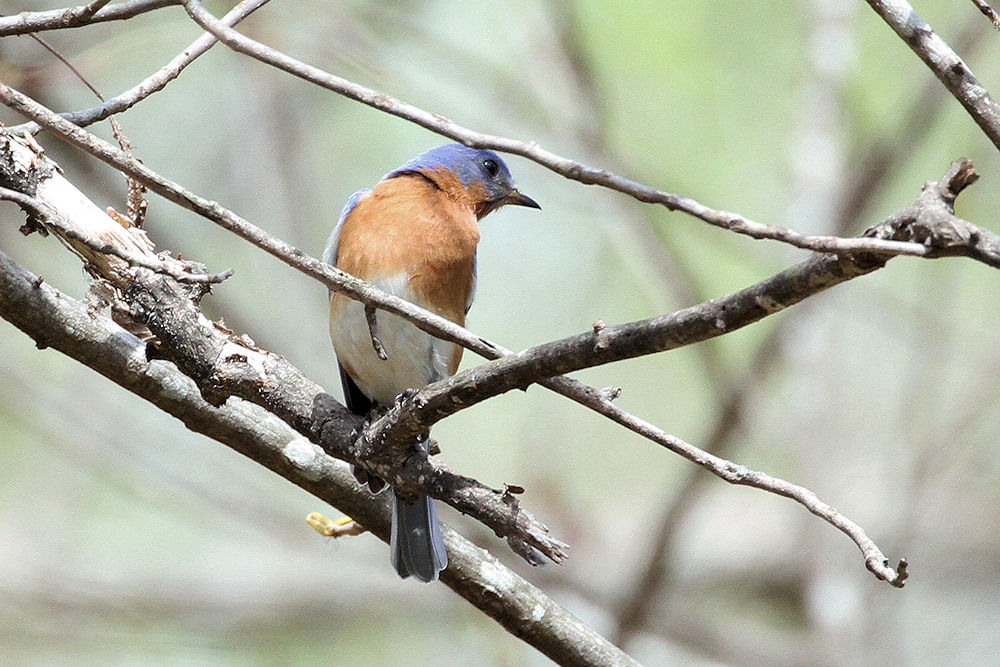
We found an Eastern Bluebird.
Did you know an Eastern bluebird can fly 17 miles per hour?  They lay between 2 to 8 eggs in each clutch and lay two clutches per season.  They have a lifespan of 6 to 10 years.  Male bluebirds sing with their beaks closed. I found my information at this link, a website called World Birds Joy of Nature, with great photos.  If you scroll down a bit, there is a delightful video of one.
Other wildflowers I saw that day, firstly Marsh blue violets (Viola cucullata).  Also known as Hooded blue violet and purple violet.
Downy Yellow Violet (Viola pubescens), also known as Downy Violet, Hairy Yellow Violet and Yellow Violet.
Yellow trout lily (Erythronium americanum), also known as Yellow dog-tooth violet.  I wasn't sure what it was at first, and certainly didn't realize it was a trout lily.  I was looking at it from a different angle.
Garlic mustard (Alliaria petiolata), also known as Poor man's mustard, Hedge garlic, Jack-by-the-hedge, Sauce-alone.
Virginia springbeauty (Claytonia virginica), also known as Fairy spud, Good morning spring, Narrowleaf springbeauty.
Bulbous buttercup (Ranunculus bulbosus), also called St. Anthony's turnip, Bulbous crowfoot, Frogwort and Crowfoot. 
Also seen in the photo above is my last wildflower.  It is Purple dead-nettle (Lamium purpureum).

And that's the end of our walkabout around the bluebells for now, until next year.  It was fun going back.  I have since found other trails that have them, so who knows where we will turn up next year.


Thanks for looking and I hope your day is a happy one.