Showing posts with label Mushrooms. Show all posts

Monday, May 18, 2026

SPINACH AND MUSHROOM CRUSTLESS QUICHE

Well, my quiche photos did not turn out the best. I cropped this one as best I could. Having finished off the quiche later I took more photos, but they were even worse. I do not know where my head was at that day! Not wanting to put you off, I'll just say if you go to the recipe site mentioned below, you'll get a better idea of how pretty this quiche is. It did taste excellent and my non-lover of cooked spinach gave it an 8 our of 10 which was high praise indeed. We served them with roasted green beans and a few cherry tomatoes thrown on the plate to brighten it up a bit. All a bit slap-dash but there you go. Onward!


I was immediately drawn to this quiche recipe when I saw that it had no crust. I used to make quiches all the time years ago, encased in pastry, but have been enjoying it without the last few times I have made it. You can find the original recipe here. I couldn't find the name of the cooking blog where I expected it to be, so I have taken the title out of the website address, Lily's Simple Recipes. You can see others offered at this link

I have added helpful notes from our host at the end of this recipe. You can go to the blog to read more.


Spinach and Mushroom Crustless Quiche

Servings: 4 slices

Calories per serving: approximately 300

From preparation to table: approximately 1 hour 10 minutes. (I only add this from the original recipe as a guideline as I go at my own pace.)


Equipment: skillet - 9-inch pie plate - mixing bowl


2 oz feta cheese crumbled

⅛ teaspoon salt adjust to taste

1 clove garlic minced

1 tablespoon cooking oil or olive oil

10 oz frozen chopped spinach thawed and squeezed dry

8 oz mushrooms sliced into ¼-inch pieces

1 cup milk, preferably 2%

½ cup shredded mozzarella

¼ teaspoon black pepper

¼ cup grated Parmesan freshly grated preferred

4 large eggs room temperature


Preheat your oven to 350°F to prepare for baking that glorious quiche.

Heat ½ tablespoon of oil in a skillet over medium-high heat. 

Add mushrooms and cook for 4-5 minutes, stirring until they’re golden and fragrant.

Add minced garlic and salt during the last minute, stirring until aromatic. 

Remove the mixture from heat and set aside.

Brush oil around a 9-inch pie plate. 

Spread the sautéed mushrooms at the bottom, followed by the squeezed spinach and crumbled feta for a delightful base.

In a bowl, combine eggs, milk, grated Parmesan, and black pepper until smooth. 

Be careful not to overmix for a fluffy texture.

Gently pour the egg mixture over the layered vegetables and cheese. 

Top with shredded mozzarella.

Place quiche in oven and bake for approximately 50 minutes, or until the center is set and reaches a lovely golden brown.

Once baked, let the quiche sit for 5-10 minutes. This allows it to firm up and makes slicing easier.

Slice warm or at room temperature.


Notes from our host

For a creamier texture use room-temperature eggs while whisking the custard mixture. It makes a noticeable difference.

The following are suggestions of what to serve with the quiche. 

A mixed green salad with a tangy vinaigrette.

A colorful assortment of seasonal fruits.

Serve with warm, crusty artisanal bread.

The host suggests a glass of chilled Sauvignon Blanc for a choice of wine.


Variations and Substitutions:

You can make this dairy-free: substitute the milk with almond or oat milk and use a dairy-free cheese to create a lactose-free quiche everyone can enjoy.

Add diced ham, cooked bacon, or shredded rotisserie chicken.

Mix in fresh herbs like thyme, basil, or dill to the egg mixture.

Substitute other vegetables like sweet bell peppers, zucchini, or sundried tomatoes.

Add red pepper flakes or diced jalapeños for more heat.

If you would like to make this vegan, swap out the eggs with a chia or flaxseed mixture (1 tablespoon of chia/flaxseed mixed with 2.5 tablespoons of water per egg), use dairy-free milk, and choose plant-based cheese alternatives.

The next night we had another slice and this time I fixed it with a veggie salad, cherry-sized mozzarella balls that I found are called Ciliegine (pronounced "chee-lee-AY-jee-neh"). Excellent for snacking. I have some in the fridge right now, cherry tomatoes, a little grated carrot, cucumbers, sliced green onions and romaine lettuce. It was a tasty combination.

Below is the full address if you prefer to copy and paste instead of using the link at the beginning of the recipe.

https://lilysimplerecipes.com/best-spinach-and-mushroom-crustless-quiche

I think I have covered everything but if I have made it too confusing or if you have any questions, let me know in the comment section and I will do my best to answer.

This is how it is supposed to look, just like a painting! 


Friday, March 6, 2026

I TREATED MYSELF TO A NEW POETRY BOOK.


Its author is the man who wrote the quote I shared in my Blue Jay post here.  The book is called Nature’s Bounty by Justin Farley, who has become my favorite at this point in time. I loved the poem I am sharing with you today.

“Children of the Forest”

~Justin Farley~

I leave you my love of the forest

and the winding creek.

I gift you with believing you are poorest 

when the sun’s warmth is absent from your cheek.

I impart to you the language of nature

and the secret harmony of her song;

I leave with you an overture 

So you’ll know her arms is where you belong.

I grant you the skill of listening 

with ears in tune with the earth.

I bless you with the excitement of discovering 

The depth and extent of her worth.

My blood flows within you;

I see my spark with your eyes.

We are children of the forest through and through,

and our spirits soar when the eagles rise.


I hope you have enjoyed this poem. This is one that will stay with me for a very long time. I thought it was beautiful.

Thanks for looking and have a great day!


Thursday, September 11, 2025

PRETTY TO PHOTOGRAPH BUT...


not the kind of mushroom you want to add to your meals! According to Google, and this website, it is called the Death Cap. Need I say more?

I haven't been too far this week so I went into my archives and when I found the photo, I realized I knew nothing about fungi.

I enjoy taking photos of them. Mushrooms are one my favorite veggies also, but I obviously only get them from the store. Do any of you forage for them? That would be very interesting to do but I think I will stick to the supermarket. My expertise is zero, but at least I know about these. I wouldn't even want to touch the things.


Thanks for the visit and 

I hope your day is going great.


Monday, January 1, 2024

HAPPY NEW YEAR AND MONDAY MORNING RECIPE POST - WALNUT AND BLUE CHEESE-STUFFED MUSHROOMS

Happy New Year Everyone!

May it be a joyous one for you all.

If you visit this link it will give you another wonderful version of Auld Lang Syne, which I mentioned yesterday.  


I am not one to make New Year's Resolutions, but these sound interesting.  

Which ones will you do? 

Are there any you would like to add?

1. Learn something new.

2. Tell people you love them.

3. Set healthy boundaries.

4. Get outside when you can.

5. Be truthful but not hurtful.

6. Read good books.

7. Sing in the shower.

8. Allow your feelings to breathe.

9. Be delighted by small things.

10. Take responsibility.

11. Practice seeing goodness.

12. Speak kindly to yourself.

13. Speak kindly to and of others, but know your worth.

14. Everyone works very hard so, let us give ourselves a little bit of the lazy.

15. Remember your dreams.

16. Take a walk in the woods, and enjoy the nature that surrounds us.

17. Swallow your pride.

18. Mend a few fences.

19. Stay compassionate and hopeful.

20. Have faith that there is always someone who loves you.


Here in the States it is traditional to fix Hoppin’ John on New Year’s Day.  You can see a recipe I made here

I also decided to go ahead with sharing a Monday recipe.  Today's came from 'Inspired by Charm', hosted by Michael. You can find the original recipe here.


Walnut and Blue Cheese-Stuffed Mushrooms:

Serves: 20

Calories per serving: approximately 55


24 large fresh mushrooms (other suggestions were white button mushrooms or cremini mushrooms)

1/2 cup seasoned breadcrumbs

1/3 cup Parmesan Cheese

1/3 cup sour cream

2 tablespoons chopped fresh flat leaf parsley

2 cloves garlic, minced

1/4 teaspoon black pepper

1/3 cup crumbled Blue Cheese (if you are not a fan of Blue Cheese you can use Feta or Goat Cheese)

1/4 cup chopped toasted walnuts

1-2 tablespoons olive oil  


Preheat oven to 425 degrees F. 

Clean the mushrooms and remove and discard the stems. Place the mushrooms stem side up on a baking sheet.

In a small bowl, combine the breadcrumbs, parmesan cheese, sour cream, parsley, garlic, black pepper, blue cheese, and toasted walnuts. 

To toast walnuts (this can be done earlier before you start the recipe) spread them in a single layer on a baking sheet and toast in a preheated oven at 350 degrees for 5 to 7 minutes, or until they become fragrant.  It doesn't take long for them to start burning so we need to keep an eye on them.

Spoon this mixture into the mushroom caps. Lightly brush with olive oil.

Bake for 17 to 20 minutes or until lightly brown on top and heated through. 

Garnish with a sprinkle of parsley.

We enjoyed this very much and didn't make any changes. If you have any leftovers, store them in an airtight container and use in two days. Reheat in the oven for best results.

These can be made in advance. Prepare them the day before up to the point of putting them in the oven. Store them in the refrigerator covered with plastic wrap. When you're ready to serve, bake as directed.

I have been adding the full web address link at the end of my recipe posts. This is in case you prefer to cut and paste rather than use the links above.

https://inspiredbycharm.com/walnut-and-blue-cheese-stuffed-mushrooms/


Thank you for stopping by, have a great week and have a great year!


Wednesday, December 13, 2023

HUNTLEY MEADOWS PARK IN ALEXANDRIA, VIRGINIA 12-5-23 WHAT I NOTICE IN THE WOOD

Before starting our walk we always stop at the signs to see what is going on at the park.

I am concentrating more on the trees and plants today as we walked through the wooded area, but the first thing I saw was a squirrel running up the side of a very tall tree trunk about 30 feet high. We don't see squirrels very often here, but we saw a lot of things today that we don't normally see.
He's eating something, perhaps a tasty acorn. I was surprised to find they were omnivores.  If I knew that originally, I have since forgotten. Aside from eating mostly nuts and acorns from oak, beech, walnut and hickory trees, as well as seeds, fruits, bulbs and flowers from other plants and trees, I read that they will also eat frogs, insects, bird eggs and farm crops such as corn and wheat.  And, of course, my daily feast of whatever I buy for the bird-feeding table!  They don't seem to be fussy eaters.
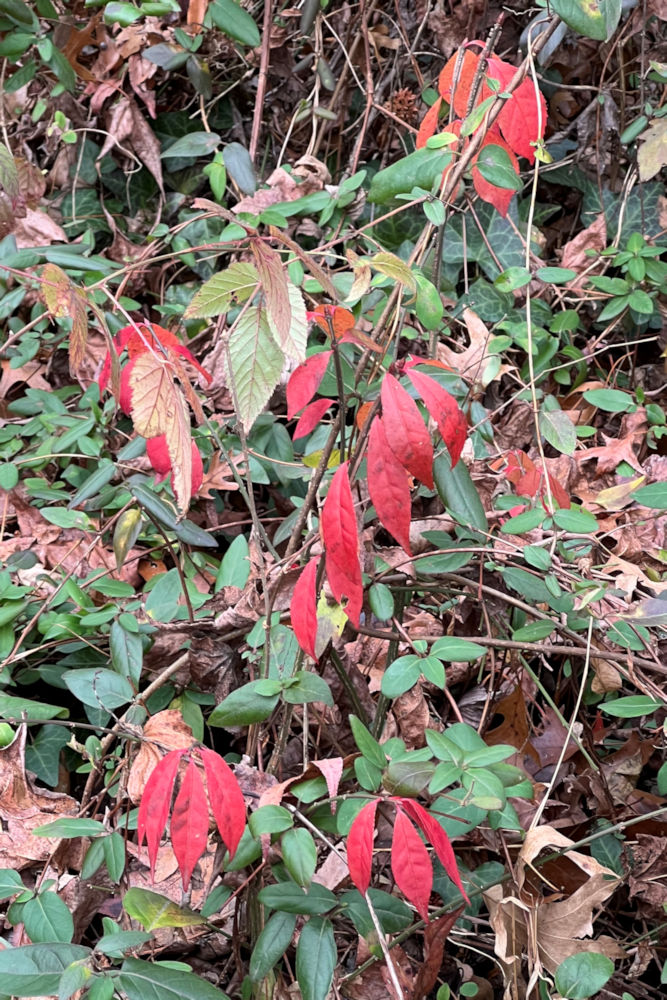
I am one of those people who enjoys looking at all the dead leaves as we walk by, to see what I can identify. The bright green leaf with all the veins drew me in. I identified it as English Ivy. European colonists introduced it as early as 1727 according to this website. Its origins are Europe, Western Asia and Northern Africa. There is a lot more information at the link. 
The smaller, lighter green leaf is Japanese Honeysuckle.  One little snippet I read at the previous link is that it was "introduced to Long Island, New York, in 1806, for ornamental, erosion control and wildlife uses."  I'm wondering if the plant app identified it correctly as I read further "It is a fast-growing vine that twines around stems of shrubs, herbaceous plants and other vertical supports.  In full sun it forms large tangles that smother and kill vegetation.  It can kill shrubs and saplings by girdling."  
It certainly looks like the kind we had in our garden years ago, but it didn't last and died off.  I was thinking I would plant more next growing season but the suggestion is to use native alternatives, "Coral honeysuckle, hairy honeysuckle, crossvine and trumpet creeper."  
I will be coming back to read this before I take a trip to the garden nursery. I remember the scent being incredible and I noticed it especially when the weather was warm.  Before it got too hot it was lovely to sit on the deck and just breathe it in.  I loved its scent, still do when I see it elsewhere.  
The Coral honeysuckle is what we had in our planter.  I don't remember any scent but then I didn't stick my nose too close to it and I couldn't detect any otherwise.  I think it was definitely Japanese honeysuckle growing in our garden, after looking at all the photos online.  If any of you are growing it, or have grown it, what do you think?  Would you plant it and can it be controlled with a lot of tender loving care?


"The red-leafed plant coming up is called the Burning Bush. It is native to northeastern Asia and was brought to North America around 1860 as an ornamental shrub.  It has been widely cultivated and planted through the eastern United States and Midwest.  Soon after its introduction, it escaped into the wild and has now naturalized in 25 states, including Pennsylvania and Delaware."  More at the link above.

Another pretty red leaf found was Arrowwood virburnum, botanical name Viburnum dentatum. It is native to the Eastern United States and Canada, to regions from New Brunswick to Minnesota and south to Georgia.  The name was inspired by Native Americans because of their use of the strong shoots which developed from the roots, for shafts of their arrows.

This is the time of year we see all the interesting fungus growing on dead logs. The one below is called Birch mazegill, botanical name Lenzites betulina
It is commonly found on decaying coniferous or deciduous woods. While its natural color is a yellowish brown, it may sometimes appear to be green due to its propensity to host algae.  It is said to be inedible because of its touch and leathery texture.  I found very similar photos of the following fungi that looked like the above photo, but my plant app kept identifying this as Turkey tail, botanical name Trametes versicolor.
Its meaning 'of several colors', versicolor in its Latin name reliably describes this fungus that displays different colors.  
Because its shape and multiple colors are similar to those of a wild turkey, it is commonly called Turkey Tail. 
Next we have a plant called Winterberry, botanical name Ilex verticillata. These bright red splashes of color were everywhere.  The berries were used for medicinal purposes by Native Americans, especially during fevers, so it is also called Fever bush.

Though I have several more photos from the park, I'll finish here for now with two photos of the Canada Goose.
They were all very quiet this time.  I hardly heard a honk!

Thanks for looking and I hope the weather is treating you well in your part of the world.


Wednesday, April 21, 2021

SHARING A WALK NEAR THE BLUEBELLS

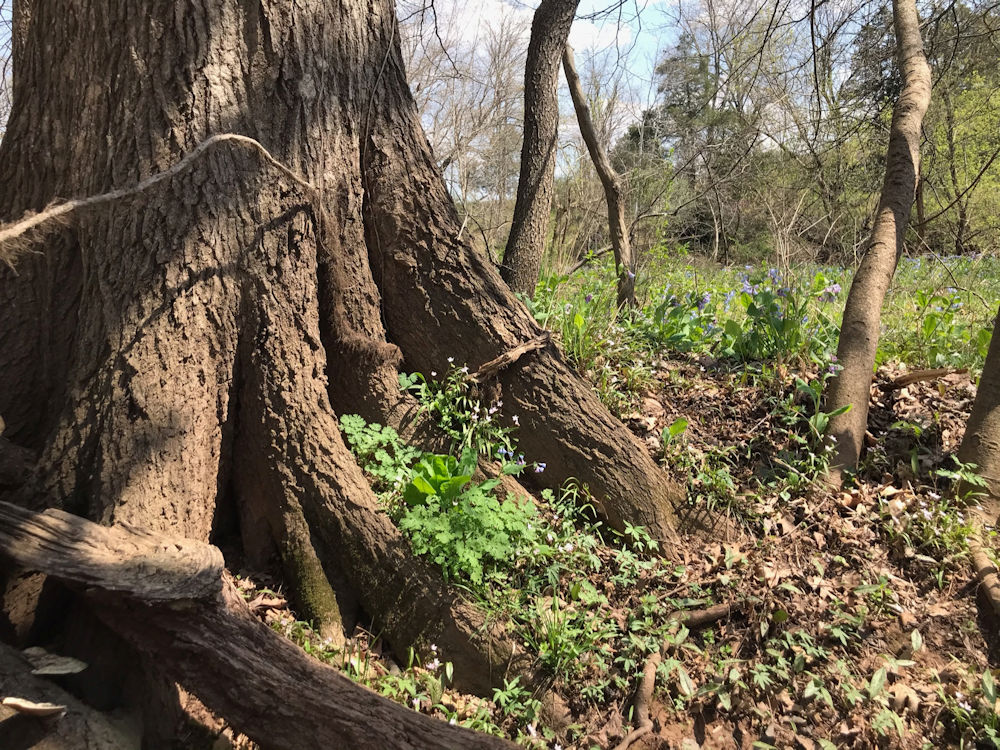
 Once again we went on a walk, this time to the Old Stone Bridge in Manassas.  We have been going to other walking trails a few miles ahead of this one, but it is well known for the Virginia Bluebells, which were in bloom.  It is also a favorite area for photographers and we saw several people walking back to their cars with cameras.

The river we walk next to is called Bull Run.
Virginia bluebells were given their botanical name, Mertensia virginica, in honor of German botanist Franz Carol Mertens.  The name Mertensia was later given to a family of jellyfishes in honor of Mertens' son, K. H. Mertens.  Like the flowers, the jellyfish are also quite colorful. 
In April 1776 Thomas Jefferson noted "a bluish colored, funnel-formed flower in lowgrounds in bloom" in one of the earliest entries of his garden book.  
Common names for these flowers are Virginia bluebells, Lungwort Oysterleaf, Virginia Cowslip and Old Ladies Bonnets.
My information came from the Lewis Ginter Garden here.
In the next photo you can see a wildflower called Dutchman's Breeches.  I looked everywhere for them but the only ones I found were these, not as showy as others I have seen.  I think I was a week late for their tip-top blooming...
but there was lovely foliage that looked a bit like parsley, and I recognized it as that of this particular flower.  I checked thoroughly in other places but though I saw more foliage, I couldn't see any more of them blooming.
This pretty wildflower is named for its sprays of yellow-tipped white flowers that reminded those who named them back in the day, of the wide-legged, traditional pantaloons worn by Dutch men.  Our flower is found throughout the eastern and midwestern North America, usually in open woodlands.  Its foliage grows from white underground tubers and is not as tall as the flowering stalk.  
This is a decayed fungus growing on a fallen tree trunk.  I have never seen them like this before.  Unfortunately my search online didn't result in any definite ID.  Still, all part of nature's rich reward when walking along.  I always enjoy finding the simplest things, as many of you do,  and still seem at this stage of my life to be curious about everything, for which I am grateful.
A lot of trees have fallen in this area.
There was blue paint on several that were very old but still upright, marked for chopping down perhaps.  There were also thousands of holes in a lot of the trees.  I thought these were from the woodpeckers burying their nuts in the bark over many winters. I have often watched them in our garden.  I sprinkle sunflower seeds on our deck rail, and watch them fly down and pick up a seed.  They fly up into one of our largest trees where they poke them into previously drilled holes.  But there are other explanation which you can read about here.


We took several more photos and I will save those for another time.

Have a great day everyone, and thanks for looking.