
Showing posts with label Williamsburg Botanical Garden. Show all posts
Showing posts with label Williamsburg Botanical Garden. Show all posts
Tuesday, December 3, 2019

Wednesday, November 6, 2019

Thursday, September 19, 2019
FLOWERS AT WILLIAMSBURG BOTANICAL GARDEN
The third and last post from the garden and our first flower here is a Sulfur Cosmos. There will be a link in red lettering, describing what that flower is. This one is native to Mexico, Central America and northern South America.
 The next several photos are of Rose Mallow, also known as the Rose of Sharon, Syrian ketmia, Shrub althea or Korean rose. They had many happy bees and butterflies visiting, other flyers also.
Other names, the Swamp Mallow, Marsh Mallow and Marsh Hibiscus.

Swamp hibiscus plants are water-loving plants and they will stop blooming in dry soil. However, the plant, which dies and enters a dormant period in winter, should not be watered until it displays new growth in spring. Once the plant is actively growing, it needs a deep watering two or three times per week during warm weather.

At this link I read "You will often read that the marshmallow plant (Althaea officinalis) was once used to make marshmallows." and then it gives more information. There is also a recipe on how to make marshmallows from marshmallow root.

I have only seen the white blooms growing wild, and pink grown in other gardens, but I have never seen the lavender. They were beautiful!

This is a Rose Mallow leaf well chewed on but thought it made an interesting photo.

Always on the look-out for an interesting story, I found the following here.


This lovely plant is called a Panicled Hydrangea, also known as Peegees Hydrangeas or Dwarf Hydrangea.

It is native to Japan and China, and is one of the more cold-hardy species of hydrangeas, and even a harsh winter does not stop it from flowering. The blooms are large and greenish-white in color, which age to a "vintage pink" when the temperatures drop.

Next we have the Woodland Sunflower. Its other names are Divergent sunflower, Rough sunflower, and Rough Woodland Sunflower. It is native to central and eastern North America, from Ontario and Quebec in the north, south to Florida and Louisiana, and west to Oklahoma and Iowa.

Marigolds, such a bright and cheerful flower.

That's about it for now on our visit here. I hope you have enjoyed the posts from Williamsburg Botanical Garden.


Wednesday, September 18, 2019
THE BIRDS AT WILLIAMSBURG BOTANICAL GARDENS....
Continuing on our walk around the garden, I saw two kinds of birds, a Cardinal that was in the process of molting/growing his feathers back, and two or three Tufted Titmouse's, all near the birdfeeders.

These are the same kind of birds I get regularly at home but I still love to see their cousins down south.

"It has long been an axiom of mine that the little things are infinitely the most important."
~Sir Arthur Conan Doyle~

This is definitely bird therapy.

I could sit and watch them for a long time, totally mesmerized.

"You can observe a lot by watching."
~Yogi Berra~

I felt another set of eyes on me and realized I wasn't the only one observing. Who's looking at whom here?

I wonder how long it will take for him to grow his feathers back?

Have a great day and thanks for looking.

Tuesday, September 17, 2019
WILLIAMSBURG BOTANICAL GARDEN, VA

Another place where the admission is free. Great for anyone who enjoys gardens. We saw friends getting together with their young children turning it into a bit of a play date/educational experience, great for families with several children, or taking visitors.

But, I am going to start off by saying don't be put off when you first enter the garden. It is very pretty but feels like a relatively small enclosure compared to other much larger gardens, and at first you might be underwhelmed. I also don't think we explored the other half of it. There is no visitor center yet and I didn't see the map until I got on line later. There may have been ones available and I may have missed them. We never plan too far ahead and take things as they come most of the time. My first reaction truthfully was, "Huh!", but, I was not thinking outside the box.

As I have found on our road trips several times now, larger doesn't necessarily mean better. Quality is more important and after ten minutes my initial reaction was turned around 180 degrees. You just have to look outside the box. It reminds me of what I think a Secret Garden would look like. And, I would not hesitate to put this on our itinerary when we find ourselves back in Williamsburg.

That little flowerpot man reminds me of a British children's show, "Bill and Ben The Flowerpot Men", which I watched avidly as a child in the early 50's.

But I don't want to got off on a tangent here. This little flower pot man was a cute garden decoration sitting next to the...


The palace provides a home for bees, wasps and other insects that don't live in hives and are a very important part of our gardens. This one is made up of clay pots, bottles, bricks with holes, plastic pipes, bamboo and pallets. All recycling materials and five star accommodations for their VIP guests who do much good in our world.

We were there at the end of August, the perfect time to visit and the perfect time for butterflies, and other flying things. The flowers were absolutely gorgeous. Whoever put the garden together, they chose the perfect pollinator flowers.

We found ourselves in the Native Plant Garden and the plants are indigenous to the area, and native to the coastal plain. There is also an Heirloom Garden that display plants from Eurasia. There is the Wildflower Meadow also. I found my information at this link. Happily, we thoroughly enjoyed ourselves, and are looking forward to returning for further exploration.

I am sharing photos of those happy pollinators. It was magical seeing so many while walking along the pathways.

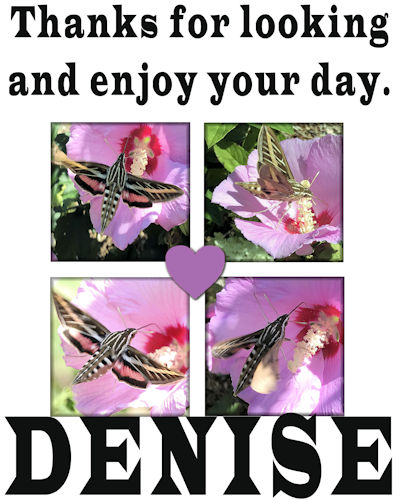
I was surprised at this one's appearance, and noticing it in my peripheral vision, and thinking it was a hummingbird, I turned and immediately realized it was not a hummer but a hummingbird moth. I had never seen its type before, maybe remembering vaguely a photograph some time ago. Certainly not the Clearwing Hummingbird moth that I have been used to photographing on occasion further north.

It was a White-lined Sphinx moth (Hyles lineata). You can go here to see more information. It is one of the hummingbird moths and its average wing span can be two to three inches. I have photographed the Hummingbird Clearwing Moth (Hemaris thysbe), which you can learn more of here. The photographs I took in Williamsburg were with my cell phone by the way. I was amazed at how it slowed down the wings so that I could get a decent enough photo. I cropped them for a better view.

It was a lot of fun keeping company with this beautiful creature.

There were many Swallowtails in the garden, and other butterflies, but those didn't land long enough for a photograph.

This is a Carpenter Bee, a good pollinator but it doesn't make honey. Also not good if you get them burrowing into your house or fence posts, or as we have at home, a big hole made in the wooden pole that holds our mailbox. They aren't as damaging as say termites or carpenter ants, but still can be a bit of a nuisance. You can read about them at this link.

A Scoliid Wasp. It is considered a beneficial insect because it helps control green June beetles and other grubs.

The Williamsburg Botanical Garden is in an area called Freedom Park, and is open at 7.00 a.m. to Sunset every day of the year.  The address is 5537 Centerville Road, Williamsburg, VA 23188. Their phone number is 757-880-1893, and you can find their website here. (Find the intersection of Longhill and Centerville Road. Follow the road into the park and the entrance is about a mile in. I add this because our GPS didn't get us there. We had to do a bit of guessing to find the gate. Yes we probably could have looked this all up before we left but then that would have been way too easy and sometimes our GPS takes us in new directions, rarely I admit but it's always fun. You will see the entrance on your left-hand side (see first photo), but you have to drive a short way past, turn right, then another short way and turn left into the parking lot, and then walk back to the garden.
 The address is 5537 Centerville Road, Williamsburg, VA 23188. Their phone number is 757-880-1893, and you can find their website here. (Find the intersection of Longhill and Centerville Road. Follow the road into the park and the entrance is about a mile in. I add this because our GPS didn't get us there. We had to do a bit of guessing to find the gate. Yes we probably could have looked this all up before we left but then that would have been way too easy and sometimes our GPS takes us in new directions, rarely I admit but it's always fun. You will see the entrance on your left-hand side (see first photo), but you have to drive a short way past, turn right, then another short way and turn left into the parking lot, and then walk back to the garden.
I liked the decorative ironwork on the gate.


A larger version of my favorite.

The following map is of the actual garden and what you will find there. You will see a pathway opposite the gate. I believe this takes you back to another parking lot, just across the road from where we parked our car.


I have two more posts on the garden coming up, of flowers and birds.
Subscribe to:
Posts (Atom)