
Showing posts with label Snowdrops. Show all posts
Showing posts with label Snowdrops. Show all posts
Sunday, April 5, 2026

Friday, March 7, 2025
GREEN SPRING GARDENS - LATEST TRIP ON 2-26-25 - PART 2

This is the road sign where we turn, and it is a short drive to reach the entrance at the end of the road.

One of the first photos taken is of the Witch hazel (botanical name Hamamelis virginiana. Other names are American witch-hazel, Striped alder, Tobacco-wood, Spotted alder, Water-witch, Snapping Hazelnut, Winterbloom and Witchhazel Witch-hazel.

This is the plant that was used in the 20th century for locating water sources. You can read more about that here towards the end of the article. Added note on 3-7-25 at 1.46 p.m. I add a photo below I borrowed from the previous website, of a map showing where witch hazel grows in the USA.


I am looking forward to seeing the planting beds bloom around the Moon Gate.

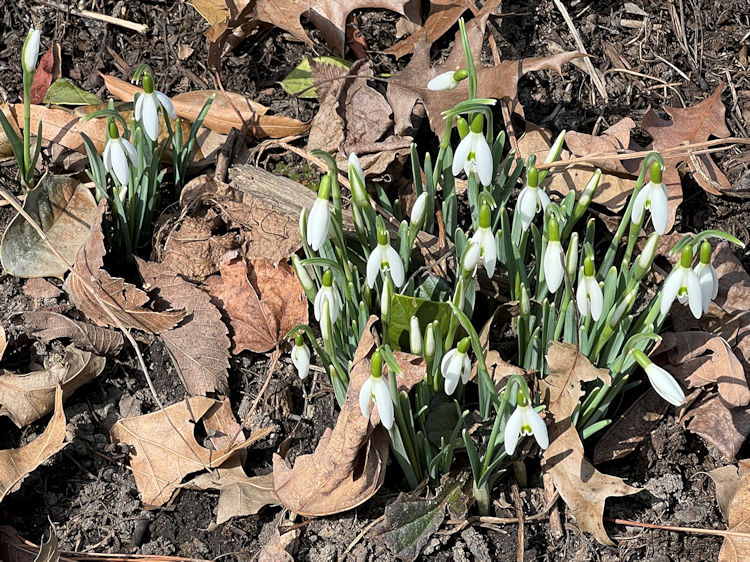
It was a very nice surprise to see the Snowdrops blooming. Their botanical name is Galanthus nivalis and other common names are Common snowdrop, Fair maids of February, Little sister of the snows, Purification flower, Candlemas bells, Candlemas lily and Common bells. These flowers have been noted throughout history, with references going as far back as the fourth century.


One last photo of a little dog who was enjoying all the smells as he scurried along. I wasn't fast enough to get a front view, but he was a cute little dog.

That's all from this visit to the garden.

Thursday, March 6, 2025
GREEN SPRING GARDENS - LATEST TRIP ON 2-26-25 - PART 1
These are the photos that Gregg took at Green Spring Gardens after our car picnic the other day. Not as many photos as usual because my trips are very short but as short as it was, it was lovely to get out and see what was going on. This place is a favorite garden.

I was very happy to see a new Paperbush plant (Edgeworthia chrysantha) in another area of the garden. There is a much larger one not too far from the gazebo. I talked to the garden manager who passed by as I was intently looking at it some time ago. We had a lovely conversation, and you could tell she thoroughly enjoyed telling me about it. She could see a happy sponge who was only too willing to soak up all the info I could. I told her truthfully, I had never seen one before. It is in my two previous posts here and here where I go into more detail. I hope that lady is appreciated. She certainly was, and hopefully still is, an excellent ambassador for the garden.
 I was delighted to see the Woodland crocus (botanical name Crocus tommasinianus).

Just like the first photo, this is a relatively new planting. I wasn't paying much attention to my surroundings in this moment, but I think these were near the recently installed Moon Gate. It's a Koreanspice viburnum (botanical name Viburnum carlesii).

A Bigleaf hydrangea (botanical name Hydrangea macrophylla). Also beautiful and I have seen these in dried flower arrangements.

Snowdrops (botanical name Galanthus nivalis) and how lovely they are to see. A harbinger of spring like all the other flowers we saw blooming on our walk.

An old tree stump and even this I find appealing.
I always enjoy seeing Gregg's photos when I download them at home. We seem to take shots of the same things but there are ones I don't think of. He sees patterns in nature that I don't.
I think I will stop here as it's late and I am ready to put the laptop up for the night. I will share what I saw soon.
Enjoy your day and as always,
thank you for stopping by.

Tuesday, February 27, 2024
SNOWDROPS - A SIGN OF SPRING - A POEM

Many, many welcomes,
February fair-maid!
Ever as of old time,
Solitary firstling,
Coming in the cold time,
Prophet of the gay time,
Prophet of the May time,
Prophet of the roses,
Many, many welcomes,
February fair-maid!

The Snowdrop
by
Alfred Tennyson, 1st Baron Tennyson FRS (6 August 1809 – 6 October 1892) was an English poet. He was the Poet Laureate during much of Queen Victoria's reign. In 1829, Tennyson was awarded the Chancellor's Gold Medal at Cambridge for one of his first pieces, "Timbuktu". He published his first solo collection of poems, Poems, Chiefly Lyrical, in 1830. "Claribel" and "Mariana", which remain some of Tennyson's most celebrated poems, were included in this volume. Although described by some critics as overly sentimental, his verse soon proved popular and brought Tennyson to the attention of well-known writers of the day, including Samuel Taylor Coleridge. Tennyson's early poetry, with its medievalism and powerful visual imagery, was a major influence on the Pre-Raphaelite Brotherhood.
More information can be read here.
Subscribe to:
Posts (Atom)