Showing posts with label Smithsonian Museum. Show all posts

Tuesday, December 29, 2020

FIRST LADIES GOWNS AT THE SMITHSONIAN MUSEUM

Thanks to Sandra at Madsnapper who told me about the blogger app for my iPhone, I am letting you know that I am without the Internet right now.  We are waiting for a new modem which is being mailed to us.  Thankfully I have had this post in draft form for a long time, an old blog post that I decided to reintroduce.   

From a visit into Washington DC on December 28th, 2009.

Back when the weather was a little warmer our family went into Washington DC to look around The Smithsonian Museum of American History. Our main objective (okay us girls as the guys elected to wait outside) was to visit the The First Ladies exhibition where their gowns are on display. The last time we couldn't even get in there without having to wait in line for a very long time and my legs were already tired from walking all over the city. This time it was a little better but still crowded. Mostly women and one or two men. I would have enjoyed taking more photographs, as many were too blurry. These came out okay. I didn't feel like I could monopolize my space and kept moving towards the end of the display, fortunately snapping off several shots along the way. Some snaps did not make it but I was happy with what I got. 

The exhibit only had 14 dresses on display. From the information I gleaned, this was because way back they did not realize how even the slightest light did so much damage to these historical dresses, so now they rotate them to prevent even more deterioration. At the time we visited we were allowed to take photographs but we could not use any flash for obvious reasons. The following is what I got on line:

"Why aren’t all of the gowns on exhibit?

Light, climate, and gravity are all harmful to fabric. Over time, they have damaged the gowns. There are some gowns that can no longer be exhibited because they were too badly damaged by their years on display. Other dresses are rotated on and off display in order to keep them in good condition."

It is hard to comprehend that this is Martha Washington's gown from the 1780's and is the oldest gown in the exhibit. It is made of salmon pink faille and is hand painted with flowers, butterflies and other insects. The collar and cuffs are reproductions.

This is Frances Cleveland's evening gown. She wore it with a fur-edged hem and a black satin and jet trim during her husband's second administration, and was made by Baltimore dressmaker, Lottie Barton.
I am not sure whose items are these, a guess might be Jane Findlay but I can't be 100 percent sure. Her portrait below shows her wearing a lace bonnet very similar to this one.

Oil portrait of Jane Findlay in about 1840 by an unknown artist. She was a Harrison family friend who came to Washington to assist with the first lady’s duties. Her gown was included in the original 1914 exhibition to represent the administration of William Henry Harrison.

This is Helen Taft’s 1909 Inaugural ball gown and is made of white silk chiffon. It is appliquéd with floral embroideries and trimmed in metallic thread, rhinestones and beads and was made by the Frances Smith Company. Her gown was the first one to be donated in 1912 so we have Mrs. Taft to thank for this wonderful exhibit.

The fabric and embroidery have become discolored and most part of the skirt was replaced as part of a 1940’s conservation effort.
Everyone who passed by this gown was in awe. It was just beautiful.
Portrait of Julia Tyler, second wife of John Tyler in about 1840.
Next is Grace Coolidge's flapper style evening dress. It is made of velvet trimmed, black and gold metallic lace over a gold lamé underdress.
Unfortunately I did not get whose dress this belonged to but there was a portrait of Pat Nixon nearby. My search online for the last hour didn't yield any results.
Various adornments worn by the first ladies.
This is Mamie Eisenhower's evening gown. It is a rose-colored silk damask ball gown for a 1957 state dinner at the British Embassy. Nettie Rosenstein designed the ensemble, which included a matching purse and shoes.
Jacqueline Kennedy wore this yellow silk evening gown, designed by Oleg Cassini, with an overlay of crepe chiffon in 1961 for the Kennedy administration's first state dinner, for Tunisian president Habib Bourguiba.
Finally this is Laura  Bush's gown. Made of red Chantilly lace and silk satin with crystal beading, it was created by Dallas designer Michael Faircloth.
It can take up to two years for a dress to go on display. A letter is sent from the Secretary of the Smithsonian asking if the First Lady would donate something that would represent herself in the collection. The gown will be on view immediately after donation. 
All were beautiful gowns, but my favorites were the vintage ones. Since I was very young I have always had a fascination for clothing going back to medieval times. My dream job would have been in a costume department either at a museum or on a stage set.  I still have a great interest in costumes and traditional clothing. 
 
Thanks for stopping by and enjoy the day. I am looking forward to catching up with you all eventually. 


Thursday, July 19, 2018

THE SMITHSONIAN MUSEUM OF NATURAL HISTORY IN WASHINGTON DC

About three weeks' ago I shared that we had met family members in Washington DC.  They were only visiting for a few hours and we went to the Smithsonian Natural History Museum.  

The African bush elephant is in the main lobby as you enter the museum.  He is a favorite of mine and is named Henry (not sure how he got his name).  Henry comes from Angola originally.


Two rodents below, a Mara and an Armored Rat.
The crab below looks like a King Crab, could be a prehistoric one, I'm not sure.  We are in the marine life area.
Below is a display of Tiger Cowries.  They are placed on the map where they were collected.
This tropical sea snail lives on coral reefs throughout the Indian and Pacific Oceans, from ankle deep waters to 30 feet (9.1 m) under the ocean's surface.
Below is a photo of a photo in the same display.  It shows what one looks like if it were alive.
The adult snails don't travel very far but their tiny larvae drift on currents, accounting for the species staggering geographical range. (All my information comes from the display.)
We went through the dinosaur exhibit briefly, and I managed to get a photo of a couple, the Tyrannosaurus...
and the Triceratops.
There is a live insect exhibit and the mural is at its entrance.
We were heading to the butterfly exhibit which I posted here.  
I didn't take too many photos of the insects but will share these.  It was crowded. 
These are White-spotted Assassin Bugs of west and south African origin.
The only other photo I tried to take was of a Pink-toed Tarantula, but it came out so blurry it is hard to tell what it is.  If you aren't adverse to looking at big hairy spiders, you can go to this link to see what it looks like, or not!  As mentioned it was very crowded with lots of curious children, so we went onto the butterfly exhibit where we were heading to in the first place.  I have already provided a link to those, but to save you scrolling up I will repeat it here.  That was crowded too but we didn't mind waiting in line.
We passed through another exhibit where a life-size Narwhal was hanging from the ceiling.  There was a sculpture in the same area.

Its description is below.
Another sculpture...
and another description.
One more photo from the museum, a cartoon showing that though we have different names for everything, the scientific name stays the same.
The rest of my photos from this day were taken outside.  Let's start off with a yellow hibiscus.
Normally I would have taken many more photos of this pretty...
but I stopped at three.
And one pretty purple flower.
Nearby is a large water fountain that is used as an ice-rink during the winter.  We were happy the spray of the water was cooling us down.
 It is surrounded by lampposts.  
There is a banner of artwork hung from each one.
Across the street is the 
By this time we are making our way back to the car.  I see one last thing that I wanted to take a photograph of, so that I can remember to go there next time we take a trip into the city.  
Once we got back to where we had parked our cars, we said goodbye to our family and each started for home. 


Friday, July 13, 2018

BUTTERFLIES AT THE SMITHSONIAN NATURAL HISTORY MUSEUM, WASHINGTON DC

Thank you for visiting and leaving comments.  I have been getting ready for company this weekend, and will be slow getting back to you, but I will catch up eventually.

This is an Atlas Moth.  They were in a mesh box protected from the public.  The reason was that they sleep during the day and are awake at night.

I have tried very hard to identify this type of long-wing but have had no success.

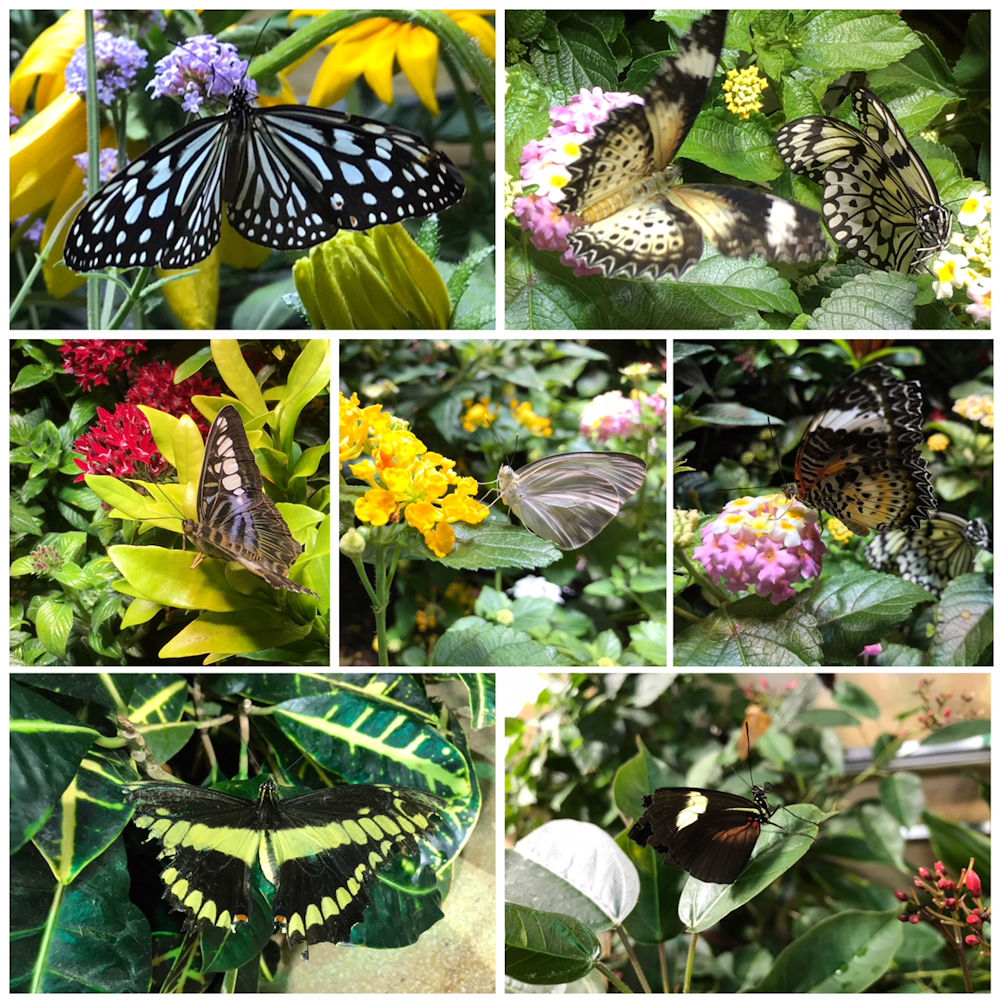
A few weeks ago we met up with out-of-town family in Washington DC.  They wanted to go to the Smithsonian Natural History Museum.  There is a small, enclosed butterfly garden in there.  I took photos and identified what I could.  If I was unsure I just left it.  Please feel free to ID them if you can, or even correct any you think I may have gotten wrong.
I could not find any ID on the butterfly above, and below I am not sure about the one on the left, but on the right is a Japanese Paper Kite.

Once again I tried hard but could not find an ID.


Above and below could not find an ID.

This one is called a Malachite.


 Lovely markings on this Leopard Lacewing Butterfly.

 Gregg had a Common Long-wing land on the back of his collar. 


 Another landed on the bottom of his shirt, a Blue Morpho. The butterflies were landing on a lot of people that day.
Here is another with less tattered wings.  A bit blurry but it gives you an idea of its pretty design. It would have been hard to take a larger camera into this small enclosure and it was crowded.  All these photos were taken with my cell phone.

Have a great weekend everyone!