Showing posts with label Mallards. Show all posts

Wednesday, July 27, 2022

WALK AROUND GREEN SPRING GARDENS CONTINUED...7-21-22

I found it hard to leave those lotus flowers and the refreshing fountain in the middle of the pond.  Though we couldn't feel its cooling spray, it was enough to sense it.  We sat on a nearby bench to see if any water birds would appear.  We haven't seen any Great Blue Herons at the pond since last year.  Maybe next time!  I felt lucky to see the female mallard, which I also shared in a previous post.   She was preening herself and then seemed to have a little snooze. 
I empathized in that heat, most definitely, but at least she could take a swim later to cool off. I always enjoy reading about them and adding to what I have already learned.  Some facts I know, others I don't, some are a good refresher course. Today I read that ducks can live from 2 to 20 years, depending on the species and whether they are wild ducks or ducks in captivity. It is a fact that a wild duck can live 20 years or more. Domestic ducks typically live 10 to 15 years in captivity. The world record is a Mallard Drake that lived to a ripe old age of 27 years.
Someone had scattered a mixture of corn and other seed near the bench, and this little girl had her lunch not far from where we were sitting. The corn was too big but she seemed to be enjoying the tinier seed.  I believe she is a female House Sparrow but please correct me if you think I am incorrect.
There was also an American Robin nearby, but that was it for the smaller birds.  The others were very elusive on our visit.  However, always grateful for small mercies, as the old saying goes.  True!
At the other end of the pond were water lilies.  There were also dragonflies.  They were flitting around and I couldn't get a proper focus for a photo.
It was time to move on and we walked towards the path that would lead us up the hill, to the flatter part of the garden.  We said goodbye to the pond area, at least until next time.
At the beginning of the path was a sign asking not to feed the ducks and geese...
and another making us aware of their ecological restoration.  There is an article at this link which tells us all about it.
Not too far from this sign we spotted the family of deer.  We counted three at least.  They were quite a distance off from us and this is one of several photos I took but these didn't exactly work out.  The tree on the right is one we pass all the time where many couples have had their names carved into its bark over many years.  You can just about make out a deer's shape in the center of the photo.  Also, the little blue glints are the reflection of its eyes.  I don't remember the flash going off.  Perhaps it was a trick of the sunlight filtering between the trees.  I shared a better photo here on my first post from our recent walk, and it is the 6th one down.
I also enjoyed the wildflowers as I walked.  Below is Blue mistflower, botanical name Conoclinium coelestinum.  Its other names are Mistflower, Wild ageratum, Blue boneset and Hardy ageratum.  It is an herbaceous perennial, is native to North America and blooms in summer and the fall.  
Next are the berries of the American elder.  Its botanical name is Sambucus canadensis.  Other names it goes by are Common elderberry, American elderberry, Elderberry, Canada elderberry and American black elderberry.  It is native to North American, a deciduous shrub and provides food for over 100 species of birds, as well as shelter for nesting.  The dark purple elderberries are used to make jellies, pies, juice, and wine.  The flowers are star-shaped and are a yellowish-white.  
We spotted a beautiful black swallowtail on the pink Garden phlox, botanical name Phlox paniculata.  Also known as Summer phlox, Fall phlox, Perennial phlox and Cross-leaved phlox.  Phlox is a Latin word for 'flame'.  It is also native to the United States.  You can read more about the butterfly at this link.  There are great photos!
Purple Joe-Pye weed is next, botanical name Eutrochium purpureum.  I feel like I am auditioning for a Harry Potter movie with all these botanical names, but I enjoy learning them.  Other names are Kidney-root, Sweetscented Joe Pye Weed, Sweet Joe-Pye-Weed, Gravel Root, Trumpet Weed and Feverweed.  It is native to eastern and central North America, and blooms in the summer and fall.  Its flowers have a strong vanilla fragrance, which makes it a favorite of butterflies.  No flutterby friends on them as I passed by.
We have crossed the stream and are making our way up the hill and will end up in the top part of the garden.
These beautiful yellow flowers are called the Cup plant, botanical name Silphium perfoliatum.  Other names are the Common Cup plant, Squareweed, Carpenter's weed, Pilot weed and Rosinweed.  It is a native to the Eastern and Central United States.  The height of this plant typically reached from 3 to 8 feet and as you can see, their blooms are similar to sunflowers.  They grew in abundance on each side of the path and these towered over my head.  
And frankly I loved them as you can see by the many photos.  There were hundreds of them along the pathway.
A closer view of one shows a bright green bug with wings.  I wish I could crop it closer without blurring it out too much (I only had my cell phone - Gregg and I swap cameras and he was further along than I was. He carries our larger camera with the zoom lens.  It is a lot heavier and my wrists start to ache if I carry it for too long.  He jokes that he is my porter, and will give it to me when I want to see something up close.  I am glad he likes taking photos as much as I do, and many of his photos I share on my blog.)   
The ID of the bug is the Augochlora pura, also known as the Augochloral sweat bee. 
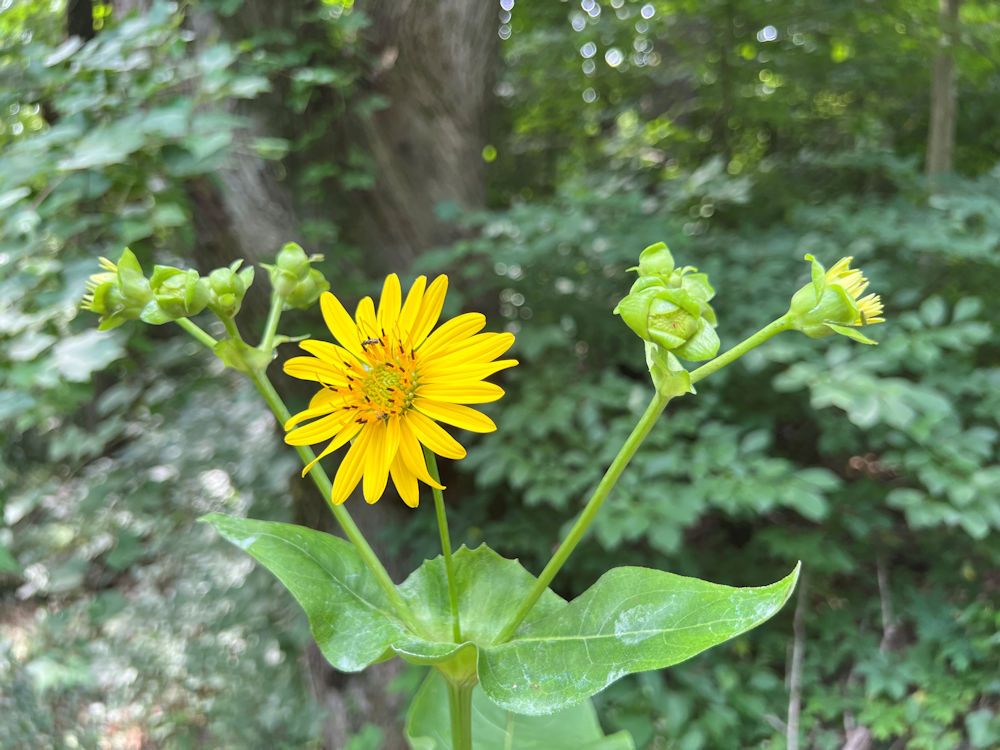
Each flower head has 20-30 yellow rays and darker yellow disks. The leaves are joined at the stem to form a small cup that holds water and attracts birds. 
I also came across another yellow flower, the Black-eyed susan, botanical name Rudbeckia hirta.  Common names are the Yellow ox-eye daisy, English bull's eye, Brown betty, Golden Jerusalem and Gloriosa daisy.  Its genus name, Rudbeckia, was named in honor of botanist Olof Rudbeck Junior, (1660 – 1740) who was a Swedish explorer, scientist, botanist, ornithologist and rector of Uppsala University in Sweden. 
People plant them to attract butterflies to gardens.  It is also a native flower to America. The stamen isn't actually black but brown.  Its yellow petals attract some birds, but the brown center isn't that attractive to our feathered friends.  However, its center acts as a good platform where they can stand and snack on the jagged ambush bugs and aphids that frequent it.  Just like echinacea, the flower has been used in traditional herbal medicine.  Growing throughout the prairies and plains, it was used medicinally by many Native Americans to care for both people and horses. 
It was declared the state flower of Maryland in 1918.  

I have a few more photos from the top part of the garden. I will share those when I can put a post together.

Thanks for looking and have a wonderful day!


Friday, July 22, 2022

GREEN SPRING GARDENS WALK - 7/21/22

The house beyond the trees is part of Green Spring.  It contains offices and I am not exactly sure for what.  The visitor center is on the other side of the garden.
It has either been very rainy with thunderstorms or hot and humid weather so, with those elements to contend with, we haven't been on a lot of walks.  We decided that even though it was going to get up to 92 degrees Fahreneit (33.333°C) yesterday, we would go out early and drive to Green Spring Gardens.  The last time we were there was on April 15th. We have been to other places for our walks since then, but not in the last week.  The following shows you what our weather is going to be like for the next 10 days, which included yesterday.
We didn't go on a very long walk because of the humidity.  Consequently we didn't stay as long as we usually do.  I might add that the garden was very quiet, and we only saw a handful of people walking around.
My main interest today was to take photos of flowers, the lotus in particular...
and was hoping for birdlife also.  
We started off in the pond area, and only saw one female mallard.  A few smaller birds flew around. We counted two turtles, but they bobbed their noses under the water as soon as we got a camera out.  
Further along when we were going through the wood, we came across a family of deer.  They were mostly obscured by trees, but we were happy to get this photo.  We enjoyed them for a little while and it was enough to see these glimpses of them, with an occasional head bobbing up and eyes staring at us, before going back to their munching. 
This is a path we take after we have looked at the pond area and walked through the wooded area I mentioned.  You can't really tell but it's quite a steep hill...
and on each side the undergrowth can get quite tall.
I am keeping this short today as it's getting late, and I want to publish it for tomorrow (today).  As you might guess I have more photos to share.  


Wednesday, March 9, 2022

GREEN SPRING GARDENS - 3-2-22 - PART 2

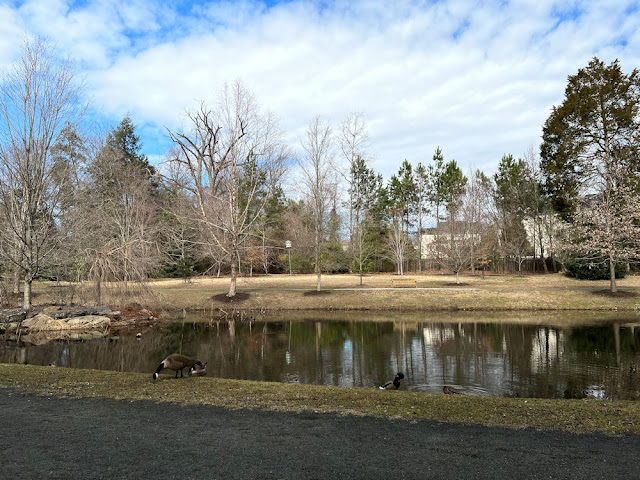
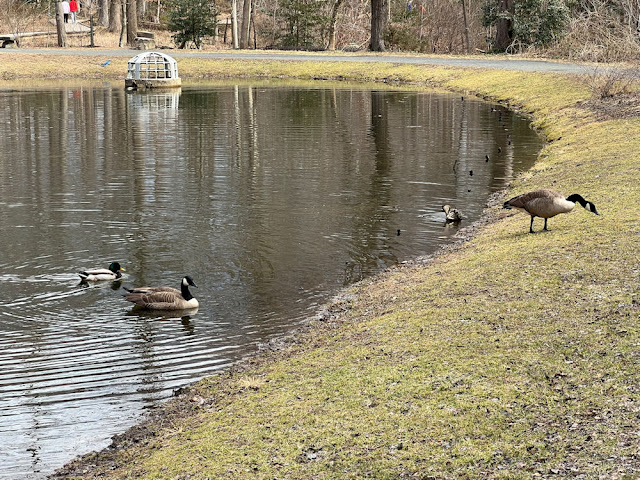
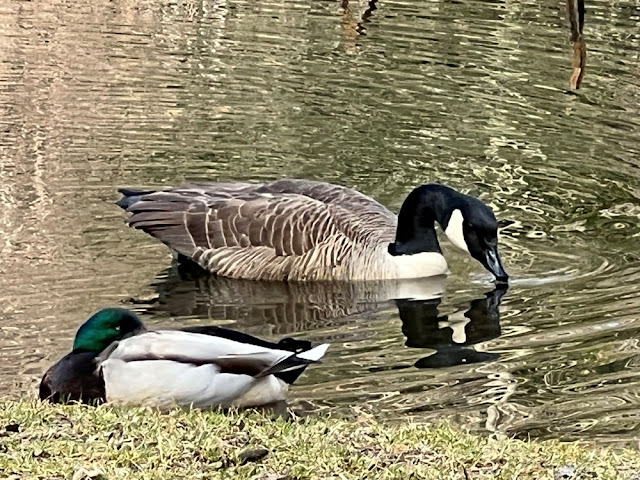
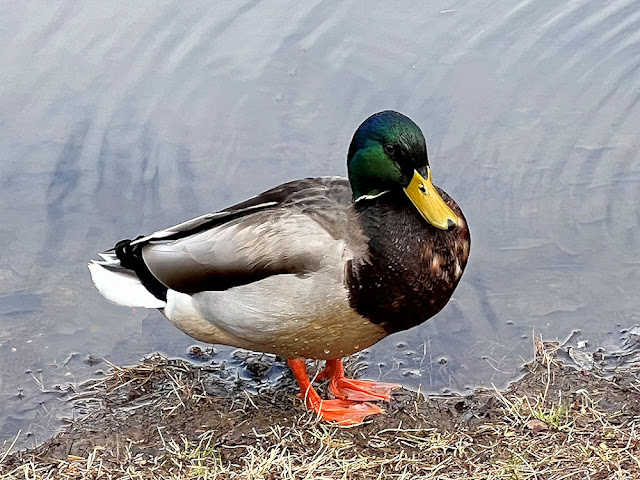
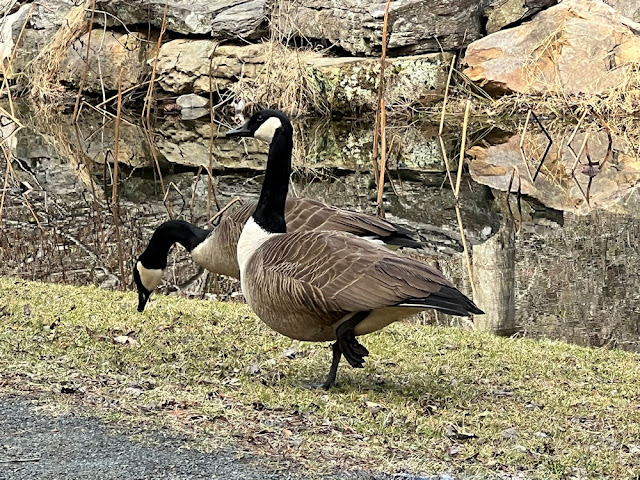
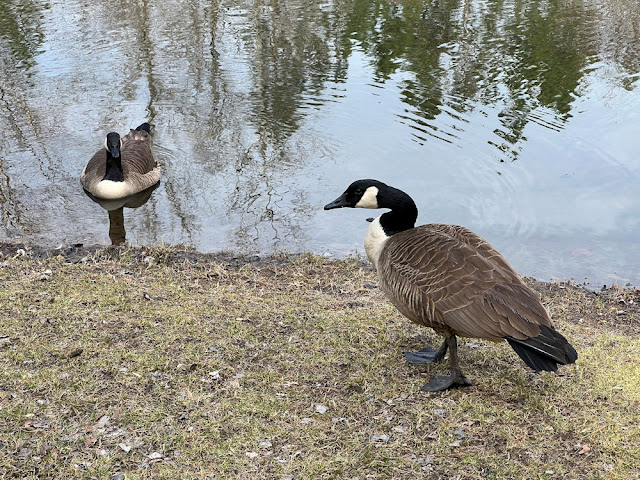
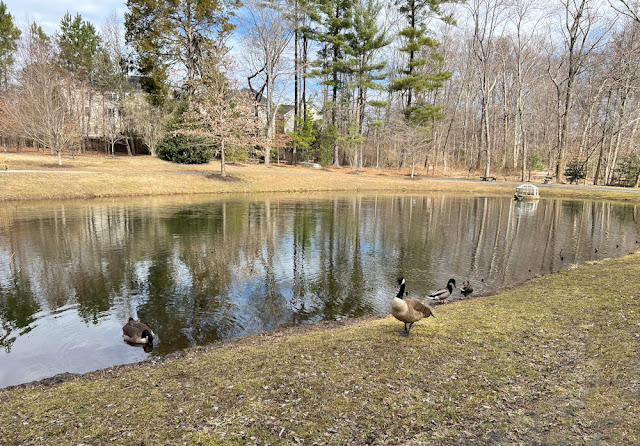
Moving on from my first post at this link if you missed it, we are now near the ponds where I was hoping to see a Great Blue Heron.  We have often seen one there, but not today.  There was a pair each of Canada Geese and Mallards.  They were fun to watch for a while.  I sat quietly on a bench as I took some of these photos. 

The garden was quiet but a lady with her two dogs walked on the other side.  Dogs always start my clicking finger dancing.
The Geese and Mallards seemed very happy to be in each other's company.
Canada geese find mates when they are around two years old, and pairs stay together for the rest of their lives (24 years on average). The birds usually pick partners that are similar to their own body size, a pattern known as “assortative mating.”
 Ducks live between 5 to 10 years. Did you know that the quacking sound that we associate with ducks comes from hens?  Drakes can whistle, growl, croak, purr, squeak, hoot or be totally silent.  
When the baby ducks (goslings as we know them) are still in their shell, they begin to communicate with their parents. They make greeting 'peeps', alarm calls, and high-pitched trills that indicate contentment. Adult calls elicit varying responses from goslings, showing that parents use a number of calls with different names to communicate with their young.
Canadian geese have a long lifespan. As an extreme, some can live up to twenty-four years in the wild, but their first year survival is precarious due to predators.
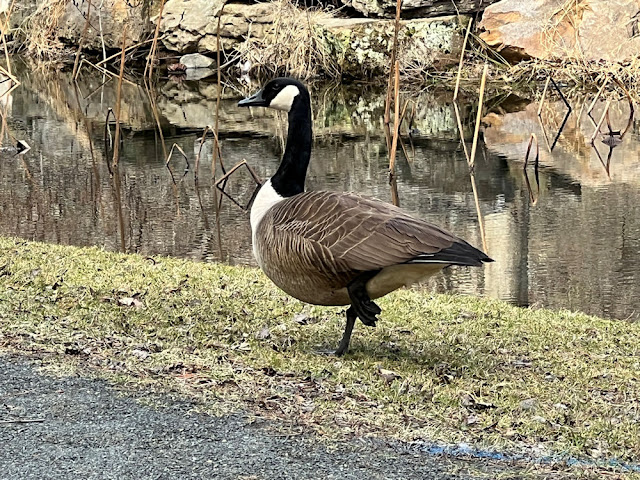
Geese stand on one leg to regulate their temperature. They are warm blooded and rely on their feathers to keep them warm when temperatures drop. Seeing as their legs have no feathers to keep them warm, they tuck one up to keep themselves a little bit warmer, swapping legs occasionally.

From here the path takes us through a wooded area. It isn’t long before we cross a bridge over a stream, which leads to a fairly steep incline.  At the top is a flat area of the garden.  But I will share that next time.

Thanks for coming with me to the garden. 
Have a great day! 


Friday, March 4, 2022

GREEN SPRING GARDENS - 3-2-22 - PART 1

It was another sunny day on Monday, the sun was shining, the skies were blue, and it was a mild day temperature wise at 62 degrees Fahrenheit.  Time to get out and go for a walk around our favorite garden. Happily, the blossoms were starting to show on some trees.
On their flag you can see Witch Hazel. It is planted in various parts of the garden.  It would be nice to see this in our own garden.  
Above is the plant color I am used to finding. I didn't realize that there was a bag worm hanging from one of its branches until I was browsing through photos on my laptop.  If looked at quickly, they look like a clump of dead leaves to me, this without my glasses on mind you.  I was also focused on taking photos of the Witch Hazel. There can be 300 eggs or more inside these things.  If you click on both links, of the bag worm above and the tent moth, they are very destructive. 
As for the Witch Hazel, when I saw these in my photo below, I was intrigued by the different color.  It's very striking.
When I did a search on this particular shade, there were other names mentioned If you go to this link it will show you.
I read: "The genus Hamamelis is made up of five to six different species most of which are large woody shrubs 10 to 20 feet tall.  Hamamelis is made up of two non-native species, Chinese witch-hazel (H.mollis), Japanese witch-hazel (H. japonica), and four species native to North America, Eastern witch-hazel (H.virginiana), Mexican witch-hazel (H. mexicana - considered a subspecies of H. virginiana, though some geneticists consider it is a distinct species, Vernal witch-hazel (H. vernalis), and Big-leaf witch-hazel (H. ovalis).  One hybrid, xintermedia is also very popular."
Always on the look-out for birds, I spotted a flurry of movement in one of the bushes near the main gazebo.  Expecting to see a squirrel, I saw an American Robin on the ground, darting into a bush and hiding under the leaves.  I have been practicing with the zoom feature on my phone, more importantly my reaction time without startling my subject too much.  It's not the sharpest but as I like to say, it's a memory.  I read here that American Robins are fairly large songbirds with a large, round body, long legs, and fairly long tail. They also belong to the thrush family and are the largest of the North American thrushes.
But first, this day I felt like walking a little further and we went down the hill to the pond area.  We always pass by the ruins of a small building.  I don't know what this is, whether it was a resident or a place for storage.  There is no sign that I could see but it's an interesting structure that always piques my interest. Added note: 3-10-22 - I came across a very interesting article mentioning this structure.  You can read about it here if curious.
It was relatively quiet as we walked to another gazebo we like to sit inside sometimes, not today.
I have shared this before on our other trips to the garden.
The nesting box is ready and waiting.

I was looking for water birds.  All we found today were Canada Geese and Mallards.  They are always a welcome sight and I will share more photos soon.


Thanks for dropping by and have a
great weekend.