Showing posts with label Geese. Show all posts

Saturday, June 20, 2026

NOT THE USUAL SATURDAY MORNING AT THE BIRD FEEDER BUT A GOOSE GAVE CHASE…

 This is a story I mentioned before but I thought it would be fun to tell it again in pictures. This happened to me 70 years ago.

A picnic with my Aunty Dorothy and cousins, a very hungry child, a white goose chasing me. I remember screaming and running as fast as the wind with my Aunty’s voice ringing in my ears, “Drop the sandwich, drop the sandwich!”  

There she goes, silly girl, feeling the pain as the goose nipped the back of her leg, but eventually she threw her sandwich into the lake, upon which the goose gave up the chase and dived in after it. My Aunty gave me a wise piece of advice when I regained my composure, how little girls should immediately drop their sandwich when a goose takes an interest in it.  

A good lesson learned! This memory is as vivid to me as if it happened yesterday. So, if you are holding a sandwich when a goose gives chase, you know what to do!
Thanks for visiting and 
I hope your day is a great one.


Tuesday, May 7, 2024

HUNTLEY MEADOWS PARK IN ALEXANDRIA, VIRGINIA - IT HAS BEEN A WHILE

 The last time we were at the park was in January at the beginning of this year. For our recent visit we picked the perfect day as the temperature was hot but there was no humidity. It was also easy to get a parking spot. There were several spaces available. 

Babies! Unfortunately, I couldn't get a closer shot as they were way too far out.  I have been reading some interesting facts about them. Goslings have been known to follow just about anything that moves, from dogs to humans, mistaking them for their mother. The impressionable young use this skill to mimic the adults, learning how to swim just 24 hours after hatching. At only one day old they can dive 30 to 40 feet under water.
Parent geese teach their young how to fly when the goslings are two to three months old. The goslings will stay with their parents for the first year of their life and even migrate with the adults that year.
As the goslings continue to grow and become more independent of their parents, they may group together with other young geese. These groups, called "gang broods," can consist of up to 100 goslings.
I have always enjoyed being around the Canada goose and, just like the squirrels in our back yard, find them very entertaining. It's important to give them a respectful distance, even more so at this time of the year.  
Canada geese aren't afraid to face a threat. If a parent goose feels a threat to their nest or goslings, they may attack. Stretching out their neck while hissing and honking loudly, serves as a warning to predators, along with biting and slapping with their wings.
We found these two later. They were rather sandy and I assumed that they had been ducking their heads under the water to feed. There were no goslings with them. Maybe later! An interesting thing I had not read before was that once a year, when the weather warms up, geese molt their feathers. During this 6-week period geese are unable to fly, leaving them vulnerable to predators including coyotes, foxes and raccoons. Water plays an important role in the safety of geese. They'll retreat into water if their warnings don't scare predators away.

More to follow later from our walk.


Friday, February 23, 2024

BIRDS AT ST. JAMES PARK, LONDON

These are old photos from a vacation in England in 2015. We spent a few days in London and had a great time exploring Saint James Park. It became a favorite place to go as it was a short walk from our hotel. There were many different kinds of feathered friends. Here are a few and I have provided links with more information on each name, including a map of the park here.
I rarely get to see a Graylag Goose. This may have been the last time.

The next two photos show the Ross' Goose. I went here to identify. If any of my ID's are wrong, I would be happy for the correction. I am no expert, always learning.
This goose is slightly larger than a mallard and smaller than a Canada Goose.

Next is the Great-crested Grebe.  

  I had never seen any before my holiday. 
There are more facts at this website.

Sometime I will share more birds from the park.


Wednesday, August 31, 2022

FROM AN OLD POST - WATER BIRDS AT TORCROSS, SOUTH DEVONSHIRE, ENGLAND - JUNE 2015

These are old photos from a trip we took back to a place called Slapton Sands in the UK, an area I used to go with my family all the time.  We lived in the West Midlands (UK) and moved to South Devon when I was 15 years old.  It was always a planned destination on holidays spent in Devon each year, since I was 8 years old.  The stretch of water is called Slapton Ley, and you can click on the links provided if you would like to learn more.

I am posting water birds found on our vacation in Torcross, which is in South Devonshire. Torcross is indicated by the red button on the map of the UK. Slapton Sands is a long stretch of beach and Torcross is at one end.
I won't be identifying all the ducks as there are too many I don't know.  I do recognize a Coot with her chicks a few photos down.  On the other side of the road from where Slapton Ley is located, is the sea.  This is and has always been my favorite destination stop in the UK.  Many a time my family and I would visit a tea-room for scones, cream and jam, and a cup of tea.
And we always visited the birds.  I remember seeing the swans with cygnets as a child, but there were none this day.


The birds were very comfortable with us as they were obviously used to people. They didn't seem to mind me taking lots of photos.  We had been there a while and I was snapping away when a family with a dog arrived.  Dog was pulling hard on its leash and barking loudly. The birds went flying into the water at a high rate of speed.  The family was very apologetic as they realized that they had put an end to any more photo taking.  They kept their dog in check afterwards.  However, the barking had done its job.


I knew the birds wouldn't be back as long as the dog was in the area, but they had already given us a lot of pleasure, and we were thankful.


We stopped at a tearoom in Torcross for lunch and afterwards had a nice brisk walk on the beach.  Passing by the Ley on the way back to our car, we noticed the birds were back and were seemingly content, with no ruffled feathers.


At the time I originally made this post, I was asked how I made my mosaics. I use Paint Shop Pro (PSP) which has all kinds of programs that help you open several layers, and you put those layers (in this case my photos) on top of the larger photo of the map.  I add borders, decorative features and 'tubes', which can be of anything; people, animals, vegetables, flowers, frames, corner decorations.  I didn't use any for this mosaic.  Tubes don't have a surround to them and you can place them on any photo in layers, with the aid of this program.  You can also make your own.  

Once your knowledge of the program has clicked in your head, like everything else it's not very complicated at all.  Years ago I joined an online graphics group and I was taught how to use PSP.  I have had it for well over 20 years now.  I am comfortable with it and it fits me like an old shoe.  I also use it for resizing photos before I send them out to family and friends.   

I expect Photoshop has very similar programs, and more nowadays.  Probably less steps too.  I am just used to this one and have stuck with it.  Over the years I have updated and on the rare occasion I might go online and do one of the free tutorials just to keep my hand in. 

That's it for my post today.  Thanks for looking and enjoy the rest of the week.


Friday, August 12, 2022

WHOEVER YOU ARE…

 “Whoever you are, no matter how lonely,
the world offers itself to your imagination, 
Calls to you like the wild geese, harsh and exciting…
Over and over again, announcing your place in the family of things.” 


Mary Jane Oliver (September 10, 1935 – January 17, 2019) was an American poet who won the National Book Award and the Pulitzer Prize.  Her work is inspired by nature, rather than the human world, stemming from her lifelong passion for solitary walks in the wild. It is characterized by a sincere wonderment at the impact of natural imagery, conveyed in unadorned language. In 2007, she was declared to be the country's best-selling poet.

Wednesday, March 9, 2022

GREEN SPRING GARDENS - 3-2-22 - PART 2

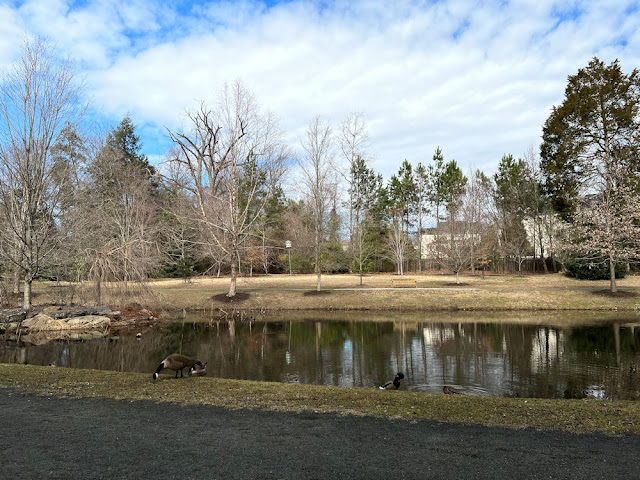
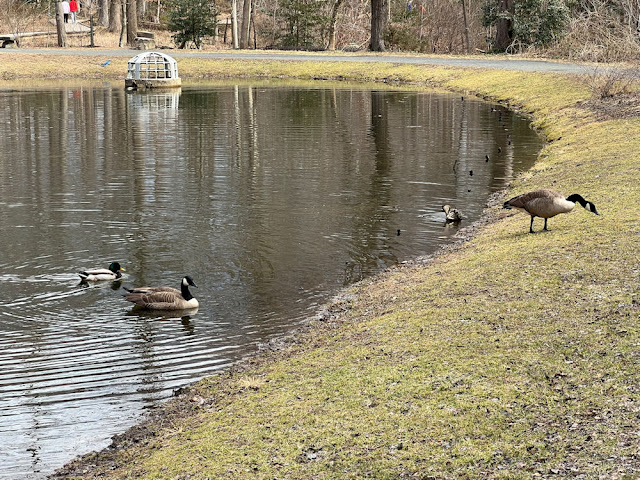
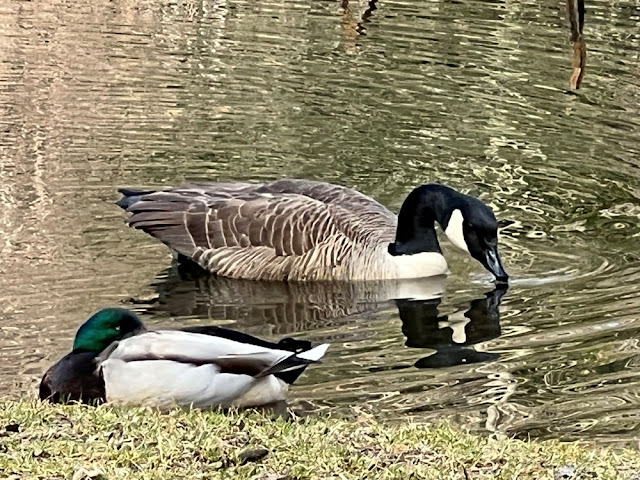
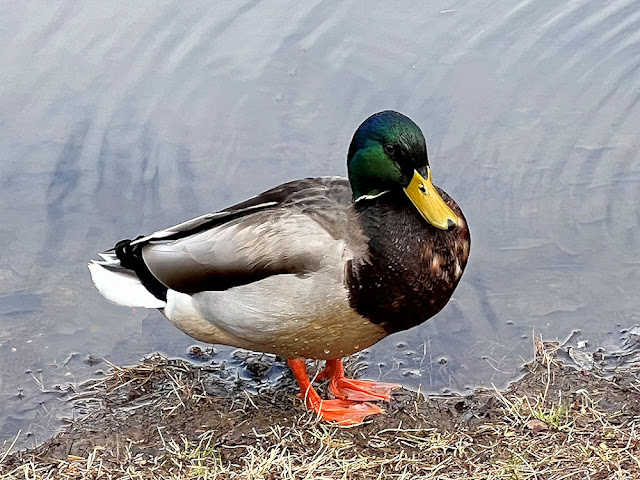
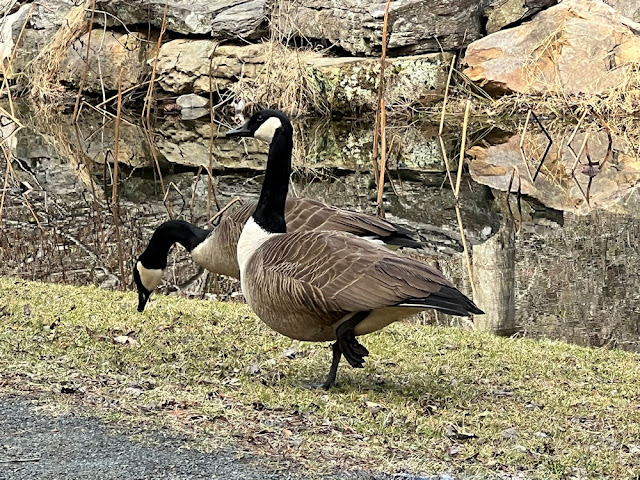
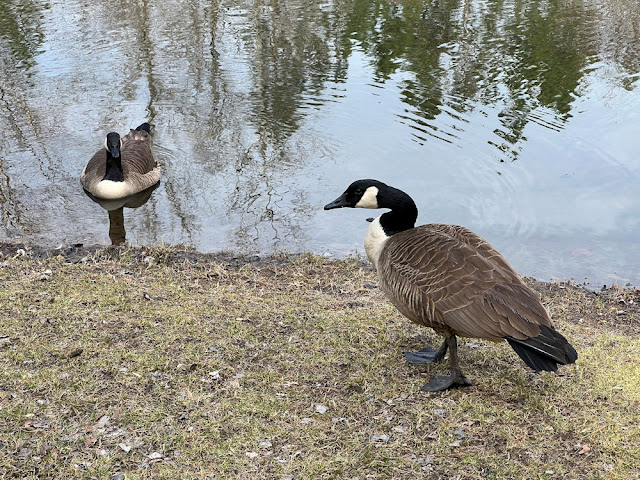
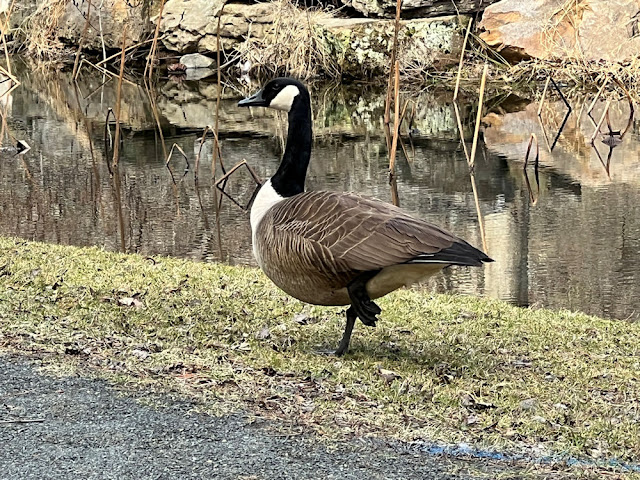
Moving on from my first post at this link if you missed it, we are now near the ponds where I was hoping to see a Great Blue Heron.  We have often seen one there, but not today.  There was a pair each of Canada Geese and Mallards.  They were fun to watch for a while.  I sat quietly on a bench as I took some of these photos. 

The garden was quiet but a lady with her two dogs walked on the other side.  Dogs always start my clicking finger dancing.
The Geese and Mallards seemed very happy to be in each other's company.
Canada geese find mates when they are around two years old, and pairs stay together for the rest of their lives (24 years on average). The birds usually pick partners that are similar to their own body size, a pattern known as “assortative mating.”
 Ducks live between 5 to 10 years. Did you know that the quacking sound that we associate with ducks comes from hens?  Drakes can whistle, growl, croak, purr, squeak, hoot or be totally silent.  
When the baby ducks (goslings as we know them) are still in their shell, they begin to communicate with their parents. They make greeting 'peeps', alarm calls, and high-pitched trills that indicate contentment. Adult calls elicit varying responses from goslings, showing that parents use a number of calls with different names to communicate with their young.
Canadian geese have a long lifespan. As an extreme, some can live up to twenty-four years in the wild, but their first year survival is precarious due to predators.
Geese stand on one leg to regulate their temperature. They are warm blooded and rely on their feathers to keep them warm when temperatures drop. Seeing as their legs have no feathers to keep them warm, they tuck one up to keep themselves a little bit warmer, swapping legs occasionally.

From here the path takes us through a wooded area. It isn’t long before we cross a bridge over a stream, which leads to a fairly steep incline.  At the top is a flat area of the garden.  But I will share that next time.

Thanks for coming with me to the garden. 
Have a great day!