Showing posts with label Swans. Show all posts

Wednesday, February 18, 2026

MUTE SWAN FAMILY

I am very thankful for old photos to share, especially in wintertime when we don't go very far, and as we get older. These were taken in 2014.


I enjoyed reading my notes and had a nice refresher on these elegant birds. 


The male and the female, called cob and pen, usually mate for life, though if something happens to one, the other will find another mate.  


The nest is a huge mound of material, normally dried grasses and assorted vegetation, sticks and rushes, constructed at the water's edge. 


The nest is built by the female, while the male supplies the materials. 


The female lays up to seven eggs between late April and early May. Both sexes incubate the eggs, which hatch after 35-41 days. 


The young birds, or cygnets, sometimes ride on their parents' backs and remain with the adult birds for four or five months. 


Cygnets are generally dingy brown above and whit-ish below. Occasionally, cygnets may be all white and are known as 'Polish swans'. 


The young of some pairs are driven off the breeding territory as soon as their plumage is predominantly white (during late autumn or winter). 


Other broods often accompany their parents to the wintering area and usually join a large flock. They will remain with this flock when the parents return to their breeding territory. 


Young birds will not generally breed for the first two years of adult life.


The oldest ringed wild mute swan was 15 years old.


We had stopped at a lake and there was a family feeding the swans. That's the reason we were able to get these photos.


Mom and Dad were doing a great job taking care of their little ones.


We saw our mute swan family on our way to the airport for the flight home. They were a nice parting gift.


I added my year review on that old post. In 2014 we were in the Everglades in January. In the middle of summer, we had a family reunion where we all attended the Normandy D-Day Anniversary, and then onto England and Norway, the latter being where we saw the family of swans.


We have lovely memories from those times.

Thanks for looking and I hope you have a wonderful day!


Thursday, April 27, 2023

LONDON SIGHTS FROM JUNE 2015

Resharing a few sights around London towards the end of a vacation from several years ago.  Some of you may remember them, but it's been a long time.  It was a very interesting walk around the city, and I like looking back on my old posts.


Thursday, January 5, 2023

UPSIDE DOWN OR RIGHT SIDE UP?


"Each time I see the Upside-Down Man
Standing in the water,
I look at him and start to laugh
Although I shouldn't Oughtter.
For maybe in another world,
Another time,
Another town, 
Maybe HE is right side up
And I am upside down."

~Shel Silverstein~ 


Tuesday, June 14, 2022

WALNEY POND WALK IN MAY

After we had been surprised by our non-Swans (decoys) shared in this post, we did what we usually do, continue our walk around the pond and enjoyed all the other sights.  
If you wanted to get some really good exercise, you would have to walk at a brisk pace along the circular path several times, as I have seen people do.  The pond is relatively small compared to others we have come across.  But there are trails and one we know leads to the visitor center through the woods.
  We noticed the Yellow Flag Iris' were blooming.  They are a lovely sight at the edge of the water.
Yellow flag iris, botanical name Iris pseudacorus, also goes by the following names: Yellow Iris, Water flag, Dragon flower and Paleyellow iris.  
I found a blog at this link, called Botany Karen, where she adds other common names which are very interesting.  One is 'Yellow fleur-de-lis', and she states this name points to the possibility that Iris pseudacorus is the historical inspiration for the heraldic Fleur-de-lis (or Fleur-de-lys), that there is a passing resemblance to the flower’s 3 standards and 3 falls, allowing for some artistic licence she says.
Karen continues, “The Fleur-de-lys’ historical usage is not confined to a single country. Its strongest associations are undoubtedly with France and French royalty through the ages. It traditionally appeared as a yellow symbol on a blue background in France."  And this from me, I can highly recommend taking a look at Karen's blog as there is so much to see, to explore and to learn.
Yellow flag is a flowering perennial plant native to Europe, Asia and Africa.  In temperate climates throughout the globe, yellow flag is cultivated as an ornamental plant, but is considered an invasive aquatic species.  In some regions it can be very invasive and harmful to native species.  It spreads easily due to its floating masses of seeds and long rhizomes, making it very hard to control.  It can also block water flow, affect bird nesting sites, and fish habitats, disrupting and changing entire ecosystems.  

Oh dear!  Well, it didn't seem to be out of control at the pond.  I daresay it is well managed, and I have always loved its presence in blooming season, but certainly these facts should be taken note of.

Other wildflowers we saw were buttercups...along with a couple of bicyclists.  A good day for getting the bikes out.

When I was a child I always loved buttercups, and I still find them pleasing.  When you are a child you don't have a care in the world and certainly don't think of things like how invasive they are.  Before I go on I would like to share another blog I found.  One called Lizzie Harper where you will find various illustrations, one of which is this buttercup.  You can see it here and then if you like, explore further and see the others.   Also more information at this link.
I am finding out about invasive plants today, and this is another one.  They are called Creeping buttercup, botanical name Ranunculus repens.  Common names are also Sit-fast, Creeping crowfoot and Double meadow creeping buttercup.  It is native to Europe, Asia and Northwestern Africa.  These glossy-petaled yellow flowers of the creeping buttercup do, however, aid in the attraction of pollinating insects.
The following is Common vetch, botanical name Vicia sativa.  Its common names are also Garden vetch, Vetch, Garden tare, Summer vetch and Tare.  
It is widely grown as a forage crop or green fertilizer, but common vetch is often considered a weed in garden settings.  However, it seems to be a gardener's friend, as its nitrogen-fixing ability enriches the soil, and it offers food and support for native wildlife.  
The vine-like growth, feathery foliage and purple flowers can be visually attractive.  So, common vetch is ideal for including in native gardens, wildlife gardens and wildlife meadows.  

Hurray for the Common vetch, and a lovely photo can be seen at this link

On that good note and as I don't want to overwhelm, I will finish as I have, surprise, even more photos to share from our time at Walney Pond.  I will be publishing another post tomorrow.


Thursday, June 9, 2022

THE SWAN STORY AT WALNEY POND

Okay, so in yesterday's post I mentioned we had heard about a pair of swans at Walney Pond.  Our neighborhood app was abuzz!   Whenever we read about these things, expectations are kept low, as you just never know.  They could have moved on.
However, inwardly I was getting a wee bit excited, hoping for those swans and who knows, maybe baby swans.  I couldn't help myself.  I ran this whole scenario.   We could see them on the other side of the pond, two small white shapes at this distance. Not wanting to startle them, we made our way around and as we got closer, we slowed our steps.  There were plants obscuring our view somewhat, but that worked to our advantage.  We decided they were blissfully unaware of our presence.There are four types, Mute, Trumpeter, Tundra and Whooper swans.  If you click on their names, the links will take you to the Audubon with more information. 
When I saw these, I wasn't thinking about its particular type.  I thought that could come later.  We stayed in one spot just to observe them. At first, we thought how calm they were.  Gregg said they aren't moving around much.  We peered through those grasses and realized we had discovered a new species.  This species is called Fake Plastic Swan!  Yes, they were decoys and are there to discourage Canada Geese.  We looked at each other and I think I rolled my eyes and Gregg had a chuckle.  It really does pay to keep your expectations on the low side.

Later, after we had finished our walk, we stepped on to the small deck and there was the sign.  We didn't start off there like we usually do, our focus on seeing the 'swans'.  As we were leaving, we were asked by two ladies had we seen them?  We don't play poker, our expressions said it all.  "Well," we said, "they are over there but...."  We didn't have to say any more.  They saw the sign.  "Oh no, they're not real?"  I could tell they were disappointed, and they mirrored each other's eye rolls.  I felt their disappointment.  And next time I really am going to keep my expectations low.

I have more photos from around the pond, as is my way, and I will be sharing those soon.

Thanks for visiting and happy Thursday to you all.


Wednesday, June 8, 2022

A SWAN SIGHTING

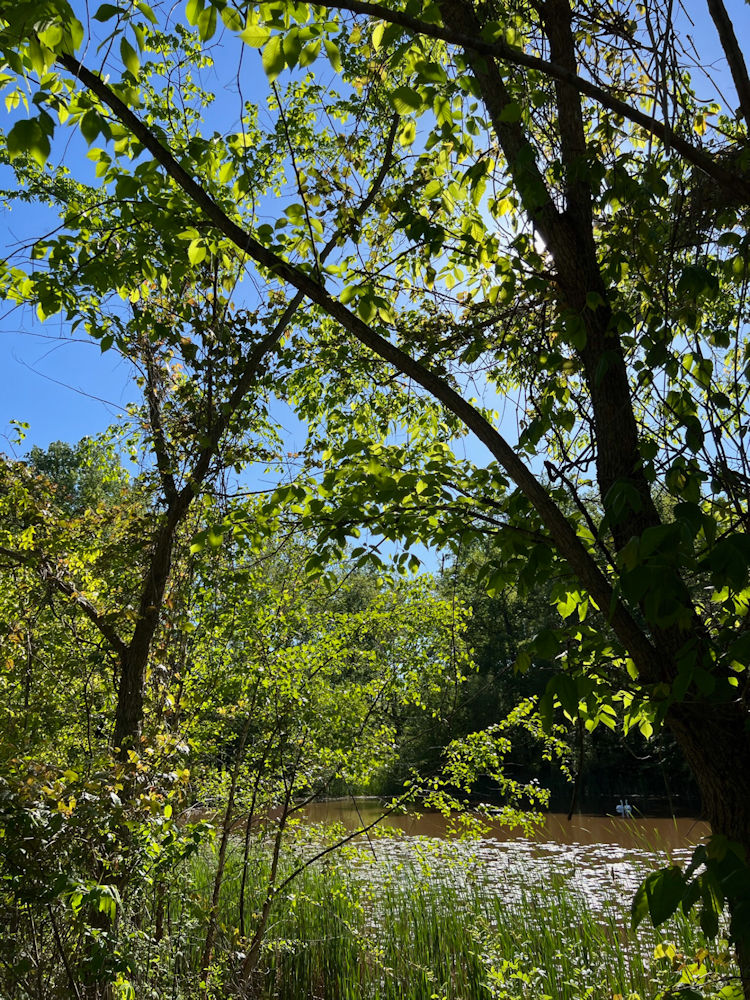
A couple of weeks ago I was reading our local 'Next-Door' app, and someone said they had seen a pair of swans on Walney Pond, and that they were still there the next day.  I told Gregg and he said we should head on over there. I heartily agreed as we had not seen this elegant bird in I can't remember when.  It was a perfect day weather-wise.  However, there is a story about those swans which I will tell you about tomorrow.  

Thanks for dropping in and I hope your day is a great one.