Showing posts with label Queen Anne's Lace. Show all posts

Thursday, November 6, 2025

QUEEN ANNE'S LACE

I can't remember where this bouquet came from, probably a birthday. I really enjoyed the simple color combination of green on white, with yellow here and there and a touch of lavender in the wrapping. It was with other more colorful bouquets and those were lovely too, but this particular one really caught my eye.

The name Queen Anne's Lace, comes from an 18th-century legend that Queen Anne of England was so fond of lace, that she challenged her ladies-in-waiting to create lace as beautiful as the flower.
Another version of the legend says the queen pricked her finger while sewing, and a drop of blood landed on the white lace flower, which is why many blooms have a single dark purple dot in the center.
Queen Anne's lace is the wild ancestor of the modern, domesticated carrot (D aucus carota). The first-year root is edible when young but becomes woody and unpleasant over time, unlike its domesticated cousin. The roots of the plant smell like carrots.

Thanks for looking and wishing you all 
A Happy Thursday!


Thursday, July 11, 2024

MORE FROM OUR MEADOWLARK VISIT ON 6-30-24

You should be able to enlarge all photos to see more detail.

Our main reason for going to Meadowlark, was that I had seen their lilies blooming on one of the local websites. They have a marvelous display of them and it is another favorite area that we make our way to at this time of the year. 

However, with the temperatures soaring we put it off hoping for a cooler day. It became apparent that we were in for several of those high soaring temperature days and, not wanting to miss the lilies, and not knowing how long the blooms would last, I asked Gregg if we could go anyway. 

I promised that it would only be for a short walk, just to see the lilies. His concern is always for me as I don't do well in high humidity. I promised, promised, promised, I would make this a short visit. Normally we usually like to take our time.  Promises, promises! Ah well, if wishes were horses as the old saying goes. We loaded up on water and placed the flasks which I had refrigerated the night before into a backpack. I took along my pretty umbrella for shade...
one of my gifts from son and daughter-in-law. The handle is in the shape of a duck's head. Do they know me? I think very much so, I love it! Off we went, encouraged by the fact that there are several benches under shady trees where we would sit and rest and drink water to keep hydrated, and with the idea of keeping in the shade as much as we could while we walked.  The first three lily photos are a little pre-show, and I will share a post of them on their own shortly. In the meantime, here is a website you can look at that will show how to care for them. I will need this one day as I have in mind to plant a whole border of them in the back.
There was a most beautiful and large display of Queen Anne's Lace (you can see a short video, plus a photo from my post here if you missed it). I have never seen this many in a single flower bed at the garden. They were an absolute delight. 
Other names are Wild carrot, Bishop's Lace, Bird's nest and Bee's nest. Its botanical name is Daucus carota. Originally native to Europe and Asia, it has spread to North America and Australia. 
I had only ever seen the white kind before, and not this different pink shade.

Apparently, it is very similar in look to Poison hemlock and this website tells you the difference.  According to what I read, "The most apparent difference between the two plants is their height. Poison hemlock grows much taller than Queen Anne's Lace and appears earlier in the year. While Queen Anne's Lace doesn't grow much taller than three feet, poison hemlock can grow to ten feet. Another distinction between the two is their stems. Poison hemlock stems are smooth, while Queen Anne's Lace stems are covered with tiny hairs.”  If you want to know more there is a lot of information at the above link.
Studies of historical paintings suggest that the carrot was cultivated in Turkey, Spain and North Africa for centuries.
 Many scholars believe that it is the ancestor of all hybrid carrots. The specific epithet, "carota' is derived from the Greek word karoton, meaning carrot. As it is often grown in the wild, so it is called wild carrot.  
This flower when in full bloom looks similar to the actual Queen Anne's lace, which is one of the prestigious clothing accessories. 
“A tiny red flower can sometimes be seen in the center and is thought to represent a blood droplet in which Queen Anne accidentally pricked herself with a needle while making the lace. Hence, it is called Queen Anne's lace.” The ones I saw on this day didn't have this tiny red flower, but I remember taking a photo once of one that shows it. I have been trying my best to look for it to share today, but no luck yet. A last photo of a patch spotted across one of the lakes.
The purple flowers below are called “Dense blazing star, also known as Marsh blazing star, Button snakewort and there are others. Its botanical name is Liatris spicata. It is a flowering plant native to eastern North America, and comes from the same genetic family as sunflowers and daisies. It is a popular choice for a variety of pollinators such as bees and butterflies. They are said to have rather exacting demands on the soil, but benefit the local ecosystems by attracting scores of pollinating insects. It can be found in meadows, marshes, savannahs, damp slopes and poor dry ridges.” I usually find all my information on these flowers from my plant app, Picture This.  I am also sharing a website which you can look at here. It is from the Wellfield Botanic Garden in Elkhart, Indiana.
This is my last flower photo today. More to follow as soon as I can share another post. 

Below I have added our forecast from July 10th to the 18th. We won't be going on any long walks for a while. I understand people have it much hotter than us, so please stay safe and cool.


Thanks for looking and, happy Thursday!
Hopefully this will give you a smile, a little humor with a point.


Wednesday, September 13, 2023

A FEW FLOWERS

I wrote all about Queen Anne's Lace at this post.  Whenever I see it blooming I always take photos.  I don't have to go too far to see these.  All the information about this flower you can find at the above link.

Next come the Black-eyed Susans.  I shared the following photo that I turned into art, which you can see here.

And another from the same area at this link where I share info about the Lazy Susans.

I love the look of Lazy Susans.
This is a favorite photo of one of the windows at the visitor center.  Those aren't birds flying around as I first thought. I took a quick look from a little distance away.  They are stickers to safeguard our feathered friends.
Not sure what the next one is.  My plant app gave me another name.  I rarely find myself doubting them but as I didn't have much surrounding for them to clue in on, leaves and whatnot, my Doubting Thomas radar kicked in.  They told me it was Western-purslane.  I don't think so.  Who knows, it could even be a coneflower!   Maybe one of our more knowledgeable blogging friends will be able to give its form a correct identification.
That's all for today.

Thank you for visiting and I hope your week is going well.


Tuesday, August 22, 2023

QUEEN ANNE'S LACE

My photos were taken along Skyline Drive.


The following is its story: 

Queen Anne of Great Britain was tatting white lace. (Tatting is the art of making lace by hand.) The beautiful white lace she was tatting became the white lacy flowers of the wild carrot plant. She pricked her finger and one drop of blood oozed out. This became the central dark red or purple sterile floret that is present on some, but not all, of Queen Anne's Lace flowers.

Legends disagree as to which Queen Anne was tatting such lovely lace. Some say it was Anne (1574 - 1619), the first Stuart Queen Anne, who was brought over from Denmark at fourteen years of age to be a Queen to King James of Scotland. Others argue it was Anne (1665 - 1714), the daughter of William and Mary, and the last monarch in the Stuart line. Both died in their forties.


Her lawn
looks like a meadow, 
And if she mows her place
She leaves the clover standing
And the Queen Anne's Lace.

~Edna St. Vincent Millay~


This is from one of my older blog posts.  We were on Skyline Drive.  Wherever we looked there were hundreds of these pretty wildflowers. The one above and below has a little visitor.  I thought the ant was special, it looked almost metallic.


It has another name besides Queen Anne's Lace and Wild Carrot.  It is also called Bees Nest, with a botanical name of Daucus carota.  It usually blooms mid and late summer and early fall.


Thursday, June 30, 2022

SKYLINE DRIVE 5-17-22 and 9-9-21

We can reach Skyline Drive under an hour and have often taken a picnic with us.  We don't use any of the designated picnic areas (which are further inland with no view and can be quite busy). Instead, we find a wall to sit on at one of the overlooks, where we have these magnificent views.  The times we go we have, more often than not, had these places to ourselves, avoiding weekends and busy holiday times.  
We didn't take many photos on this trip.
This is one of the parking areas (overlooks). 
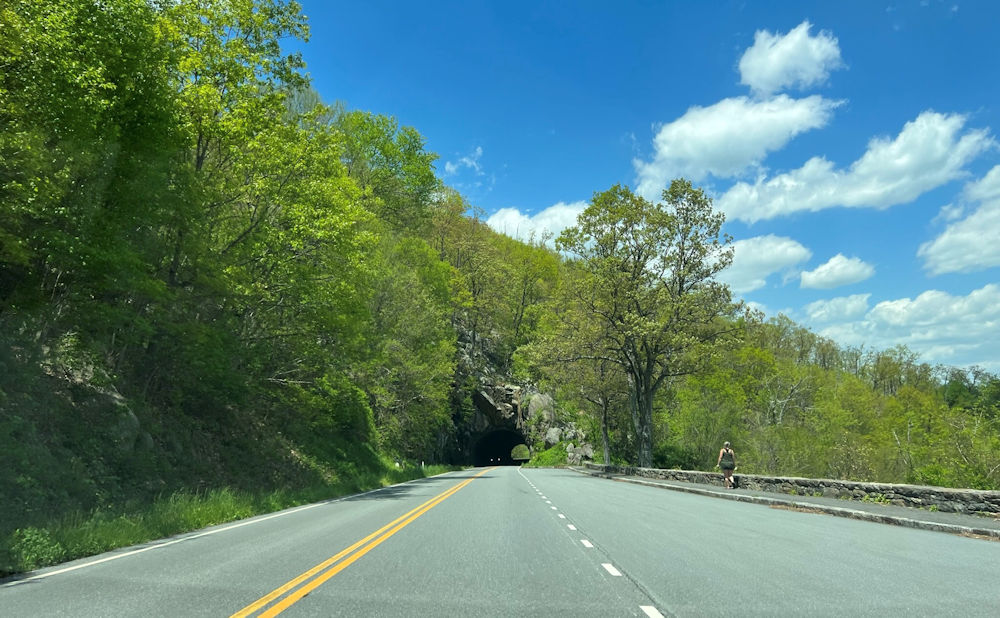
We are approaching Mary's Tunnel.  You can read about it here.  This website gives information on all the overlooks found on Skyline Drive.
The tunnel was constructed in 1932, is 610 feet long and 12 feet 8 inches high.  
The mountain that the tunnel goes through is actually called Mary's Rock.  It is 3514 feet high.  It is the 8th highest peak in Shenandoah National Park.
You can read a few stories of how Mary's Rock was named here.  Scroll down a little until you come to Legends of Mary's Rock.

I found the rest of the photos a few days ago. They were in draft folder from September 2021.  I couldn't see them from any other posts when I checked, so I don’t think I published them before.  The Queen Anne's Lace were seen on a walk at Big Meadows   

I won't go into detail about them today.

The bug below is a Goldenrod Soldier Beetle.  Though they feed on nectar and pollen, the goldenrod soldier beetles do not chew the flower petals or damage them. These harmless beetles neither sting nor bite.

On the other hand, the bug below is a Japanese Beetle and is a species of scarab beetle.  It is not a gardener's friend as they are very destructive and can completely defoliate plants.
This is the Oxe Eye Daisy.  I actually like this plant very much and was thinking of putting it in the garden.
The Soapwort was growing wild.  I have been leaving links in all my posts, usually on the name.  If you click on these links, they will take you to more information.  
A misty view on one of the overlooks we stopped at (this being in September of 2021 as mentioned above).
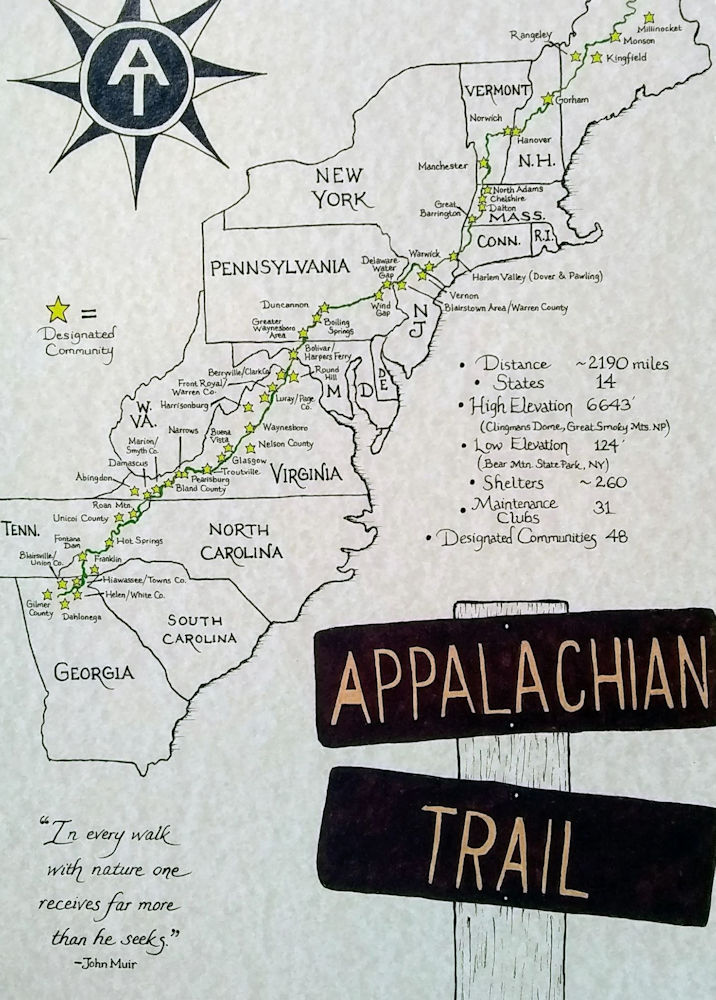
Next is a marker pointing to the Appalachian Trail.  The trail is approximately 2,178 miles long and is the longest 'marked footpath' in the United States.  If you are an adventurous hiker, this trail stretches from the summit of Springer Mountain in Georgia, all the way to the top of Mount Katahdin in Maine.  
If you hiked the entire Appalachian Trail, you would pass through 14 states and take around 5 million steps.  About 500 people hike the whole trail each year.  
Virginia is home to 544 miles of the Appalachian Trail, which is more miles than any other state. 
We found part of the trail at the back of Big Meadow's Lodge and walked a couple of miles, which was great.  I remember the beautiful wildflowers in bloom, but the most memorable happening was when I saw this beautiful deer standing on the incline above us.  She was quite close, not more than 15 feet away.  I took this photo with my cell phone.  She didn't move and we slowly walked on as she continued to munch on the grasses.
Skyline Drive is 105 miles long and takes about three hours to drive along its entire length.  The speed is 35 miles per hour in most places.  It is a very winding road and there are often steep drops.   (You also have to pay attention to any wild animals, as in our time there we have seen deer and bear.  They appear as if suddenly out of nowhere crossing the road in front of us.)  The map shows you its route.
Cell coverage is not reliable throughout most areas of Shenandoah National Park. However, I read that it is generally available at Dickey Ridge Visitor Center and at some west-facing overlooks. Free, public WiFi is available at Byrd Visitor Center, Big Meadows Lodge, and Skyland Resort.
We didn't get to Big Meadows Lodge on this trip.  Above is a postcard I bought, a reproduction of one of the earlier ones.  There are rustic rooms and cabins you can rent here, and we stayed two nights in the main lodge.  It was a very nice experience, and there is a gift shop where I have treated myself to souvenirs every now and again, local honey or jam, a bear ornament, greeting cards or postcards.  We were able to get down to Big Meadows to see the sun rise on that stay, and it was wonderful.  Hopefully we will be able to do this again one day.

That's all of Skyline Drive for now.