Showing posts with label Meadowlark Gardens-Vienna-Virginia 6-30-24. Show all posts

Wednesday, July 17, 2024

MORE FROM MEADOWLARK GARDENS ON 6-30-24

 I found this pretty little red flower very easily. It really popped out against the vibrant lush green fauna as I was walking along the path. It is the Florida tasselflower. I have never heard of it and if I have seen it before, have never noticed. It is also known as Cupid's shaving-brush, Red Florida tasselflower and one more, Flora's paintbrush, with a botanical name of Emilia fostbergii. Thankfully non-toxic to humans and pets. 

A member of the sunflower family, it is a common yard weed. Although many dislike seeing these pop up in their lawns, the pollinators are very attracted to its small bright red flowers. It reseeds itself easily with dandelion-like fluffy seeds and can become invasive if not removed. Unusual for me, I only took one photo instead of my usual dozen or so! Who shouts "Hurray to the digital age?" My one photo will have to do this time, I am blaming it on the heat.

I enjoyed seeing the Cardoon. Its other names are globe artichokes, Prickly artichoke and Cardy, with a botanical name of Cynara cardunculus. I have shared it before but maybe I missed some information. I would have to check with previous posts to find out, so at the risk of repeating myself: It was first brought to the United States by Spanish and French settlers in the middle of the nineteenth century. It was popular in ancient and medieval Greece, Rome and Persia, and appears in written records from as early as the 4th century BC.


They are edible but I have no clue how to prepare them and I am going to have to go to bed soon as it has been a long day. Next time I photograph them I will delve into that side of things more thoroughly, but there is plenty of information online if you want to do a search. I did learn that they are an ingredient in one of Spain's national dishes - cocido madrileƱo - and have long been an important part of the Christmas meal in Spain's northern regions, and at least one Italian region. Also, Cardoon flowers are used as a vegetable rennet in some traditional Spanish and Portuguese cheeses.


You have to be careful when handling them because of those nasty looking spines, so it would be wise to wear gloves. There is lots of information in the link below my first photo of the Cardoon, if you would like to find out more. They towered above me, are said to grow 3 feet to 6 feet but these seemed much taller. In the winter finches eat the seeds and then when spring appears, if any of the soft down remains, it may be used to line nests.


When they bloom, bees and other pollinators will visit them. The bees were very busy when we were there. The flowers produce lots of pollen and nectar between June to September.  I certainly enjoyed watching the bees for a while. I always find them fascinating little creatures. There were two types of bee, the smaller one remained elusive and the bigger of the two was easier to photograph.


One last little bee plus the tiny insect in the top middle of the photo.  That's as close as I could get.


And finishing off with a photo of the two of us (at the beginning of our walk). We didn't take our usual long one around the garden because of the heat, but even so we had a very enjoyable time. We just have to pace ourselves more and know when to quit!  Me and the mouse in my pocket that is, as Gregg is a Virginia boy and can take these high temperatures. I on the other hand wilt like a lettuce, and that hasn’t changed since we started married life at our apartment in Alexandra, Virginia. The following year when my family visited in the height of summer, they were the same. How about you, can you handle humidity?


I always have more photos to share from the garden, but I will give this one a rest for a while. It is also getting late and it's time to put my laptop to bed. 

Thanks for looking everyone, 
and have a great Wednesday.


Friday, July 12, 2024

THE DAYLILIES AT MEADOWLARK BOTANICAL GARDEN ON 6-30-24

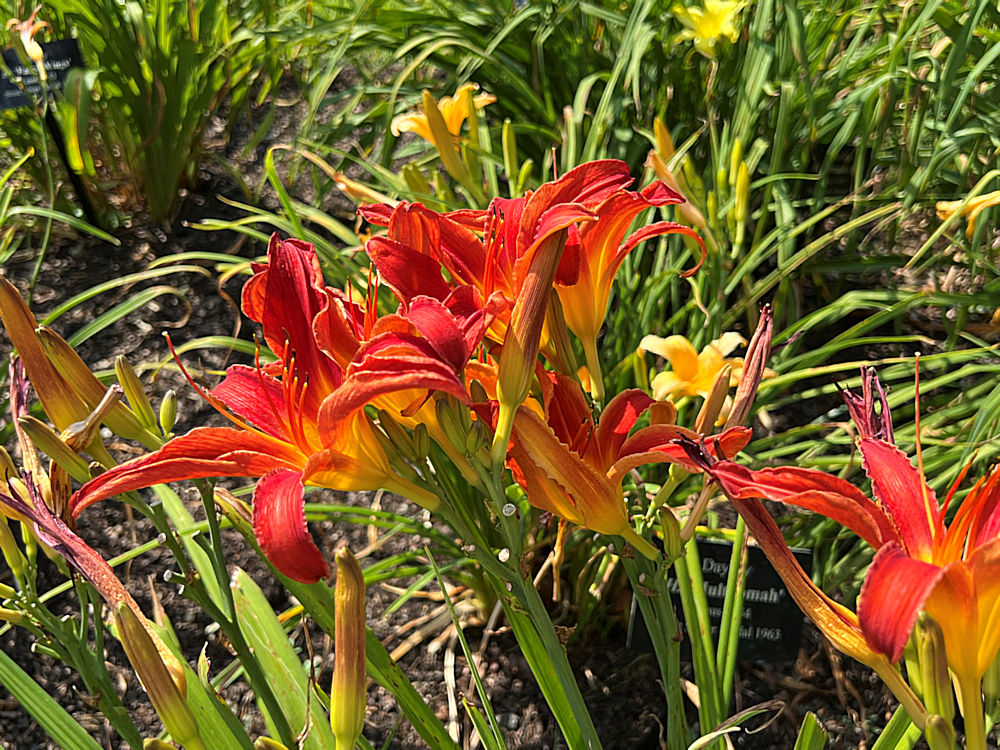
 I am sharing many, many Daylilies.  I identify if an ID is shown but please let me know if you think any are misidentified. It might be a simple case of one marker being too close to another with different names. Some are very similar to each other, or I might not have seen a marker at all. Feel free to jump in if you have a positive ID, one in your garden perhaps. I am learning as I go along.


I am including this website as it has eight interesting facts about this flower. For instance, it says that there are over 80,000 varieties.


Did you know that Daylilies are not actually lilies? I read, "Daylilies are in the genus Hemerocallis, which is a member of the family Asphodelaceae, and subfamily Hermocallidoideae."

True lilies, on the other hand, are in the genus Lilium, family Liliaceae, and subfamily Lilioideae. So when you are shopping for daylilies, you will notice this. All of the botanical names will start with that genus name "Hemerocallis," no matter the type. You know you are looking at a true lily if the botanical name starts with "Lilium."

There is a very nice pdf file for reading on the garden and the daylilies here. Also I was very curious about the origins of the Stout Garden and found the following information at this website. I read:

"We owe the modern fame of the daylily, Hemercollis, to a single man whose work at The New York Botanical Garden birthed an industry. Arlow Burdette Stout (1876-1957) was a research scientist, geneticist and daylily hydrbidization specialist. His career at the New York Botanical Garden spanned nearly four decades (1911-1947) where he served as Director of Laboratories and later Curator of Education and Laboratories."

"Dr. Stout was internationally known for his achievements in plant genetics. His research at the NYBG led to important advances in the development of daylilies. Before Stout, a habit of self-sterility in daylily species (an inability for a flower to pollinate itself) made it difficult to propagate them without failure. Nearly 50,000 cross-pollination experiments later, stout had all but reinvented the flower. He developed over 100 registered daylily cultivars of lasting horticultural value."

Above Webster's Pink Wonder.


As you can see, there were several I couldn’t name. If you have them in your garden, please would you let me know?  Thanks in anticipation.


The ID marker with this beautifully colored daylily is called H. 'Bess Ross' - Claar 1951 - Stout Silver Medal 1962.


The marker for this one above and below read "Daylily - H. 'Little wart' - spalding 1964"


Above and below, "Daylily - Frozen Jade"


I was happy to find out that daylilies are drought tolerant, each one said to having "low" water needs. It has tuberous roots and these can store enough nutrition and moisture to get it through periods of dought.


Above and below, Daylily Peggy Jeffcoat.


Probably a daylily overload but I wanted to get them all in one post. 


Thursday, July 11, 2024

MORE FROM OUR MEADOWLARK VISIT ON 6-30-24

You should be able to enlarge all photos to see more detail.

Our main reason for going to Meadowlark, was that I had seen their lilies blooming on one of the local websites. They have a marvelous display of them and it is another favorite area that we make our way to at this time of the year. 

However, with the temperatures soaring we put it off hoping for a cooler day. It became apparent that we were in for several of those high soaring temperature days and, not wanting to miss the lilies, and not knowing how long the blooms would last, I asked Gregg if we could go anyway. 

I promised that it would only be for a short walk, just to see the lilies. His concern is always for me as I don't do well in high humidity. I promised, promised, promised, I would make this a short visit. Normally we usually like to take our time.  Promises, promises! Ah well, if wishes were horses as the old saying goes. We loaded up on water and placed the flasks which I had refrigerated the night before into a backpack. I took along my pretty umbrella for shade...
one of my gifts from son and daughter-in-law. The handle is in the shape of a duck's head. Do they know me? I think very much so, I love it! Off we went, encouraged by the fact that there are several benches under shady trees where we would sit and rest and drink water to keep hydrated, and with the idea of keeping in the shade as much as we could while we walked.  The first three lily photos are a little pre-show, and I will share a post of them on their own shortly. In the meantime, here is a website you can look at that will show how to care for them. I will need this one day as I have in mind to plant a whole border of them in the back.
There was a most beautiful and large display of Queen Anne's Lace (you can see a short video, plus a photo from my post here if you missed it). I have never seen this many in a single flower bed at the garden. They were an absolute delight. 
Other names are Wild carrot, Bishop's Lace, Bird's nest and Bee's nest. Its botanical name is Daucus carota. Originally native to Europe and Asia, it has spread to North America and Australia. 
I had only ever seen the white kind before, and not this different pink shade.

Apparently, it is very similar in look to Poison hemlock and this website tells you the difference.  According to what I read, "The most apparent difference between the two plants is their height. Poison hemlock grows much taller than Queen Anne's Lace and appears earlier in the year. While Queen Anne's Lace doesn't grow much taller than three feet, poison hemlock can grow to ten feet. Another distinction between the two is their stems. Poison hemlock stems are smooth, while Queen Anne's Lace stems are covered with tiny hairs.”  If you want to know more there is a lot of information at the above link.
Studies of historical paintings suggest that the carrot was cultivated in Turkey, Spain and North Africa for centuries.
 Many scholars believe that it is the ancestor of all hybrid carrots. The specific epithet, "carota' is derived from the Greek word karoton, meaning carrot. As it is often grown in the wild, so it is called wild carrot.  
This flower when in full bloom looks similar to the actual Queen Anne's lace, which is one of the prestigious clothing accessories. 
“A tiny red flower can sometimes be seen in the center and is thought to represent a blood droplet in which Queen Anne accidentally pricked herself with a needle while making the lace. Hence, it is called Queen Anne's lace.” The ones I saw on this day didn't have this tiny red flower, but I remember taking a photo once of one that shows it. I have been trying my best to look for it to share today, but no luck yet. A last photo of a patch spotted across one of the lakes.
The purple flowers below are called “Dense blazing star, also known as Marsh blazing star, Button snakewort and there are others. Its botanical name is Liatris spicata. It is a flowering plant native to eastern North America, and comes from the same genetic family as sunflowers and daisies. It is a popular choice for a variety of pollinators such as bees and butterflies. They are said to have rather exacting demands on the soil, but benefit the local ecosystems by attracting scores of pollinating insects. It can be found in meadows, marshes, savannahs, damp slopes and poor dry ridges.” I usually find all my information on these flowers from my plant app, Picture This.  I am also sharing a website which you can look at here. It is from the Wellfield Botanic Garden in Elkhart, Indiana.
This is my last flower photo today. More to follow as soon as I can share another post. 

Below I have added our forecast from July 10th to the 18th. We won't be going on any long walks for a while. I understand people have it much hotter than us, so please stay safe and cool.


Thanks for looking and, happy Thursday!
Hopefully this will give you a smile, a little humor with a point.