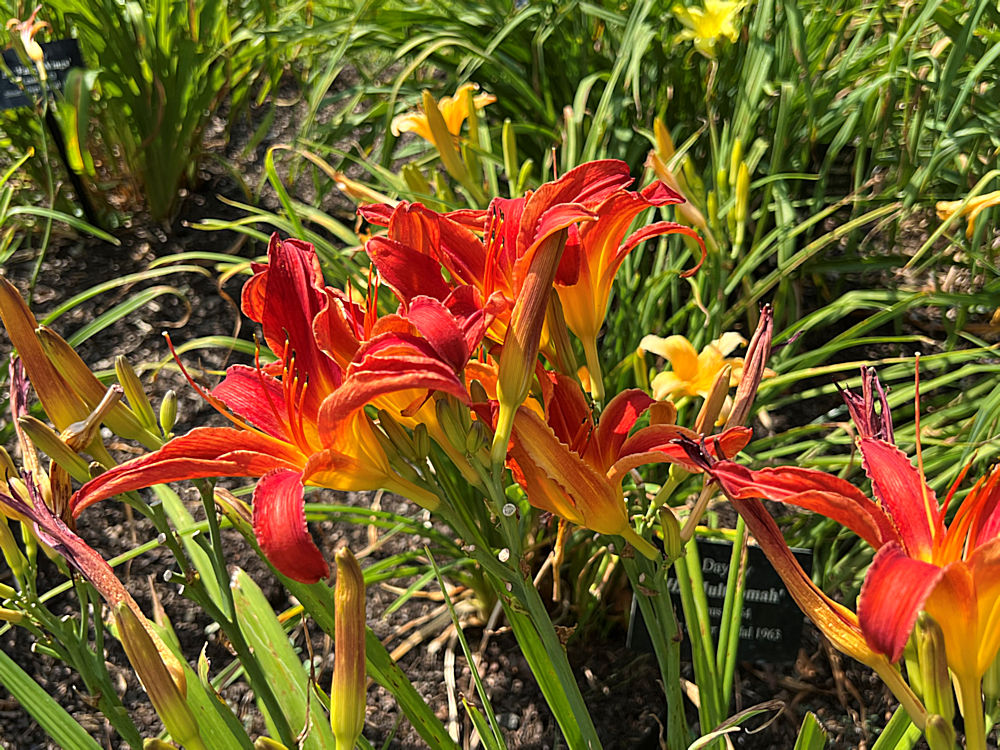
I am sharing many, many Daylilies. I identify if an ID is shown but please let me know if you think any are misidentified. It might be a simple case of one marker being too close to another with different names. Some are very similar to each other, or I might not have seen a marker at all. Feel free to jump in if you have a positive ID, one in your garden perhaps. I am learning as I go along.

I am including this website as it has eight interesting facts about this flower. For instance, it says that there are over 80,000 varieties.

Did you know that Daylilies are not actually lilies? I read, "Daylilies are in the genus Hemerocallis, which is a member of the family Asphodelaceae, and subfamily Hermocallidoideae."

True lilies, on the other hand, are in the genus Lilium, family Liliaceae, and subfamily Lilioideae. So when you are shopping for daylilies, you will notice this. All of the botanical names will start with that genus name "Hemerocallis," no matter the type. You know you are looking at a true lily if the botanical name starts with "Lilium."

There is a very nice pdf file for reading on the garden and the daylilies here. Also I was very curious about the origins of the Stout Garden and found the following information at this website. I read:
"We owe the modern fame of the daylily, Hemercollis, to a single man whose work at The New York Botanical Garden birthed an industry. Arlow Burdette Stout (1876-1957) was a research scientist, geneticist and daylily hydrbidization specialist. His career at the New York Botanical Garden spanned nearly four decades (1911-1947) where he served as Director of Laboratories and later Curator of Education and Laboratories."

"Dr. Stout was internationally known for his achievements in plant genetics. His research at the NYBG led to important advances in the development of daylilies. Before Stout, a habit of self-sterility in daylily species (an inability for a flower to pollinate itself) made it difficult to propagate them without failure. Nearly 50,000 cross-pollination experiments later, stout had all but reinvented the flower. He developed over 100 registered daylily cultivars of lasting horticultural value."

Above Webster's Pink Wonder.




 The first three lily photos are a little pre-show, and I will share a post of them on their own shortly. In the meantime,


