Showing posts with label Pansies. Show all posts

Monday, March 6, 2023

LAST SATURDAY WE WENT OUT FOR A WALK - PART 1

 the first one in a while.  It was gloriously sunny at Green Spring Gardens, but windy and very chilly.  We cut our walk down by half.  However, it was a good start, and enjoyable seeing what was blooming in the garden.  


The flowers were putting on a good show in front of the old house.


Good to see the Daffodils, along with the Wild pansy.  


The pansy's botanical name is Viola tricolor but is also known as Johnny jump up, Jack-jump-up-and-kiss-me, Heartsease, Come-and-cuddle me, Love-in-idleness, Tickle-my fancy, Pansies and Three faces in a hood.   Have to say, all these names made me smile.  Its flowers are edible and can be consumed in salads, drinks or used as a garnish, though they are best eaten only in small amounts.  Important to note that for consumption, they should only be eaten if organically grown with no pesticides.

These next photos are of the Lenten Rose.

Its botanical name Helleborus orientalis.  Also known as the Christmas Rose and Helleborus.

It belongs to the buttercup family, a perennial and can be grown in the shade but preferably needs three hours of light a day. 

It has been cultivated in Germany since the mid 1800s, with varieties created in the United Kingdom shortly after.  

Between the 1920s and 1960s there was little interest in its cultivation until Helen Ballard bred new varieties.  

They bloom early in the year, hence they get their name, "Lenten rose".


Next is the Japanese apricot.  I noticed its pretty bloom growing out of the tree trunk.  There were several others on the branches.  Its botanical name is Prunus mume.  Also known as Chinese plum, Mume, Plum blossom and Flowering apricot. 


A deciduous tree which can grow from 13 to 33 feet tall, and its blooms have a strong, fragrant scent.  You will see it flowering in late winter and early spring.  They have a long life and can live up to 100 years old, but still much shorter than some trees.  There are over 400 species in the Japanese apricot family, from plum trees and almonds to pin cherry shrubs.  


“Flowers are a proud assertion that a ray of beauty out values all the utilities in the world.”

~Ralph Waldo Emerson~


Wednesday, May 18, 2022

THE FAIRY GARDEN AT MEADOWLARK GARDENS 5-5-22 - AND A WHIMSICAL TALE

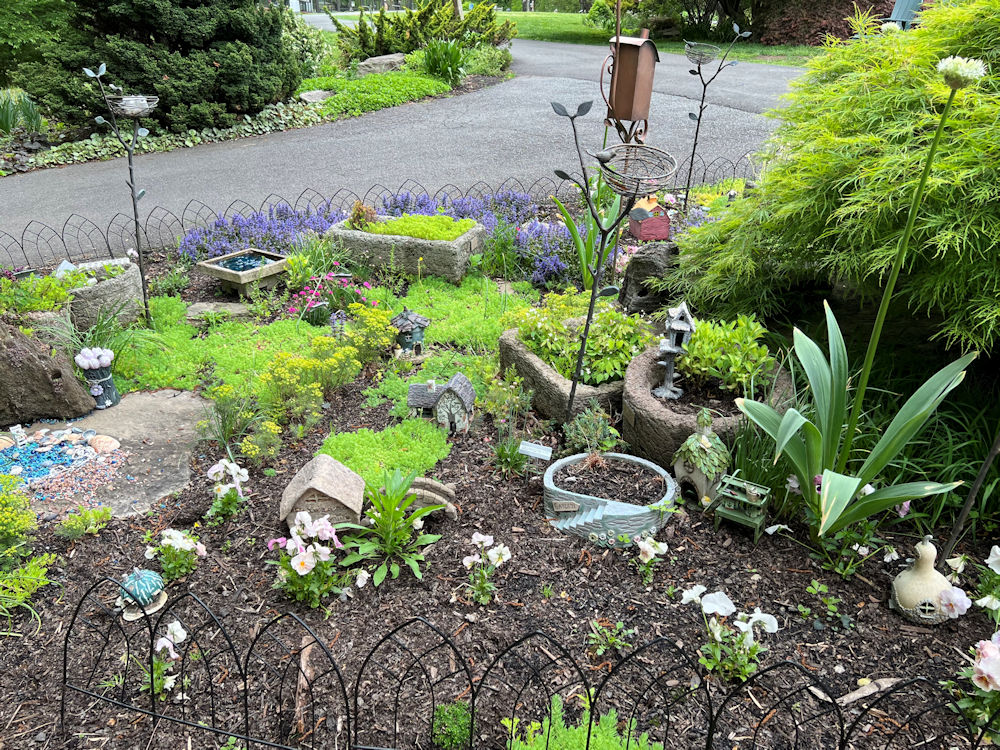
There were a few old friends here, and a few new ones.  It was good to see the Fairies back after their winter sleep.
"A rustle in the wind reminds us, a fairy is near."  I don't know who the author is of this quote, but there's been a lot of rustling lately.
The three Graces were out in front of their tiny houses, chatting away.
Mommy Fairy was listening to her son about his day in Fairy School, while waiting for dinner to finish cooking.
The frogs had gone back to the lily pads for a rest, but other help had arrived to take care of things. 
 A Little Brown Skink was on guard.   
The Fairies appreciated it taking care of them while the frogs were away.
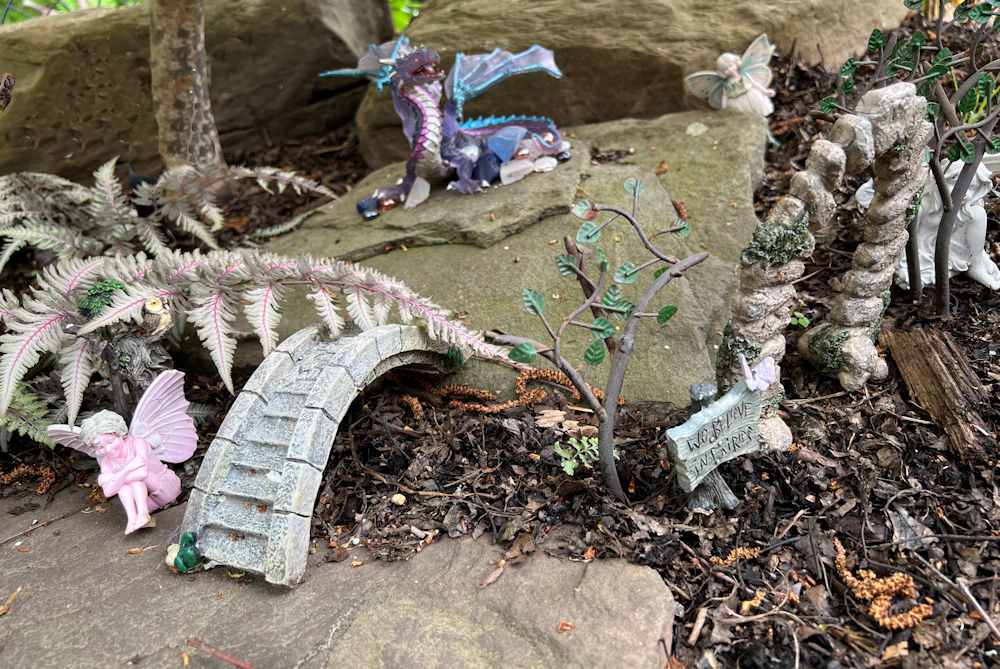
The Dragon also made an excellent guard.
He looked fearsome and could be if needed but, was also gentle and kind.
He had adopted the Fairies and they were his family. 
The Queen of the Fairies could also be fearsome to protect her young...don't mess with that fairy stick!
The Flying Pig and other Piggies were standing guard...
 also the Jolly Gnomes.  
And listen carefully...
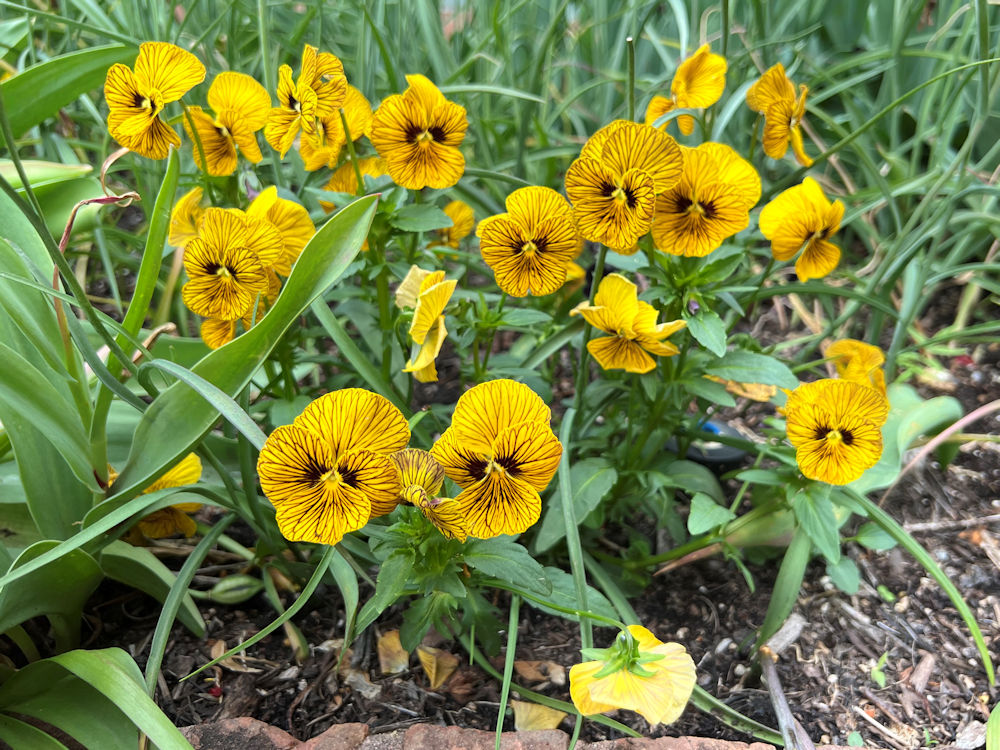
soft, musical notes are coming from the pansies...
These pansies were singing a different tune.  Yes, different but all flowers grow in the same soil, where music is One...
and when combined, their notes sing the promise of peace all throughout the Fairy Kingdom.

And so it goes in the Fairy Garden.  


Wednesday, March 30, 2022

GREEN SPRING GARDENS ON MARCH 20TH, 2022 - PART 1

We come here often for our walks, as you will see from all the blog posts I have made from the beginning. You can visit those if you click on the garden's name among the labels at the end of this post (too many to view in one sitting truth be told).  If you are ever in the area and would like to visit, I am including their address this time, and also with a map below:

Green Spring Gardens, 4603 Green Spring Rd, Alexandria, VA 22312

There is also a very cute YouTube video I just found, of a walk around the garden, seen from the eyes of a Shebainu.  A very cute dog!  You can see it here.  And talking about dogs, here are four that we saw being walked around the large green.  They were cute too!

As mentioned in my previous post I stopped off at the Edgeworthia chrysantha plant, to see how it was progressing bloom-wise.
   I can be seen on the other side of the plant as Dear Other Half takes a photo.  He takes many of our photos during visits to parks.  I always enjoy seeing what catches his eye on our walks.  This time it was me plus plant.  He uses our larger camera with the zoom lens.  It gets too heavy for me and he carries it most of the time, until I see something like a bird, when I ask for it back.  I take a lot of my photos now with my cell phone.
The plant is not too far from the visitor center.  
At this link I read, "Edgeworthia chrysantha, commonly called paperbush or edgeworthia, is a deciduous suckering shrub that typically grows to 4-6’ tall and as wide. It is native to woodland areas in the Himalayas and China. Short-stalked, lanceolate-oblong, dark green leaves (to 3-5” long and 2” wide) are crowded near the branch ends. Alternate, narrow-oval, dull dark green leaves (to 5” long and 2” wide) are gray-green beneath. No fall color." 
"Young leaves are covered with silky white hairs. Tiny, apetalous, tubular, yellow flowers are compacted into dense, rounded, umbelliferous flower heads (up to 40 flowers per head). Flower buds begin to form in late summer each year, overwinter on the bare stems and burst into bloom from late February to early April before the new leaves emerge. 
Silvery winter flower buds and brown branching are ornamentally attractive. Fruits are dry drupes."  I may be repeating some of the information from a previous post, as I have shared several, but sometimes it is easier to repeat than to look back at the others.
There were freshly planted pansies at one of the entrances... 
and other areas.
The blossoms of the pansy are edible, and are being used for cake decorating and cocktail garnishes.  I think it is very important to note though, and probably goes without saying but I'll say it anyway, that anything we might use for such things, should have been grown without pesticides, or indeed anything that would pass on any toxicity.  I have, some time ago now, seen small containers of pansy petals in supermarkets.  I bought one two or three years ago and used them for a salad.  They looked pretty but I never thought to buy them again.  My curiosity was satisfied.  I thought at the time I would rather see them growing in the garden.
Apparently both the blooms and the leaves are edible and high in Vitamins A and C.  The description I read about them said they taste like a slightly floral version of lettuce.  (I can't remember what they tasted like.)  The flowers can also be used to make syrup-flavored honey and used as a natural dye.   (There were other flowers blooming, but I am going to put those in my next post.)
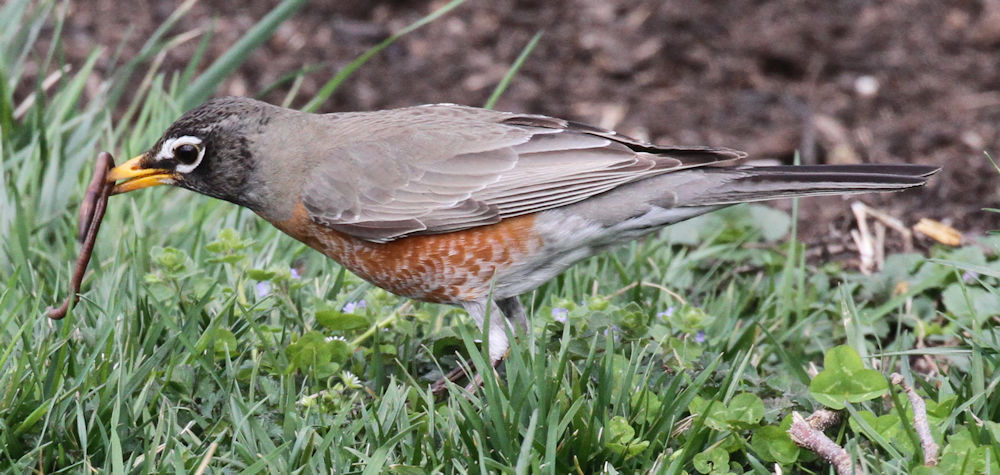
The only bird that came close enough to photograph was this American Robin digging for its lunch, a worm.  Below, in the top left photo of my collage, you will notice that the robin's eye seems to be opaque.  I smiled at the description found on the Audobon page where the title reads, "Birds Have Built-in-Goggles" and goes on to say that "A third eyelid provides the extra protection needed to fly and hunt". The article goes into more detail which you can read at this link.  
It further goes on to say, "...beneath the outer eyelids lies an extra eyelid, called the nictitating membrane. Nictitating, for all its alliterative syllables, simply means “blinking”. This extra eyelid is hinged at the inner side of the eye and sweeps horizontally across the cornea. The nictitating membrane is largely transparent, and it helps keep the eye moist and clean while guarding it from wind, dust, and hazards."  It is a very interesting article and worth reading

As I usually do, I have more photos to share from our walk, but will post those next time.  Thank you for walking with us, and I hope your day is a great one.