It was lovely seeing flowers blooming around the garden. Crocus, for instance, was putting on a lovely show. These are Woodland crocus, other names Tommasini's crocus, Tommies and Early crocus. Its botanical name is Crocus tommasinianus. Woodland crocus should always be planted in the fall. You will see its blooms from late winter to the spring. If you go to this link it will tell you how to grow and take care of them.
Next are the snowdrops. They are quite sturdy and are one of the only flowers
that thrive in winter. You will often see them poking through when the snow melts. They make a lovely sight don't they? I am always interested in other names for all flowers, including the botanical ID, which is Galanthus nivalis for the snowdrop. Those other names are Common snowdrop, Fair maids of February, Little sister of the snows, Purification flower, Candlemas bells, Candlemas lily and Common bells.
Longfield Gardens has a page which gives information on planting and taking care of them. You can access that here. Snowdrops
are very old. A Greek botanist and philosopher wrote about them in the 4th century, but at that time they were called white violets. Because snowdrops have been in the UK for centuries, many believed it was native
to Britain. However, they were actually discovered in Europe and the Middle East, and it was the Romans who actually brought them to the UK.
One of the things I was fascinated on this visit, was the lichen growing on the trees, and even an old bench, one of the few I didn't sit on but did take photos.
According to my trusty plant app, this particular fungi is called Parmeliaceae. That is also its botanical name and it is a large family of lichen-forming fungi. Nearly all fungi within the Parmeliaceae family, has a symbiotic association with green Algie. It comes in a very wide variety of shapes, and insects either eat or nest in these lichens.
It gets its nutrients through photosynthesis, and if like me you need a refresher on what that is, here is the description I found online: "Photosynthesis is the process by which green plants and some other organisms use sunlight to synthesize foods from carbon dioxide and water. Photosynthesis in plants generally involves the green pigment chlorophyll and generates oxygen as a byproduct."
This family of lichen can grow and flourish just about anywhere, from tree canopies to in-between rocks. They thrive in a multitude of climates as well, ranging from the Arctic to the rainforest. It is a massive family with more than 2700 different species within it.
I always look forward to our next trip to the garden. It will be interesting to see what replaces the sign. The green reed-like plant is actually wild garlic, but I'll let that go for now.
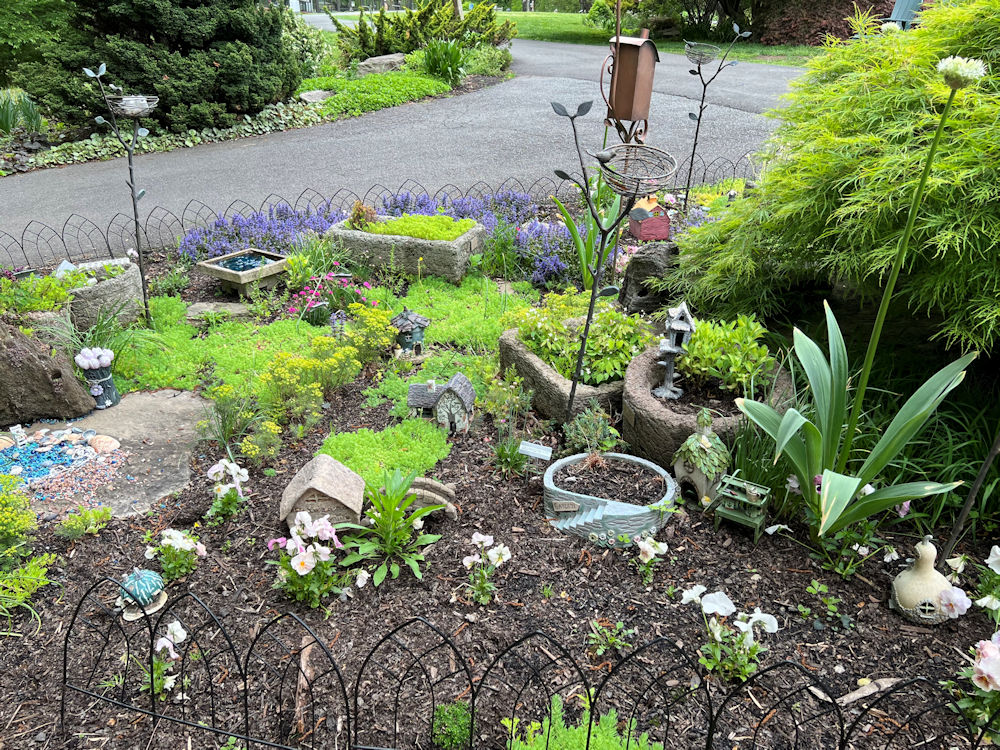
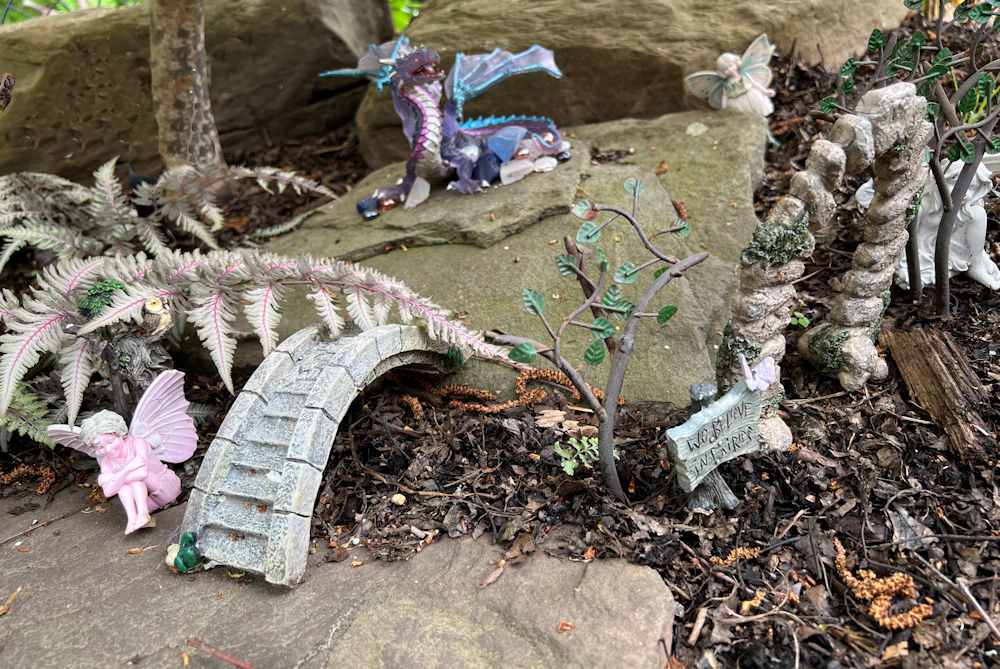
Just some odds and bods I photographed. The flying pig bottom left of the collage, with a larger snapshot below that, has been at the garden for years. He is placed in the fairy garden. All the fairies have disappeared. I am hopeful we will see them again during the warmer months and the weather isn't quite so harsh. They haven't taken the fairy garden sign down.
The ID marker stuck next to these branches, said it was the Golden Curls Willow. You can find information here. The ID actually identified it as the Golden Curls Corkscrew Willow. I'm pretty sure it is correct as my photo and the one on the website look identical. One of the first times I checked with my plant app and it didn't have any information about this particular tree.
That's all for this post. I have a few that I took inside the visitor center, photos of a few art pieces, and will share those another time.
Thanks for stopping by and I hope your day is full of sunshine.
 It was lovely seeing flowers blooming around the garden. Crocus, for instance, was putting on a lovely show. These are Woodland crocus, other names Tommasini's crocus, Tommies and Early crocus. Its botanical name is Crocus tommasinianus. Woodland crocus should always be planted in the fall. You will see its blooms from late winter to the spring. If you go to this link it will tell you how to grow and take care of them.