Showing posts with label Lakes. Rivers and Oceans. Show all posts

Wednesday, April 20, 2022

WALK ALONG THE POTOMAC RIVER IN ALEXANDRIA - 4-12-22

 Just over a week ago today we drove down to the Potomac River, for another walk. 

Much to our surprise, we realized that the biking trail we saw, was the one my dear other half and I used to travel many times.  I am going back over 46 years' ago, when we bought bicycles to ride the local trails.  This was when we started married life living in a small apartment in Alexandria.
We let the bicyclists enjoy their rides, and we headed in another direction.  The ducks we found right away.  
On the other side and not too far from where we parked the car, we could see National Harbor in Maryland.  It is another place on the list, and it has been a while since our last visit.
We walked along for a while, keeping pace with the ducks.
Shortly afterwards we found an Osprey sitting on its nest. 
There was only one bird keeping watch, and I thought perhaps its mate was fishing.  It wasn't until I saw later on my laptop screen, in the photo below, one more Osprey.  The nest wasn’t very far away.   I could just make out a bird on the top of the floating platform, and I am assuming it was the mate.  It is hard to see but if you go to the blue folding chair off-center-right, and look up that center pole to the roof, there is a contraption with another thin pole attached, and on top of that is the Osprey.  Its head is tucked in so it's hard to see.
Here is another shot of its mate looking after the nest.  Unfortunately, a plastic bag seems to have been tangled within its branches.  Maybe the bag was caught on the wind and that's where it landed.  

There will be more of our trip in my next post.
Thanks for visiting and have a happy day!


Tuesday, March 29, 2022

GO OUT I BEG OF YOU...


 Just in case the words embedded in my photograph are a difficult read (there are days for me too), I am repeating the words here.

"Go out, go out I beg of you, and taste the beauty of the wild.  Behold the miracle of the earth with all the wonder of a child."

Canadian Poet 1891-1978


We don’t necessarily have to go far to enjoy the wild.  It could be in our own garden.  What miracle of the earth did you see recently? Spring has many of them.


Photo from trip to Alaska in May 2018


Friday, October 29, 2021

OCCOQUAN BAY NATIONAL WILDLIFE RESERVE - FRIDAY - 10-22-21 - PART 3

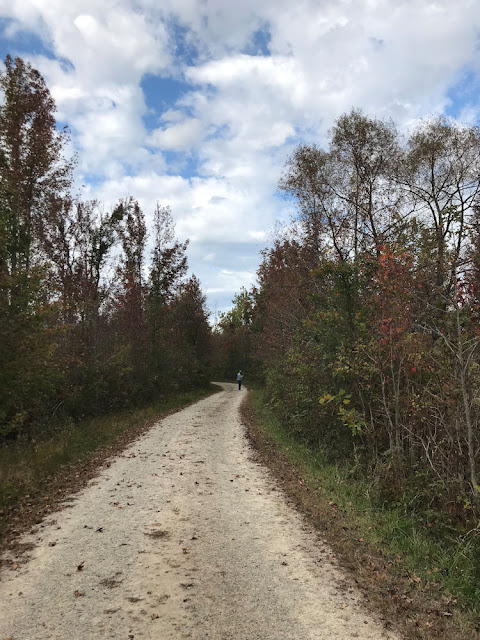
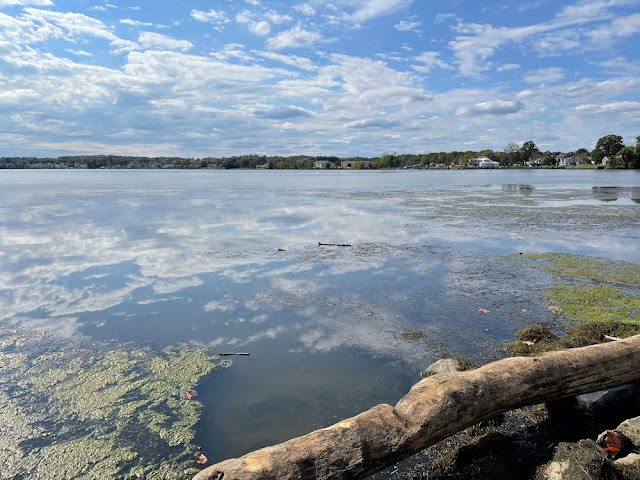
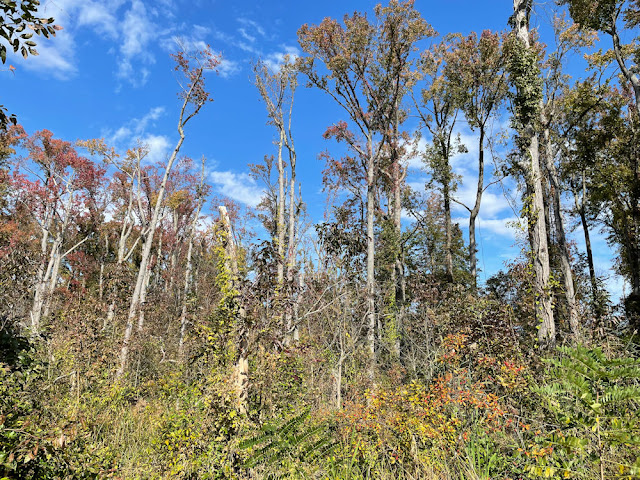
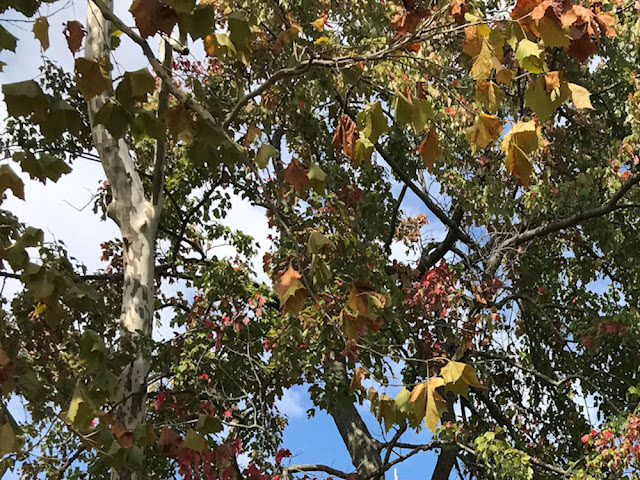
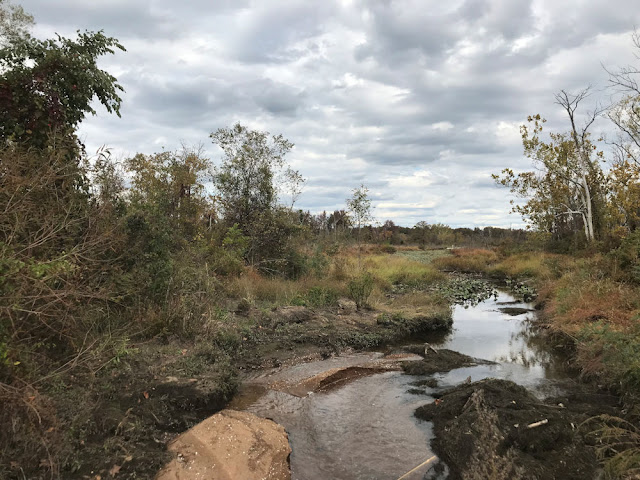
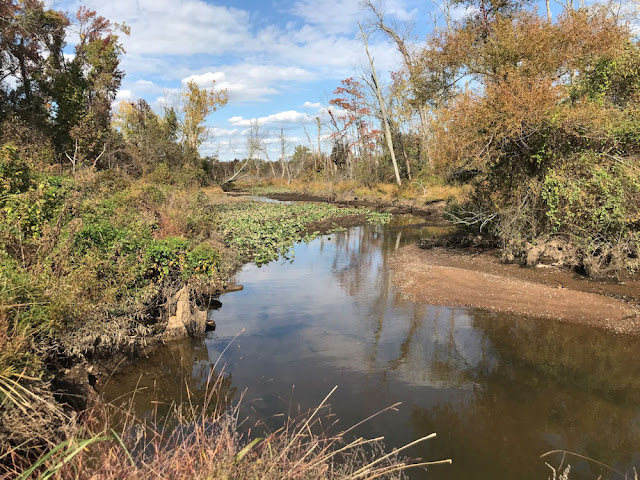
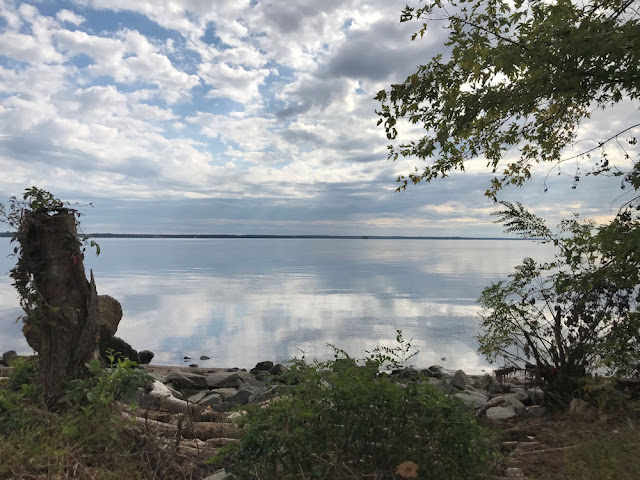
 We are walking along looking at the river.  We can see the State of Maryland in the distance.  It is very peaceful, the river on one side of the trail and trees on the other, with their colors turning into Autumn gold...and one of the many reasons to go for a walk at this time of the year and take it all in. We pass small streams, run-offs here and there... and notice that there are fish, what kind I don't know.A favorite quote next by A. A. Milne...my philosophy basically, especially when on these walks."Rivers know this: there is no hurry.  We shall get there someday.""I don't need very much now," said the boy, "just a quiet place to sit and rest.  I am very tired."  "Well," said the tree, straightening herself up as much as she could, "well, an old stump is good for sitting and resting.  Come, Boy, sit down.  Sit down and rest."  And the boy did.  And the tree was happy.
~Shel Silverstein~
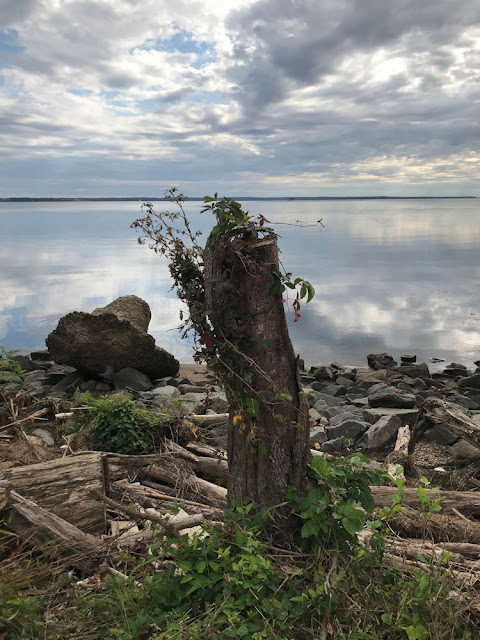
"...the universe...sets out little signposts for us along the way, to confirm that we're on the right path."
~Michelle Maisto~
"I imagined your stick, washing in the waves for hundreds of years, turning to driftwood, smooth and hard like stone.  I imagined a little girl finding it on a beach so many years later.  Saving it on her shelf, where she put the things that made her feel like the world was magical."
~Ava Dellaira~
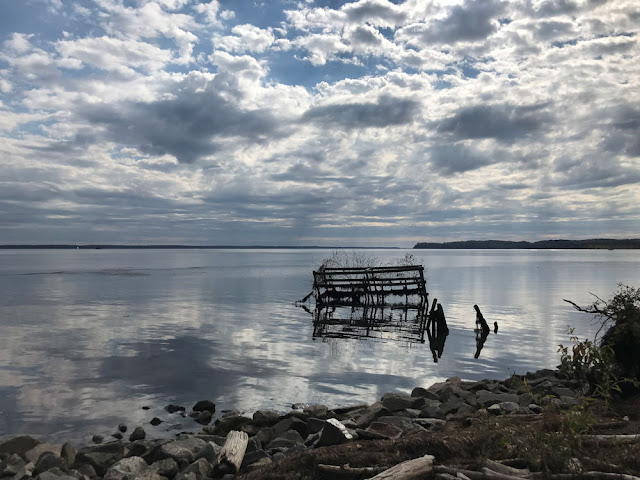
An old duck blind returning to the water, to become driftwood perhaps?
"Clouds, they make a painting out of the sky."
~Marty Rubin~
We found the loop back to our car.  Neither of us felt like going the whole way round, and took the shorter trail down the middle.
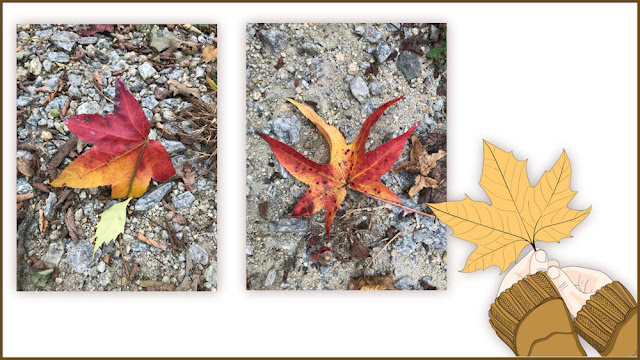
Gregg is in the distance taking his own photos, and I am lollygagging again...and my dear Mum used to complain when Dad was 15-20 paces ahead.  For some reason this photo made me think of Mum with Dad striding ahead.  We used to tease him that he only had three speeds, fast, very fast and faster still, but she was a lollygagger and yes I am smiling. This time I was taking photos of leaves on the path....
and I just remembered who I got my lollygagging from.  Thanks Mum, you taught me to slow down and smell the roses.  Or in this case, take a look at the leaves on the ground. As for Dad, one of his favorite hobbies was taking photos. He also passed on his love for animals and flowers, to respect all things in nature.  Thanks Dad!
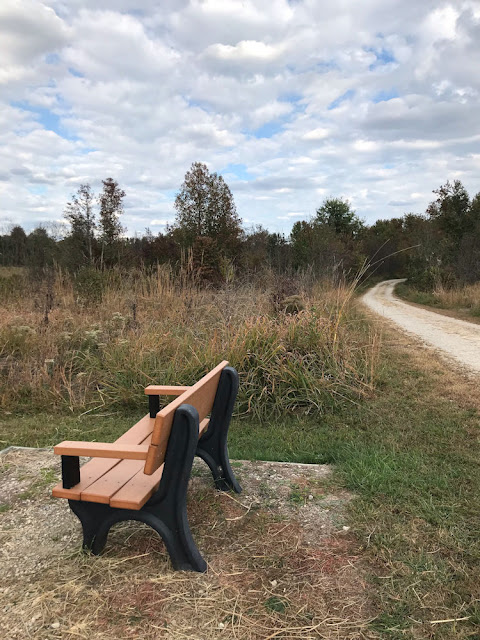
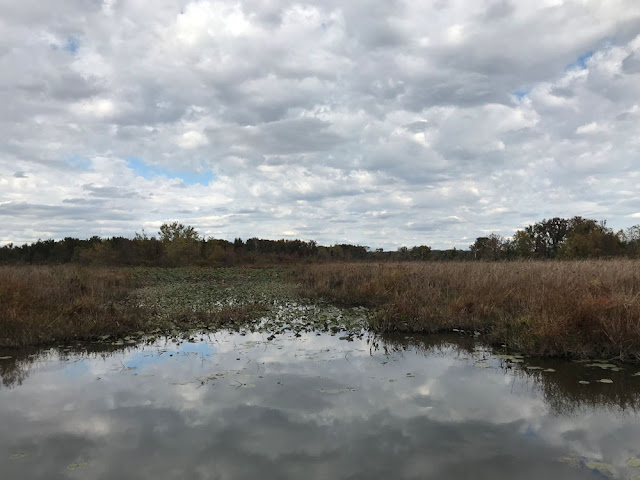
One last bench before reaching the car.  It was in front of this area.  All water birds seem to have flown south for now.
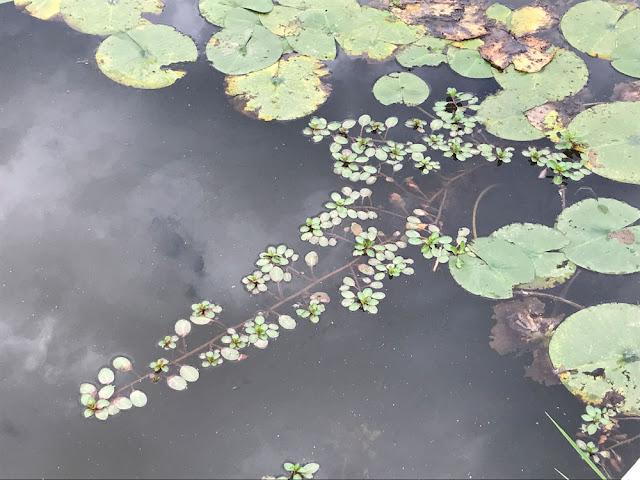
I looked nearby and found this interesting plant next to the lily pads.  A new one for me.  It is Floating primrose-willow (botanical name Ludwigia peploides).  Its other names are Creeping water primrose and Water Primrose, and is an herbaceous perennial wetland plant.
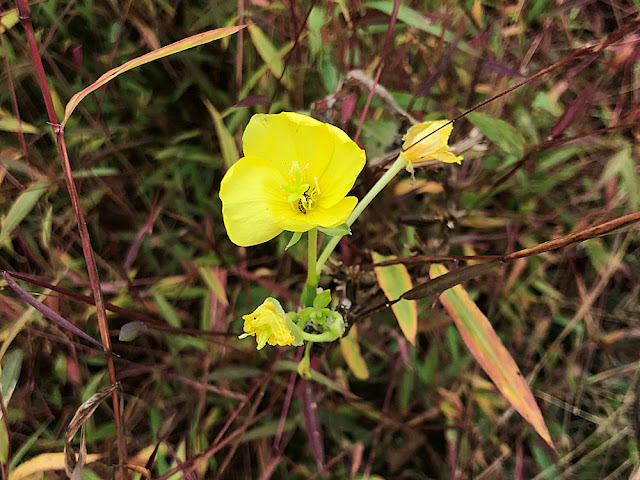
Earlier at the side of the path I came across this pretty yellow flower, also a type of Primrose but this one an Evening-primrose (botanical name Oenothera biennis).  Also known as German rampion, Fever plant and Common evening primrose.  It is another herbaceous perennial, recognized by its flowers that open in the evenings and close again at sunrise.  It wasn’t exactly evening but this part of the path was very shady.  
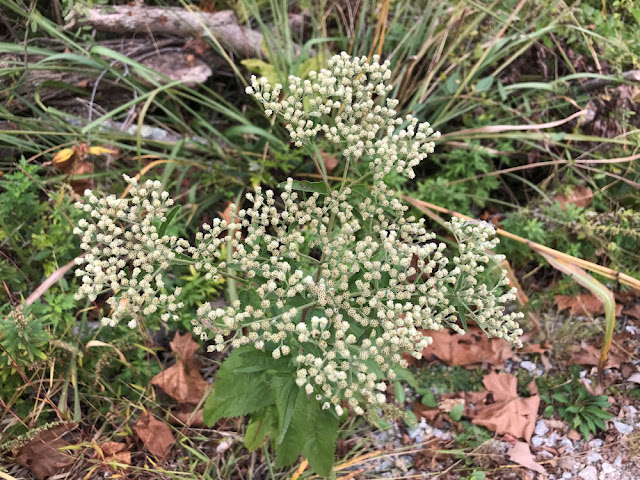
Next we have Lateflowering thoroughwort (botanical name Eupatorium serotinum).  Also known as Late boneset and Fall boneset.  Native Americans and early settlers used the plant for medicinal purposes, and the name thoroughwort is given for this reason.  It has the intrinsic value of being native to the land.  Also, this flower has been part of an ecosystem special to North America for millennia.
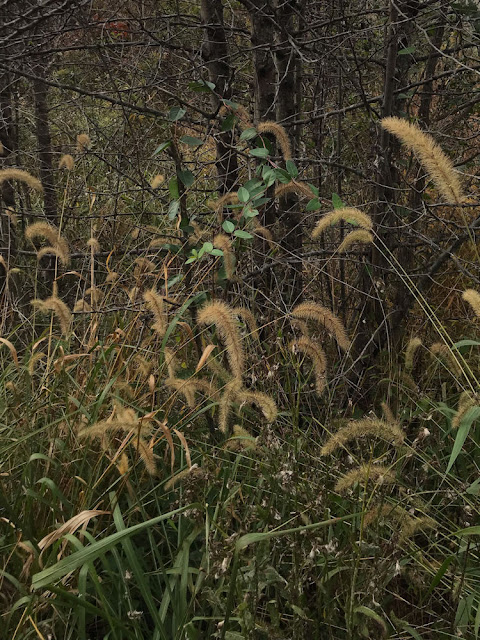
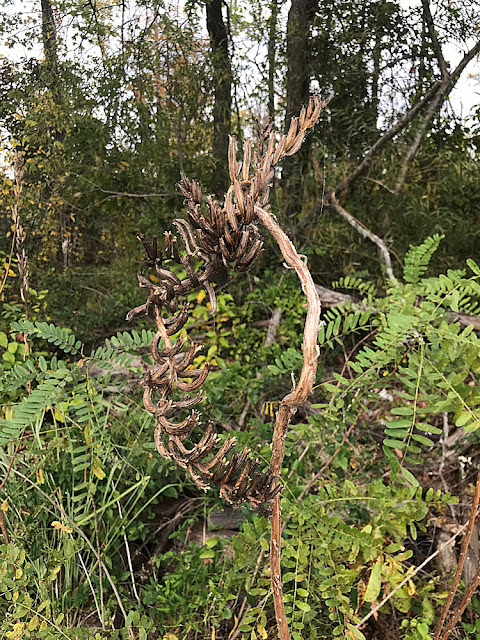
I couldn't find the proper name for these grasses, other than it was a fountain grass.  I liked the look of it so took a photo...
and the same for this one, a dried up plant with an interesting oval shape.  When I took a photo of it in my plant app just now, it said it also was an Evening primrose.

And that's about it for our trip to Occoquan Bay National Wildlife Refuge.  I hope you have enjoyed it.

Thank you for stopping by, have a wonderful weekend, and don't forget to do a bit of lollygagging.  You deserve it!


Thursday, October 28, 2021

OCCOQUAN BAY NATIONAL WILDLIFE RESERVE - FRIDAY - 10-22-21 - PART 2

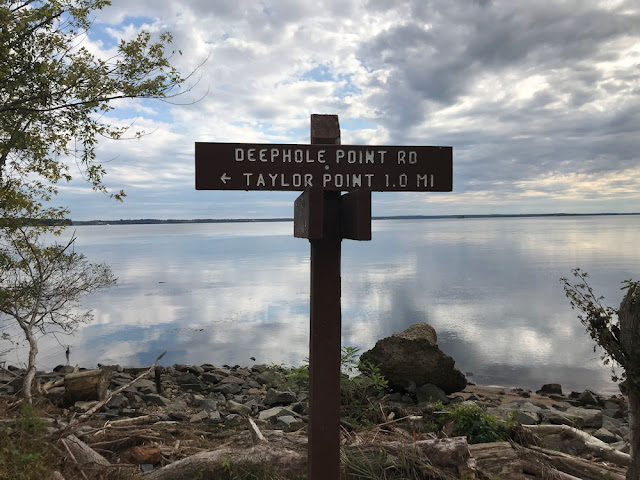
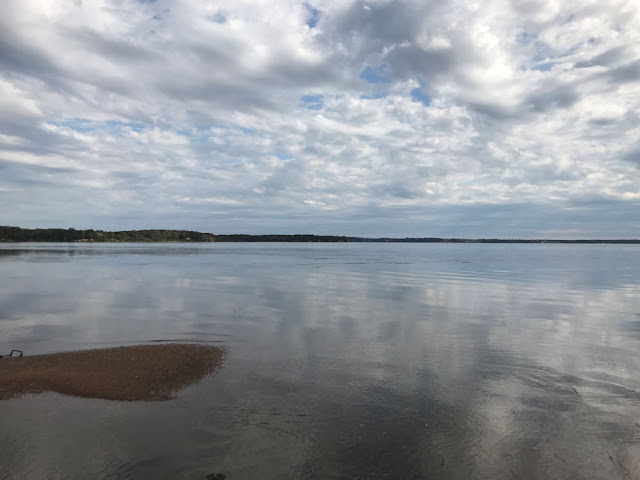
We reached the water and it was wonderful!  Across the river is Maryland.  We are on the Virginia side. More on this part of our walk in the next post.
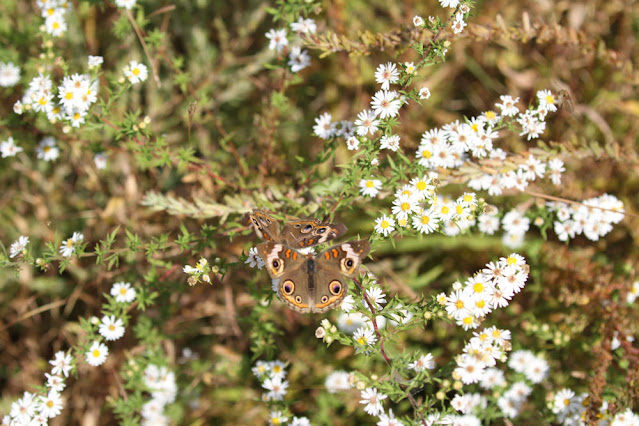
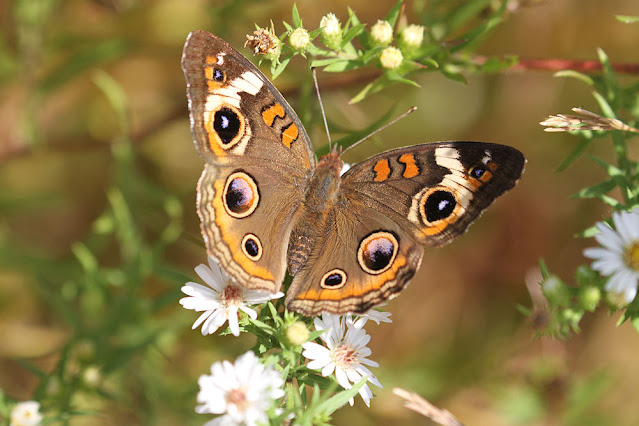
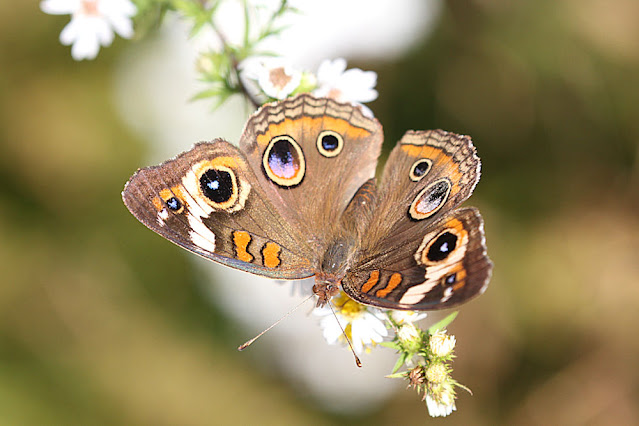
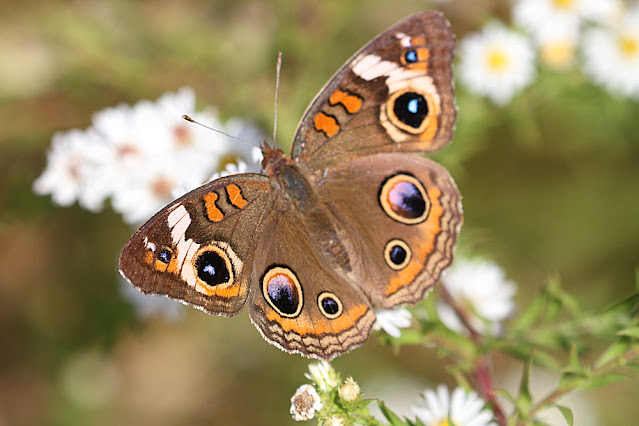
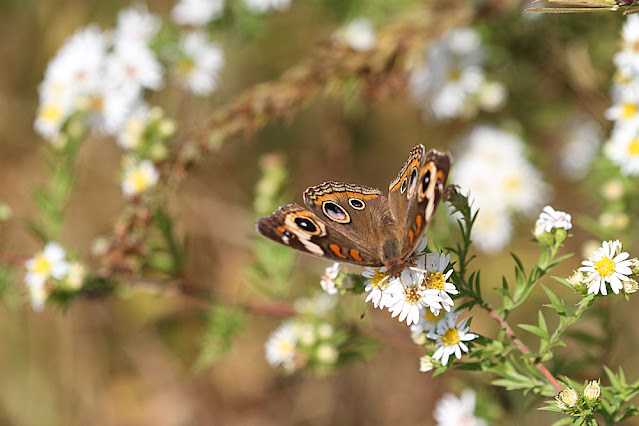
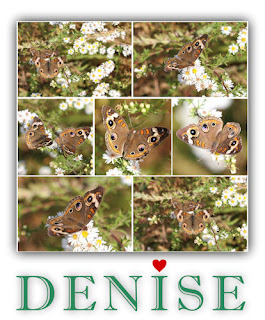
In my previous one I promised you butterflies.  We found a pair on the Frost Aster (botanical name Symphyotrichum pilosum), but I won't go into any more detail on the flower today, as I am going to concentrate on butterflies (and later in my post the snails, which aren't quite as pretty but totally fascinating all the same.

 Gregg took photos of the pair.  

I couldn't tear myself away and took several single shots.  It has been a rare sighting for me this past summer.  I was very happy when I spotted them.Named for its conspicuous target-shaped eyespots, the common buckeye, Junonia coenia Hübner, is one of the most distinctive and readily-identifiable North American butterflies. 

The common buckeye is a resident across the southern United States and much of Mexico, and regularly expands its range northward each year to temporarily colonize much of the U.S., occasionally reaching southern Canada. Starting in late summer and continuing through fall, huge numbers of adults migrate southward into peninsular Florida, where the adults overwinter.  There is a very interesting article that you can read here, that also shows you photos of a microscopic view of their wings if you scroll down.

The brightly-colored eyespots are evolution's gift to scare away their predators.  The adult lifespan is 6 to 20 days, and during that time its food is the nectar of flowers such as tickweed sunflower, aster, gumweed, knapweed and chicory.
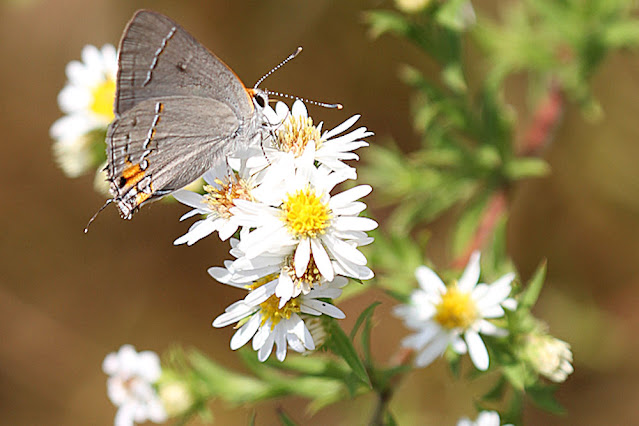
In the next photo I found this one on the same flowers nearby.  I didn't take a very sharp one.  It fluttered away soon after.  The closest I came to an ID was at this link, which said it was a white M. Hairstreak.  I haven't come across it before, or its name.  Hopefully someone out there will be able to confirm the ID, like last time.  I am always very grateful to my blogging friends who share more knowledge than I have.

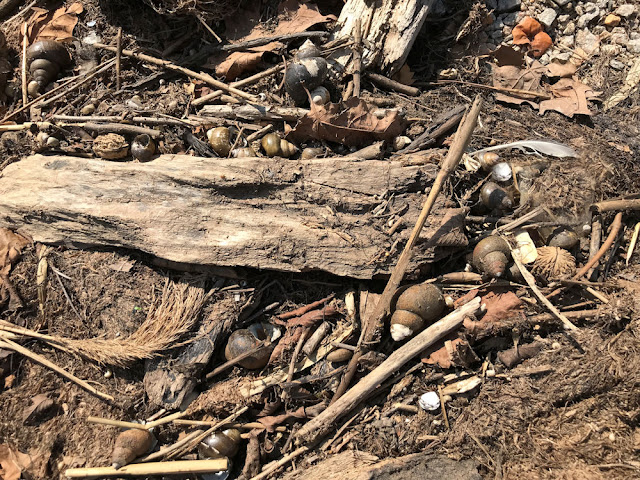
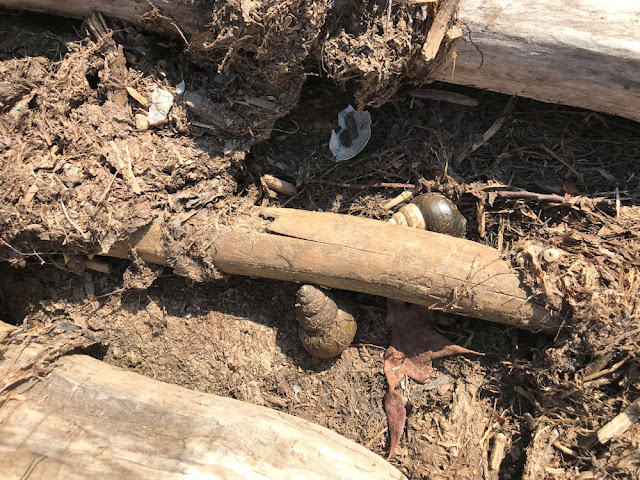
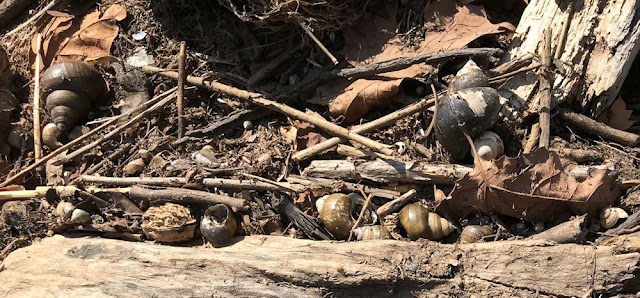
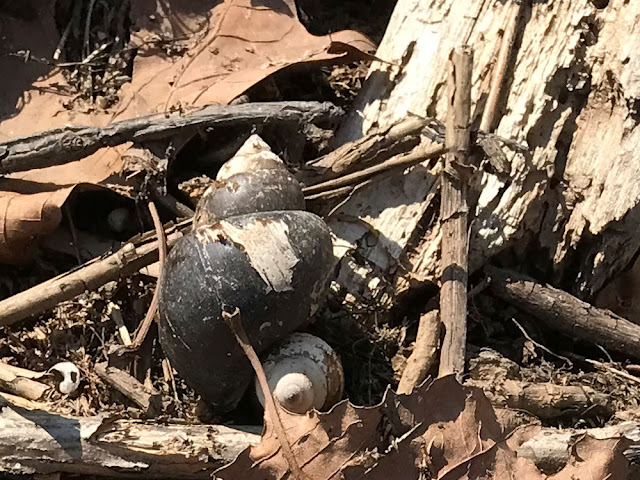
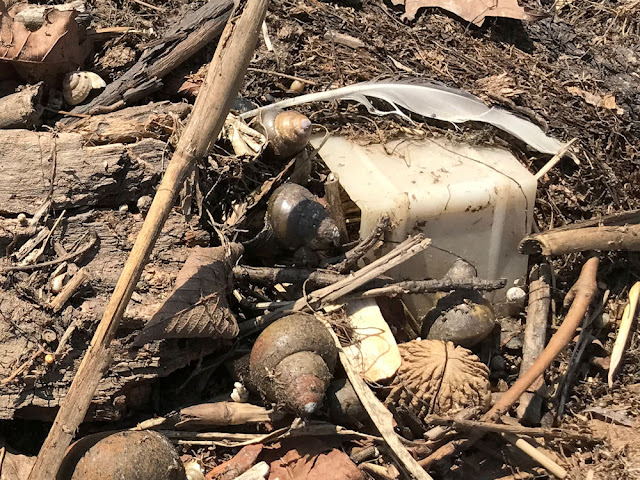
Gregg walks on ahead of me. I am lollygagging as usual, taking photos of river snails left behind by the tide.

The information I found about them online was fascinating.  Feel free to fast forward!  They are called Mystery Snails.  It is said they got their name from the fact that during spring they give birth to young, fully developed juveniles that suddenly and mysteriously appear, while most other snails lay eggs.  They are the largest fresh water snails in the region, and can grow up to 3 inches.

  These snails can close their shells with something akin to a trap door, and survive out of the water for as long as a month. The snails feed on the algae growing on the river bottom, yet they excrete very little of the pollutants phosphorus and ammonium.  In their tissue the snails concentrate spilled oil and other toxins, a trait that makes them potentially valuable as tipsters on pollution.  When water temperatures rise above 59 degrees, a female snail starts giving birth to quarter-inch-long juvenile snails, a hundred at a time.  If pressured by predators she can reproduce at twice the normal rate.  

Females live for about five years, males for three.  They retreat to deep waters for the winter where they hibernate in the mud.  They were introduced by merchants and sailors to the West Coast in the 1890s, for the Asian food markets.  They are native to Burma, Thailand, South Vietnam, China, Korea, the Phillipines and Java. By 1911 the snails had escaped to California irrigation ditches.    

Later they were introduced in at least 27 states, especially in the northeast and the Great Lakes region, and now can be found in the Potomac River.  Demands for food, aquarium and water-garden markets helped distribute the snails across the country.  By 1960 mystery snails had found a haven in the Potomac River at Alexandria.

More information than is needed I am sure for this blog post, but I wanted to add this as I find it fascinating and always want a record of everything that peaks my curiosity.

Sadly the beach along the river is littered with plastic bottles and other debris that is washed ashore from all over.  I read on someone's blog that each time they visit this area, they take along a rubbish bag.  I thought what a good idea!  I know it seems that one person can't do much, but the next time we took a walk there I would like to bring along our own.  To my mind every little helps and I would feel a whole lot better doing my small part.

So, that's it for today.  I will be sharing Part 3 next time.

Thanks so much for visiting and I hope your day is a great one.


Wednesday, September 22, 2021

JACKSON M. ABBOTT WETLAND RESERVE ON 9-15-21 - PART 2

Continuing my post from yesterday...

I am not sure how old this turtle was but not one of the big ones I have been seeing lately.
I was trying to get more photos but it jumped/dropped/plonked unceremoniously into the water seconds after these were taken.
It was a hot day, not the hottest we have had, but very humid. Feeling a bit like a wilted lettuce comes to mind.
A pretty one, this is the Purple false foxglove (botanical name Agalinis purpurea), and its other name is Purple gerardia.  
It is a native to the eastern United States and Canada. The caterpillars of the Common Buckeye butterfly feed on the foliage.   
These yellow flowers are called Bearded beggarticks (botanical name Bidens aristosa).  Also known as Western tickseed and Tickseed beggarticks.  It is related to the sunflower family.
I am always drawn to grasses.  Very pretty!  This is Hairy wild rye (botanical name Elymus villosus).  You might also know it as Silky wild rye.
Here is the same stalk of grass with the Bearded beggarticks.  The Hairy wild rye is a native grass of the eastern USA.  It favors damp woodlands and small meadows.  It does not attract insects as it is wind-pollinated.  Birds seldom eat the seeds and the plant is not palatable to wildlife or livestock, because the bristles on the seed heads are so coarse and can injure the animals.
More photos of the New england aster.  It is an easy-to-care perennial.  I would like to grow them in planters and was happy to find that they can be potted in well-drained compost.
Like most asters, it blooms late in the season.  It provides a critical fall nectar source for pollinators, especially Monarchs as they stock up for their Fall migration to Mexico.
This is definitely a place we would like to come back to, and our first impression was a very good one.
We had taken our photos, gotten our exercise and okay, no speed walking for us. We rested on a couple of the benches around the lake and watched whatever came into our view.  The turtles, the dragonflies, the butterflies and all the pretty flowers.  
But now it was time to go home.  
Getting out and enjoying our surroundings can be the best medicine, and so soothing for body and mind.
This fits in with the way I walk.
"One step at a time is good walking."
~Chinese Proverb~
The last plant I am sharing is Linden viburnum (botanical name Viburnum dilatatum).  Its other name is Linden arrowwood and it is a native of eastern Asia.  It will grow from 6-8 feet tall,  blooms from late spring to early summer and produces bright red berries in the fall.  Its dark green foliage turns to shades of bronze and burgundy-red in the fall.  They attract a variety of birds.  
If you ever see anything from any of my posts that you think I have misidentified, I am always happy to be helped with the correct ID, and will change accordingly.  All this research I do is a learning experience, and most definitely a fun hobby of mine.

Thank you for coming along on our walk, and I hope your day is a great one.