A male House Finch. He is in the tree that we had to cut down (these are from a while back). You can read very interesting facts about House Finches at this website. One of facts I read was:
"Once limited to the Western United States and Mexico, House Finches are now found from coast to coast, and as far north as southern Canada. In 1939 a few of the birds, originally captured in Santa Barbara, California, were set free on New York’s Long Island by a pet store owner. By the early 1940s wild nests were beginning to show up in Long Island, and from there the spread continued.
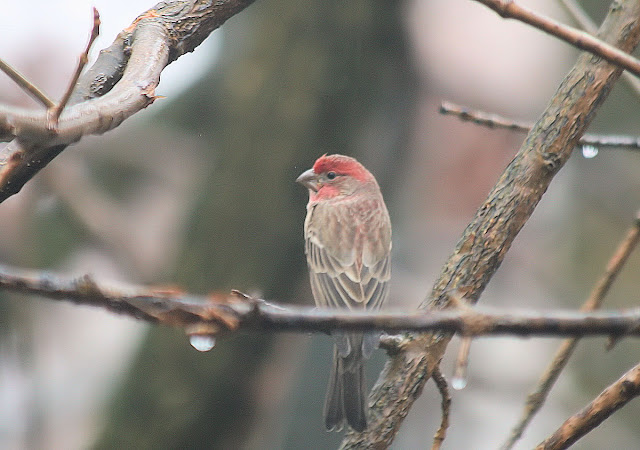
"They’ve also been introduced and become widespread in Hawaii. In some places, House Finches are considered an invasive species. They act as a vector for disease and compete for food and territory against native birds like Purple Finches - a species they are sometimes confused with since males share reddish plumage." This website shows how to tell them apart.
It's a sad state of affairs to take animals and birds out of their own natural habitat, and placed in areas where they should not be, for them and for the native species that are devastated, and in many cases made extinct by the introduced non-native species.
Case in point, here and you will read how the pythons became prolific in the Everglades (Florida). 
One of my favorite birds around here is the Tufted Titmouse. I love their sweet song. I have a pair that visit every day. They flit around so much that it's hard to get them in the same picture, but my reflexes must have been faster than usual this day. They fly down, grab a seed and immediately take it back to a tree branch to eat. They are one of just a few perching birds that can use their feet to hold seeds while breaking them open. I think our next feathered friend is a female Cowbird. They don't build their own nests or tend to their young. Instead, they lay their eggs in the nest of other birds, such as the chipping sparrow, destroying the eggs that were there before. These adoptive birds hatch the cowbird eggs and also feed them until they can take care of themselves, and the parents don't realize that they are feeding a tiny cowbird. As much as I would like to think so, it's not all rosy in nature. 
Next is a female Red-bellied Woodpecker. This website has photos of male and female. Females don't have quite as much red on their heads as a male, but you will see the difference by the photos at the link I have added above. These woodpeckers often create "caches" of food by drumming rows of small holes and wedging a single nut or seed into each one. We had a tree in our yard with a thousand such holes on its trunk, and often watched the woodpeckers hard at work creating these holes. How does it not get a headache or concuss itself? I found another website that tells us. It says, "The secret lies in the construction of the woodpecker's head and neck. A pad of soft tissue located between the bird's beak and skull absorbs most of the shock of each blow. The woodpecker's brain almost fills the skull cavity, which minimizes jostling. The brain is further stabilized by a strong muscle that runs down the sides of the neck and up the back of the skull." Fascinating! 
The Northern Cardinals I have shared many times before and they are in the garden all year round. Did you know that Cardinals get their red feathers from food? While female cardinals are light brown, the red pigment in the male cardinal's feathers come from carotenoids in their food. If these pigment-triggering foods are in short supply, their feathers may fade to a more brownish tone. I read my facts here, and there is more information which is interesting. 
The American Goldfinches have started visiting again. This one seems to have gone through its molting process, as the others looked a bit bedraggled and patchy. The American Goldfinch is the only finch species that molt twice a year. The first time is in the spring when the males get their bright yellow feathers, and the second is at the end of summer when the darker feathers grow in. Compared to other native North American birds, Goldfinches are late breeders. The birds wait to start building nests until late June and early July when the thistle and milkweeds are going to seed. The small birds like to use the seeds in their nests, and also as a nearby food source for their young. While some other bird species are omnivores, Goldfinches are avid vegetarians. The only time the birds stray from their vegetarian diet is when they accidentally swallow a small insect. 
We get many birds visiting us in our area, various Sparrows and Robins, Downy Woodpeckers, Red-bellied Woodpecker, one time a Pileated Woodpecker, Wrens, the Cardinals, Black-capped Chickadees, the Tufted Titmouse, Blue Jays, Mourning Doves, Grackles, Starlings, Crows and the occasional Red-wing Blackbird, and Hawk. Apart from the Hawk landing on our deck rail a few weeks ago, I remember others in past years and once a pair, parent and child, could be seen at the top of the tallest tree. I love seeing them but have to admit, I am ambivalent. I wanted them to hang around to observe and yet wanted them to move on also. The smaller birds seem to know they are there as they disappear for a while, and I have never seen anything distressing. I also don't replenish the seed until I know the hawks have moved on.
When the Starlings arrive, there are usually over a dozen at a time. They fight for their place at the feeders and gobble up all the birdseed.
In the winter we get a lot of Grey-slated Junco's but when the warmer weather arrives they migrate north. That seems to happen at the end of March, beginning of April. They have done this every year since we have lived in our home.
It has been 33 years since we moved from California. We rented for 12 months in the next town. It gave us the opportunity to look for areas in which we would like to settle, paying particular attention to schools. Our son was ten years’ old at the time. It also took us about a year to sell our home in California, which was located on the outskirts of San Diego.
Getting back to our birds, I enjoy the activity in the garden and am always looking for a new feathered friend to land here, one that I haven't seen before. I spotted a Northern Flicker last week but sadly it was a one stop. Maybe it will be back. Of course, there are the Squirrels and a now rare sighting of a Chipmunk, and the occasional Raccoon. I haven't seen one of those for a couple of months or more. I don't encourage them and have mentioned this before. We have a lot of young children in our neighborhood and though raccoons usually come out at night, you just never know. We also have a lot of pets in the area.
There are fox sightings each year and we used to get a few deer wondering through the neighborhood, but not for a long time.
No bears yet. I have never seen one myself but when one wanders through the neighborhood, I can read about it on our neighborhood app, with the occasional photo at a bird feeder. They are still hibernating. However, I only learned recently that they occasionally come out of their dens in the wintertime. I did not know that.
So, some happy and sad things about nature in my post today. I hope you have found it interesting. I know I tend to ramble on about things that interest me, hence the name of my blog! I also tend to reread my posts for refreshers on topics learned which I may forget.
Okay, I think I have rambled on long enough.


