Showing posts with label Garden Phlox. Show all posts

Sunday, August 10, 2025

HAPPY SUNDAY EVERYONE - OAT GRASSES, BLACK EYED SUSANS AND MILKWEED BUGS AND SUCH

The Mourning Doves are cooing right now, such a pretty sound, so peaceful and relaxing. The sun is shining (I wrote this on Saturday the 9th), and it is 78 degrees F. (25.5 degrees C(?), going up to 83 (28.33(?) in Centigrade). We are off for another walk later on when the sun starts going down. 

Continuing the visit to Walney, in the same flower bed as the Black-eyed Susans, I saw Inland Sea Oats. At least I think they are, so if you can confirm or deny because you already know, go right ahead. I try my hardest to get a correct ID. On this website there is a debate going on, about whether to plant these oats or not. It is the first time I have noticed them. I have seen a lot of grasses but not these. Anyhow, if you are really interested in this yay or nay conversation, you can check it out at the above link. I think they look lovely together but I read that the Inland Sea Oats can take over if allowed to.

I was very curious about these Inland Sea Oats, so I did a search on Google. They are edible but I doubt I am ever going to try them. Unless I am 100% sure about what I forage, there is no way I would eat them. I am not 100% confident in my abilities, and then of course they would have to be pesticide free. Anyhow, not an expert and only read about foraging. But I enjoy finding out and passing on what I read. At the same time they are very appealing to me, and I would love to have a bed of Black-eyed Susans with Inland Sea Oats among them. In the meantime, I'll take note of what others' experiences are first, and I'll just be happy to take photos in any of the gardens where I seem them grow.
From Google: "Inland see oats (Chasmanthium latifolium) are edible. The seeds can be processed and used as a cereal grain or ground into flour. They can also be cooked and eaten as a grain, similar to traditional oats. Some resources note that they were a Staple food crop for some indigenous peoples."
And more: "The seeds of the inland sea oats are the edible part. The seeds can be processed similarly to traditional oats, including being ground into flour or cooked as a grain.
The Cocopah Indians are known to have used the seeds as a food source.
In modern use some foragers and wild food enthusiasts suggest that the seeds can be used in a variety of ways, similar to other cereal grains."
The next day (8-4-25) it was another very pleasant temperature, cloudy but I thought I could still get some decent photos. The first things I came across was these little creatures on the milkweed pods. They were several Milkweed plants in the front beds of the house, it was the right time to see these red bugs. 
On the left of center on the above photo, you can see the Small Milkweed Bugs which you can read about at this site. They also show the Large Milkweed Bug. There are other similar bugs mentioned. I found it a very interesting read. 
I have no idea what this is, some kind of shield bug perhaps? It seemed to me that it had caught the attention of the Small Milkweed Bug as it followed it around the pod.
As I hadn't taken photos of these bugs in a long time, I left them and turned to the Milkweed Nymphs. These are immature milkweed bugs that feed on milkweed plants. They gradually develop into adults through a series of five molts, which eventually brings them to adulthood.
Not cute and cuddly creatures by any means but fascinating to me. They lack wings at this stage, often found in clusters on milkweed plants. Their bright orange and black coloration serves as a warning to predators, indicating they are unpalatable due to the toxins they accumulate from milkweed. You can read more about them here, along with a few other insects that feed off the same plant.
Leaving bugs alone for now, here are some pretty flowers including the above spider flower and below, the garden phlox.
One last photo and that's all from Walney until the next time we go.

Thanks for taking the time to visit. 
Hope you all have a great day!


Wednesday, July 27, 2022

WALK AROUND GREEN SPRING GARDENS CONTINUED...7-21-22

I found it hard to leave those lotus flowers and the refreshing fountain in the middle of the pond.  Though we couldn't feel its cooling spray, it was enough to sense it.  We sat on a nearby bench to see if any water birds would appear.  We haven't seen any Great Blue Herons at the pond since last year.  Maybe next time!  I felt lucky to see the female mallard, which I also shared in a previous post.   She was preening herself and then seemed to have a little snooze. 
I empathized in that heat, most definitely, but at least she could take a swim later to cool off. I always enjoy reading about them and adding to what I have already learned.  Some facts I know, others I don't, some are a good refresher course. Today I read that ducks can live from 2 to 20 years, depending on the species and whether they are wild ducks or ducks in captivity. It is a fact that a wild duck can live 20 years or more. Domestic ducks typically live 10 to 15 years in captivity. The world record is a Mallard Drake that lived to a ripe old age of 27 years.
Someone had scattered a mixture of corn and other seed near the bench, and this little girl had her lunch not far from where we were sitting. The corn was too big but she seemed to be enjoying the tinier seed.  I believe she is a female House Sparrow but please correct me if you think I am incorrect.
There was also an American Robin nearby, but that was it for the smaller birds.  The others were very elusive on our visit.  However, always grateful for small mercies, as the old saying goes.  True!
At the other end of the pond were water lilies.  There were also dragonflies.  They were flitting around and I couldn't get a proper focus for a photo.
It was time to move on and we walked towards the path that would lead us up the hill, to the flatter part of the garden.  We said goodbye to the pond area, at least until next time.
At the beginning of the path was a sign asking not to feed the ducks and geese...
and another making us aware of their ecological restoration.  There is an article at this link which tells us all about it.
Not too far from this sign we spotted the family of deer.  We counted three at least.  They were quite a distance off from us and this is one of several photos I took but these didn't exactly work out.  The tree on the right is one we pass all the time where many couples have had their names carved into its bark over many years.  You can just about make out a deer's shape in the center of the photo.  Also, the little blue glints are the reflection of its eyes.  I don't remember the flash going off.  Perhaps it was a trick of the sunlight filtering between the trees.  I shared a better photo here on my first post from our recent walk, and it is the 6th one down.
I also enjoyed the wildflowers as I walked.  Below is Blue mistflower, botanical name Conoclinium coelestinum.  Its other names are Mistflower, Wild ageratum, Blue boneset and Hardy ageratum.  It is an herbaceous perennial, is native to North America and blooms in summer and the fall.  
Next are the berries of the American elder.  Its botanical name is Sambucus canadensis.  Other names it goes by are Common elderberry, American elderberry, Elderberry, Canada elderberry and American black elderberry.  It is native to North American, a deciduous shrub and provides food for over 100 species of birds, as well as shelter for nesting.  The dark purple elderberries are used to make jellies, pies, juice, and wine.  The flowers are star-shaped and are a yellowish-white.  
We spotted a beautiful black swallowtail on the pink Garden phlox, botanical name Phlox paniculata.  Also known as Summer phlox, Fall phlox, Perennial phlox and Cross-leaved phlox.  Phlox is a Latin word for 'flame'.  It is also native to the United States.  You can read more about the butterfly at this link.  There are great photos!
Purple Joe-Pye weed is next, botanical name Eutrochium purpureum.  I feel like I am auditioning for a Harry Potter movie with all these botanical names, but I enjoy learning them.  Other names are Kidney-root, Sweetscented Joe Pye Weed, Sweet Joe-Pye-Weed, Gravel Root, Trumpet Weed and Feverweed.  It is native to eastern and central North America, and blooms in the summer and fall.  Its flowers have a strong vanilla fragrance, which makes it a favorite of butterflies.  No flutterby friends on them as I passed by.
We have crossed the stream and are making our way up the hill and will end up in the top part of the garden.
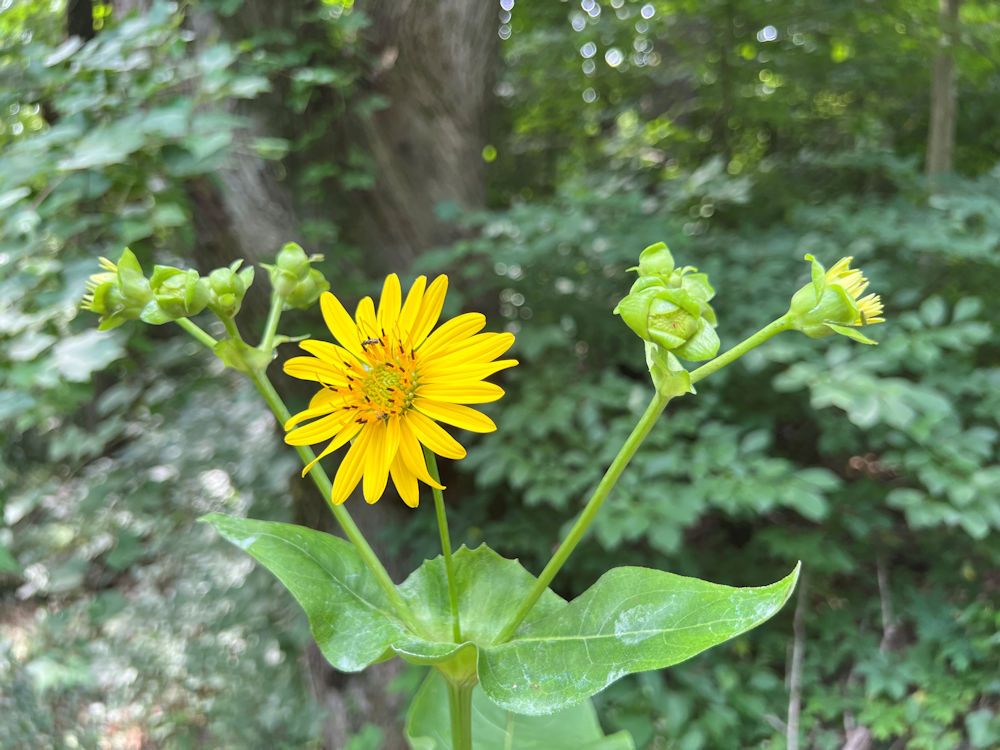
These beautiful yellow flowers are called the Cup plant, botanical name Silphium perfoliatum.  Other names are the Common Cup plant, Squareweed, Carpenter's weed, Pilot weed and Rosinweed.  It is a native to the Eastern and Central United States.  The height of this plant typically reached from 3 to 8 feet and as you can see, their blooms are similar to sunflowers.  They grew in abundance on each side of the path and these towered over my head.  
And frankly I loved them as you can see by the many photos.  There were hundreds of them along the pathway.
A closer view of one shows a bright green bug with wings.  I wish I could crop it closer without blurring it out too much (I only had my cell phone - Gregg and I swap cameras and he was further along than I was. He carries our larger camera with the zoom lens.  It is a lot heavier and my wrists start to ache if I carry it for too long.  He jokes that he is my porter, and will give it to me when I want to see something up close.  I am glad he likes taking photos as much as I do, and many of his photos I share on my blog.)   
The ID of the bug is the Augochlora pura, also known as the Augochloral sweat bee. 
Each flower head has 20-30 yellow rays and darker yellow disks. The leaves are joined at the stem to form a small cup that holds water and attracts birds. 
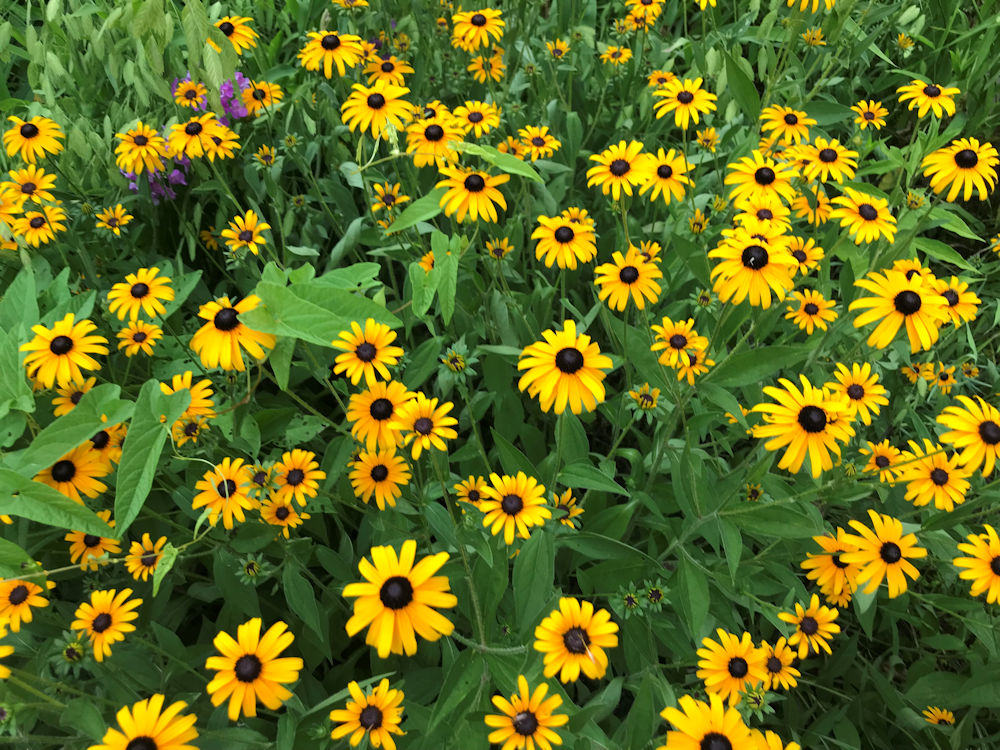
I also came across another yellow flower, the Black-eyed susan, botanical name Rudbeckia hirta.  Common names are the Yellow ox-eye daisy, English bull's eye, Brown betty, Golden Jerusalem and Gloriosa daisy.  Its genus name, Rudbeckia, was named in honor of botanist Olof Rudbeck Junior, (1660 – 1740) who was a Swedish explorer, scientist, botanist, ornithologist and rector of Uppsala University in Sweden. 
People plant them to attract butterflies to gardens.  It is also a native flower to America. The stamen isn't actually black but brown.  Its yellow petals attract some birds, but the brown center isn't that attractive to our feathered friends.  However, its center acts as a good platform where they can stand and snack on the jagged ambush bugs and aphids that frequent it.  Just like echinacea, the flower has been used in traditional herbal medicine.  Growing throughout the prairies and plains, it was used medicinally by many Native Americans to care for both people and horses. 
It was declared the state flower of Maryland in 1918.  

I have a few more photos from the top part of the garden. I will share those when I can put a post together.

Thanks for looking and have a wonderful day!


Tuesday, August 10, 2021

BACK TO WALNEY - 7-22-21

We went back to Ellanor C. Lawrence Park, where we always start off at the Visitor Center.  It has a nice area to walk around, and we enjoy seeing the flowers in the front of the house. 

Let's start off with the Common Milkweed.  There were many.  I am always happy to see them as I know how essential they are to the Monarch Butterflies, and others.

Milkweeds are the only plants Monarchs will lay their eggs on.  Unfortunately there weren’t any around today, but a few Cabbage whites were fluttering about.  

The two birds you see on the window are actually decals, to stop birds from getting confused and flying into the mirror image no doubt.

This is Black-eyed susan, a species of Coneflowers (Rudbeckia).  Also known as Yellow ox-eye daisy, English bull's eye, Brown betty, Golden jerusalem and Gloriosa daisy.  It's botanical name is Rudbeckia hirta.  

The description I read said, "the black-eyed susan is a flowering black and yellow plant with curving leaves.  It is culturally important in the Southern United States, and is often used to attract butterflies to gardens.  It long ago spread throughout North America and much of the world.  Black-eyed susan is the state flower of Maryland".

I have shown this before.  It is a circular bed of plants and flowers called the Butterfly Garden.

The plate of stones has been added since the last time we were here.  It says: "This is a puddling stone.  "Puddling" is a behavior common to butterflies.  They often congregate on wet sand or gravel to sip water and they also get salt and minerals needed for survival."  It seemed too late in the day for butterflies, and although it was still light it was in the early evening. 
In the same flower bed, more milkweed...
 but also Garden phlox.  Other names are Fall phlox, Autumn Phlox, Summer phlox, Perennial phlox and Cross-leaved phlox.  Its botanical name is Phlox paniculata.  Garden phlox is native to the United States.  The name phlox comes from the Latin for "flame", reflecting its bright colors.  
It can also become important food sources for not only butterflies, but other insects and hummingbirds.  The sweet aroma of garden flox nectar draws the hummingbird in, allowing the plant to douse the bird in pollen to be carried on to other flowers.  (And I once again thank my plant app "PictureThis", for all the great information it provides.  I take the photo while in the app, and it automatically pops up with all this great information.)
I have a hard time dragging myself away from this area, but the rest of the garden is calling.
The kitchen garden is thriving...
and nearby our bench is waiting.
We have been lucky as it has been vacant the last few times we have been here.  Our timing is specifically for when it is quiet.  We sit and enjoy looking at any birds that may be around, and notice there are grapes growing on the arbor.
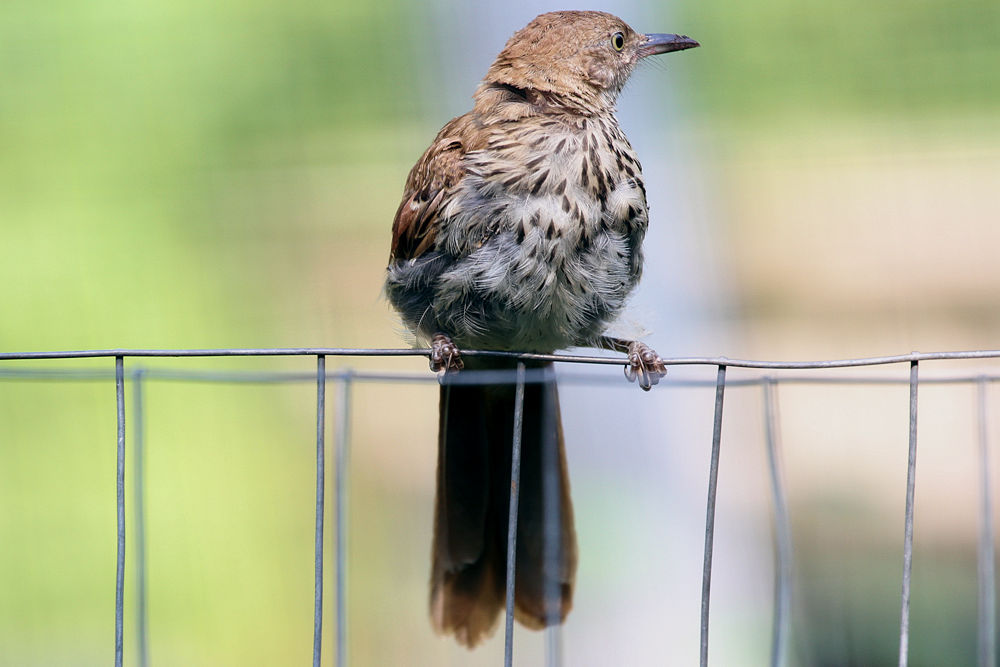
The Brown Thrasher was sitting on the top of a roll of chicken wire near the shed next to the kitchen garden.  I was happy as I haven't seen one in a very long time.  It's a clever little bird.  When feeding it can hammer nuts such as acorns in order to remove the shell.  In one case, a bird was observed to dig a hole about 0.59 inch deep, place an acorn in it and hit the acorn until it cracked, considered to be a form of tool usage.
You can read more information about them here.  I was interested to find out that it has great flexibility in catching quick insects, as the amount of vertebrae in its neck exceeds giraffes and camels!  Also, Brown Thrashers have the largest repertoire of songs of the North American birds, and are able to vocalize 3000 distinct songs.
It is the state bird of Georgia, is very territorial and will vigorously defend its nest.  The name "thrasher" does not come from the aggressive nature of the bird, but rather that the name is believed to have come from the thrashing sound it makes when digging through ground debris.  That's one explanation anyway.  The longest known lifespan in the wild is twelve years, but they are susceptible to disease and parasites which can shorten their life considerably.
Maybe it had its eyes on the bees but they were  safely guarded...
and I make sure I don't get too close.  We visited for years when there was no electric fence.  I would love to know the reason why it was erected but, as I have mentioned in other posts, the visitor center has been closed perhaps due to us picking the later time for our arrival.  I make my usual guess that it is to stop animals from raiding the hive.  I remember the Spanish word "peligro".  I learned it while watching episodes of Sesame Street with our son when he was very young. It has been a long time but the word stuck.
It looks like everything is growing well in the kitchen garden.
This is the restored Smoke House used by the family who lived in the old house in the first photo.  
It is time to head down to the pond, which I will tell you about soon.