Showing posts with label Dogwoods. Show all posts

Sunday, August 31, 2025

HAPPY SUNDAY EVERYONE - ACTS OF KINDNESS…


“Acts of kindness remind us that humanity shines brightest when extended to the voiceless. Compassion is the truest strength.”


~Author Unknown ~


Tuesday, May 2, 2023

DOGWOODS

To dreamy languors and the violet mist

Of early Spring, the deep sequestered vale

Gives first her paling-blue Miamimist,

Where blithely pours the cuckoo's annual tale

Of Summer promises and tender green,

Of a new life and beauty yet unseen.The forest trees have yet a sighing mouth,

Where dying winds of March their branches swing,

While upward from the dreamy sunny South,

A hand invisible leads on the Spring.

His rounds from bloom to bloom the bee begins

With flying song and cowslip wine he sups,

Where to the warm and passing southern winds,

Azaleas gently swing their yellow cups.Soon everywhere, with glory through and through,

The fields will spread with every brilliant hue.

But higher o'er all the early floral train,Where softness all the arching sky resumes,

The dogwood dancing to the winds' refrain,

In stainless glory spreads its snowy blooms.

Dogwood Blossoms

by 

George Marion McClellan


George Marion McClellan (September 29, 1860 – May 17, 1934) was an American writer. Born in Tennessee, McClellan was educated at Fisk University and Hartford Theological Seminary. He worked as a Congregationalist minister and as a high school teacher and principal. His writing, generally self-published, included both prose and poetry.  You can click on his name underneath the poem to find out more.

Wednesday, May 4, 2022

LATEST WALK AROUND GREEN SPRING GARDENS ON 4-15-22 - PART 2

Continuing our walk at the garden, we have just left the ponds and are walking through a wooded area.We eventually turn right, where the path takes us up to the flatter part of the garden.  First there is a steep incline through more trees, and at the top is the flatter part of the garden, which is more manicured.  I like these equally.  There is always much to see and enjoy in both areas.  For instance, before we cross the stream...

Mayapple (Podophyllum peltatum), also called American mandrake, Wild mandrake, Ground lemon and Mandrake.   They are found in shady locations just like the one we were in when we found it.  You can find them in forests and riverbanks.  We were in a wooded area and near a creek.  It is not poisonous to the touch, though the unripe fruit is toxic.  The mayapple berries are eaten by box turtles and mammals such as opossums, raccoons and skunks. Its symbolism is friendship, happiness and positive emotions, prosperity and good fortune.  This website has very interesting information and photos of various stages.  
The interesting photo above is the Hobble-Bush (Viburnum lantanoides), also known as Witch-Hobble, Aler-Leaved Viburnum and Moosewood.  It is easily confused with wild hydrangea. Either may have larger flowers around the outer edge of the cluster, though this is more common in hobblebush. Individual tiny hydrangea flowers have 8 or more stamens, while hobblebush has 5. The shape and texture of the leaves are different.  A very interesting website here.
White trillium (Trillium grandiflorum) is a plant I talked about at this link.   It is also called Great white trillium, Snow trillium, White wake-robin and Large-flowered trillium.  It is a flowering plant that is native to the eastern parts of North America, from Quebec, Canada, all the way down to Georgia in the United States and grows as far west as Minnesota. Also east Asia.   It likes partial sun to full shade and is a perennial plant.    
This pretty yellow flower is a Celandine poppy (Stylophorum diphyllum).  Also known as Woods poppy and Yellow wood poppy, and is native to North America.  This species is considered endangered in Canada.  It grows in the eastern United States and Eastern Canada.
Wild blue phlox (Phlox divaricata).  Other names are Woodland phlox, Blue phlox, Forest phlox and Wild sweet William.  
It is indigenous to eastern North America.  Phlox is Greek for "flame", because some flowers of this species have intensely vibrant colors.
Here we have Golden ragwort (Packera aurea).  Another name is Golden groundsel.  It is a member of the aster family and blooms in spring and summer.  It likes full sun to part shade, and is a perennial.
Here is the White Dogwood tree that is my favorite, and one I hope we will be planting to replace the other trees we had to cut down in our back garden.  We are going to have a chat with a professional to make sure it is a good area to plant them.  
The flower itself is the small, greenish yellow part in the middle of the bloom. The four petal-like parts surrounding the flower aren’t petals at all—they’re actually bracts, a type of modified leaf.  It is also the State flower of Virginia.

That's the end of our walk through the wood.  In Part 3 I will be sharing mostly tulips I found in the top part of the garden.

Thank you for looking and enjoy your day.


Tuesday, May 3, 2022

LATEST WALK AROUND GREEN SPRING GARDENS ON 4-15-22 - PART 1

We were at the gardens on April 14th.  It was a gorgeous day and far too good to stay inside.  
I also wanted to see the dogwoods while they were still blooming.  We are thinking of planting them to replace the two trees that we had to cut down.  The white ones are my favorite as they were the first kind I ever saw.  We drive out into the country and see them growing wild in amongst all the other trees.  It is a lovely sight.  
The pink ones are spectacular too and these were at the lower end of the garden.  
We have both in our neighborhood, which look stunning.  Our son and daughter-in-law mentioned them, how beautiful they looked, when heading over recently.  
But, I have a bee in my bonnet about the white and would like to plant those.  Dear Other Half doesn't have a strong opinion and would be happy with both.  Looking at these, however, well.....
We usually take the pathway next to the old house, but we wanted to go to the ponds today.  We walked the narrow road down the hill instead.
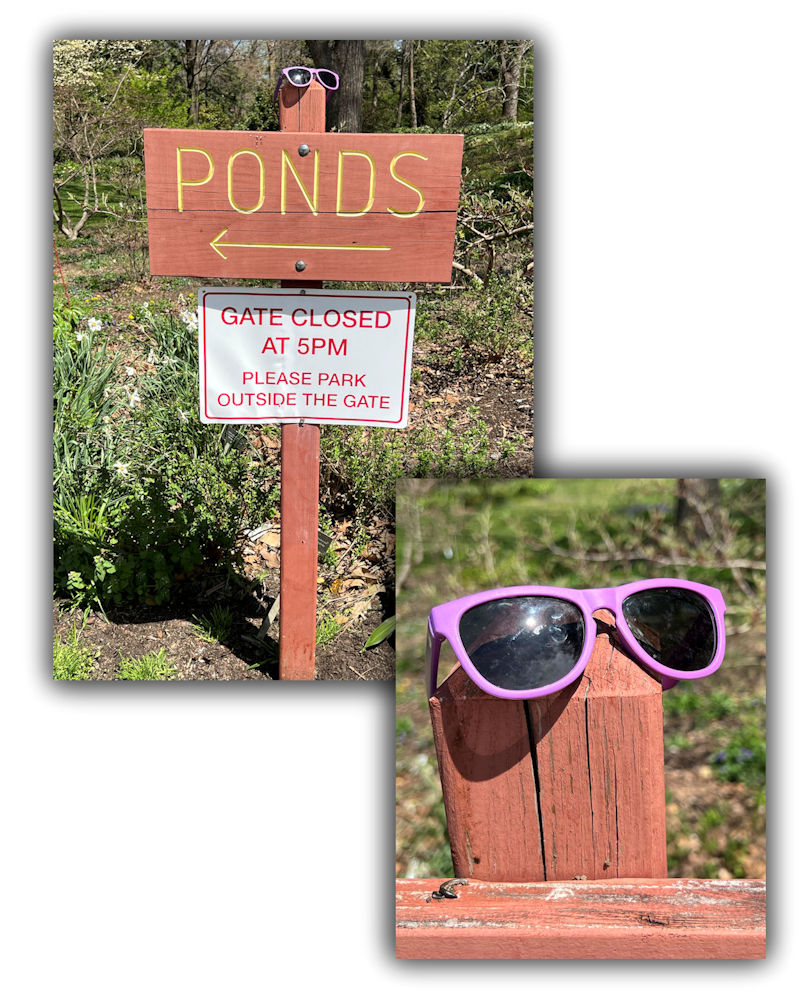
A kind person had found a pair of sunglasses and popped them on top of the sign where, hopefully, they will be found before their owner leaves the garden.  As you can see, the garden gates are closed at five.  We have in the past arrived at a later hour and was glad we read the sign.  You can still walk around, probably until it starts to get dark, and we have left our car on the other side of the gate.  It is only a short walk to the garden.  One time we wanted to go during that golden hour for photo taking, and remembering the sign, we parked beyond the gate.  We did not have a problem finding a spot as most people had left by then.
I did not think I would be seeing any more daffodils, but there were many on our way to the ponds.  


I have seen paler daffodils - narcissus? - but not the frilly kind.  The closest I could get to identifying these was Double Daffodils - Sir Winston Churchill.  
You can see if you agree at this link.  The website here has them for sale.
There are many benches throughout the garden, and we always make use of one that is right next to the water.  
Gregg is taking photos of the fish.
I am sitting on our favorite bench.  From where I am, it is a good place to watch for activity on the water.  I was hoping for birds but came across something very interesting.
A couple were on the edge peering down and then the gentleman exclaimed very loudly.  He turned round to where I was sitting, and said there were huge fish just under the surface, come and see!  His excitement and enthusiasm made me smile and as I recognized another nature lover, I walked over.  We chatted for a while and Gregg joined us.  The gentleman told me he thought they were American Carp.  I couldn't get a decent photo of the big ones but they were well over four-feet in length.
The smaller swam towards us and stayed in place for a while, opening and closing their mouths as they usually do.  It didn't take long to realize they were waiting for us to feed them.
I thanked the couple.  We have never seen fish this big before and we look into the water on every visit, checking out the much smaller ones.  These were a surprise.  The Great Blue Heron we occasionally see fishing will have a hard time picking one up for dinner.
We also got a decent photo of a Male Northern Cardinal, as curious about us as we were about him perhaps?
And I'm thinking this is a House sparrow.  What do you think?
And an American Robin.  Gregg took the bird photos.
We leave the pond and walk along the trail through the wood.  The bark of trees interests us both and Gregg also took the next photo.   On doing a little research (please let me know if you think it is something else), this is a River birch tree, also known as Water birch, Black birch and Swamp birch.  River birch is a strong but knotty wood.  It is sometimes used to make woodenware and furniture, but it is not usually used for commercial lumber.  Native Americans would boil the sap to make a sweetener and would even eat the inner bark when food was scarce.  It is also a food source for many wild birds and even deer.
One last photo taken by my Dear Other Half, and that is one of the creek.  There is a bridge we cross over before going up the hill.

I will end here as there are more photos to share.  I hope you have enjoyed Part 1.

Thank you for visiting today's blog post.  
May your day be a happy one.


Friday, April 15, 2022

OUR WALK AT OCCOQUAN BAY NATIONAL WILDLIFE REFUGE

 We are happy to enlarge our walking areas, each within a not-so-long car ride from home. Occoquan Bay National Wildlife Refuge is one we discovered last year, and we were happy to add it to our favorites list, where we go for exercise in their beautiful surroundings.  Marvelous places in any season, always changing and always something new that keeps feeding our love of nature.

The weather was starting to warm up.  The sky had lots of clouds and we were glad we went early, as rain was forecast.Our intention was to walk to the pond.Our short cut was still a bit of a trek.  When we arrived two other gentlemen, both with tripod and camera, were the only other people around.  One had been sitting on the steps leading to a small dock. 
The other was in long grass in a field, looking toward the trees and pointing his camera in the direction of the many bird calls.  I am not sure if he got any photos, and we didn't want to disturb either of them, they were so focused.  
Gregg left to take photos in another direction.  I took a seat under a sheltered picnic area, and watched them from the shadows. The two men seemed to know each other but left separately.  A short while later Gregg joined me. He took a photo of the windmill right next to the picnic tables. I thought to take a shot of it but the moment passed and I was glad Gregg took this one.The photo (above) with the beautiful reflection of the clouds that day, was also taken by Gregg.  You can just about make out a round circle resting on top of the water, not too far from shore.  Here is a closer look.  We think it is some kind of filter system where several turtles like to rest.  There weren't as many as the last time we were here.  The photos with the inserts are what he took, and I put the close-up circles into the photo, because I had time to play with my Paint Shop Pro for an hour.On the other side we saw a duck and we stared, and we stared and we stared, ever hopeful that he was going to be joined by his companions.  It took us a few minutes to realize it was a decoy.  There were no other birds on the lake.
There were Turkey Vultures flying overhead. If you click here you can read interesting facts about them.  They are not everyone's cup of tea but they do look magnificent in flight.  Their scientific name is Cathartes Aura, which means in Latin "cleansing breeze".  Researchers have determined that they can travel up to 200 miles in a day.  Also, their average height is 2-1/2 feet tall with a 6 foot wingspan and yet as big as they are, they only weigh about 3 pounds.  Here you will also read how they are considered nature's clean-up crew. This last site is the Wildlife Rescue League.
American Robins always seem to be present.  Normally I see them hopping around on the ground, but Gregg found this one high in a tree.  I have mentioned this before but they are unrelated to the European Robin, and ours are actually part of the thrush family.  Early colonial settlers named them American Robin because of its resemblance to the smaller European Robin they were familiar with.  You can read a lot more at the above website.
Later I spotted a Downy Woodpecker.  It was nice to see one other than at my feeders out back.  I couldn't get a closer shot as Gregg had the camera with the zoom, but I wanted to practice with the zoom on my phone.  It worked pretty well considering.  
Just in case I haven't mentioned it before, Downy Woodpeckers are our smallest and most commonly seen woodpecker, up to 7 inches long.  They aren't as skittish around people and can be seen in people's backyards at bird feeders, especially if peanut butter is part of their meal.  An old blogging friend told me once though, to be careful feeding peanut butter to birds, as it could be a choking hazzard.  Have you heard this?  She mentioned about mixing it really well with other ingredients, like seeds and nuts.  I have never made my own suet cakes and have had it in my head to do just that.  But I will have to look around and find a really healthy one.
You can just about see the little splash of red on the back of his head, (enlarging the photos help) which tells me that he is a male.  There is a lot of interesting information at this website, where I found the following.  

"Legend has it the red patch of the male bird inspired legends with many Native American Tribes across the United States, from being a fire detective to bearer of a warrior's badge of courage.  This bird has been a symbol of bravery and hard work.

Special feathers around their nostrils keep them from breathing in wood chips.

Their brain is protected from shock by a pad of spongy elastic material between their bill and their skull.

Woodpeckers may hammer on a tree as much as 10 times in a minute.

Downy woodpeckers create nest hole openings that are hidden by fungus or lichens, which resembles green spongy moss."

A lot more interesting information can be read at the link above.
Searching online, the closest I came to identifying the flower below was the Common serviceberry (botanical name Amelanchier arborea), and are native to Eastern North America, according to The Spruce website, found here.  There is a very nice illustration of the different types.  
Below is photo from a different tree on the same trail but is also a Common serviceberry.  My plant app (PictureThis) came up with the name, and then I did an online search to compare.  Their berries are an important food source to birds, when other types of fruit are not yet ripe.
My next picture you may have seen in yesterday's post.  The bud is still opening and soon it will be more easily identifiable as the Flowering Dogwood.  There is a good website at this link giving more information.  Its botanical name is Cornus florida, and common names are American boxwood, Flowering cornel and Virginian dogwood.  It may grow from 15 to 25 feet tall, and is native from southeastern Canada to eastern North America to eastern Mexico. The genus name comes from the Latin word for horn, cornu, most likely in reference to the tree’s hard, dense wood. 
We are coming to the end of our walk and the skies have been the most beautiful blue with lots of puffy clouds, but we knew that rain was on the way.  When we were driving home it started to sprinkle but it was a gentle rain and didn't last that long.  By the time we got home it had stopped.
We have seen many Ukrainian flags hanging outside people's homes, in our neighborhood, in other neighborhoods as we drove to Occoquan.  They were everywhere, and we saw them along country roads on our way home.
Still praying that peace comes to them very soon.  

Thank you for visiting, and I hope your day is a happy one.