Showing posts with label Churches_Cathedrals and Other Religious Buildings. Show all posts

Thursday, May 16, 2024

FROM THE ARCHIVES - THE CHURCH WHERE WE WERE MARRIED

I was thinking of waiting to reshare these photos next December on our anniversary but decided not to wait. The church is in the village where I lived before I met Gregg. Our son was Christened here a few years later. I took these photos in 2015 on vacation.  


It was wonderful visiting again. Built in circa 1400 (west tower), remainder built in circa 1450, chapel circa 1520, and the Chancel was restored in 1874.


The Oxeye Daisies were growing everywhere…


and I loved taking photos of them. These are a few as I was a snap-happy-camper that day.


This is the lane leading up to the church.


In folklore and mythology, Oxeye daisies have been associated with purity, innocence and new beginnings.  

Thanks for visiting and indulging me while I reshare another post.  

I hope your day is a great one!


Tuesday, August 15, 2023

WHILE I AM GETTING ANOTHER POST READY....

I am sharing four photos turned into paintings.  I have mentioned before how much I enjoy my ArtCard app, and haven't lost the novelty of it yet.  I made up a simple title for each one but there's no other narration.  These are favorite photos taken over many years.  I picked them out at random and will share others periodically.  


~Sweet Canine~


~Busy Working~  


~Waving Poppies~


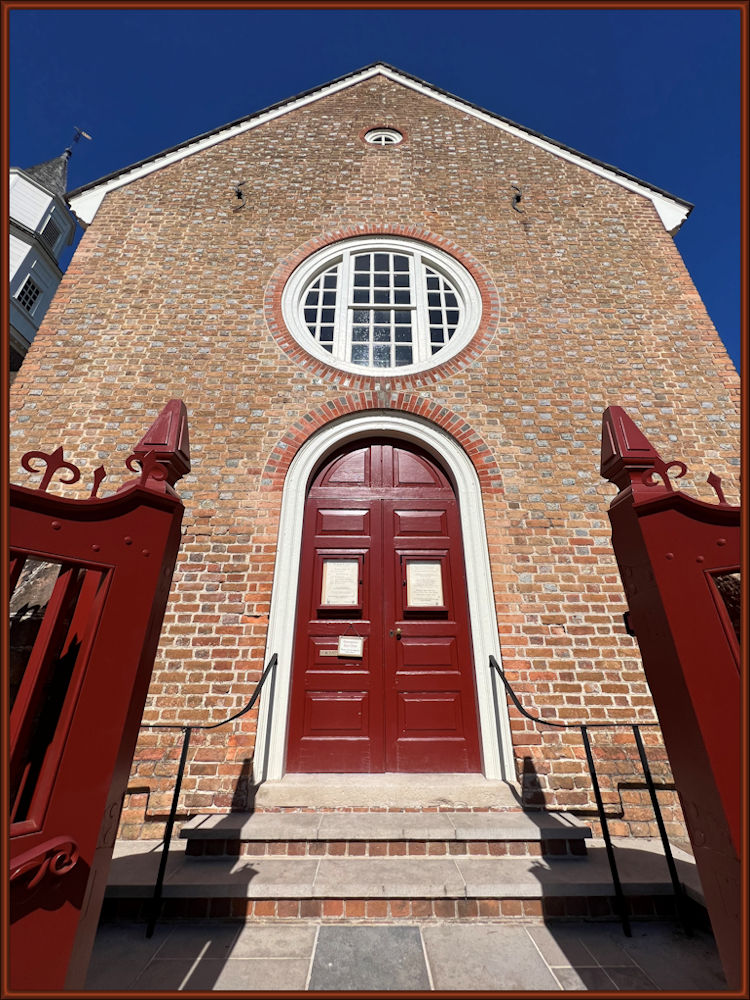
~Church with Red Door~

Have a great day everyone, and 
thanks for stopping by!


Tuesday, October 25, 2022

LONG WEEKEND IN WILLIAMSBURG - BRUTON PARISH CHURCH IN COLONIAL WILLIAMSBURG, VIRGINIA

 Gregg and I were in Williamsburg from Thursday to Sunday.  We were there to join in the celebration of a nephew getting married.  The Bride and Groom had glorious weather and it was a wonderful gathering of family and friends. 

Not wanting to drive up on the same day as the wedding rehearsal, we left 24 hours earlier and was able to enjoy a leisurely walk around Colonial Williamsburg.  It has always been one of our favorite places.  We have taken many people who visited, from both sides of our family, friends also, all of whom enjoyed it tremendously.  Most of Gregg's immediate family have lived not so far away since the 60s. I have been coming here off and on since we were married, as we only lived an hour's drive away for several years. Even now it is only a short three-hour drive.

I saw the above artwork on the wall of one of the gift shops. I thought it was delightful!
The painting shows part of The Bruton Parish Church, which was designated a National Historic Landmark in 1970 as a well-preserved early example of colonial religious architecture.  
The church was named after Bruton in the County of Somerset, England.  The name honored the prominent Ludwell family and Governor Sir William Berkeley whose ancestral homes were from Bruton.  It traces its roots back to both the Church of England and the new settlement of the Colony of Virginia at Jamestown in the early 17th century.
There is a lot of history at this website also.  It says it was the first Anglican church built in 1660, and its first rector was Reverend Rowland Jones.

In 1761, merchant James Tarpley presented the church with a bell. Bids for a steeple or belfry to house the bell were let on January 1, 1769. The vestry awarded a £410 contract for a brick tower surmounted by a wooden octagon and for miscellaneous repairs, to Benjamin Powell that September 14. The addition can be seen from outside the church, as the steeple bricks have a darker color than the salmon-hued bricks of the rest of the church. Tarpley's bell is still in use.

From this website, I read that among the Williamsburg notables buried beneath the marble flagstones inside the church was Governor Francis Fauquier, one of the best loved of the colonial governors, who died in 1768. 
The same year an English organ was installed. Gaolkeeper Peter Pelham was hired to play it for £25 a year, a position he held until about 1802. Pelham brought to church with him a prisoner from the Gaol, whose job it was to pump the instrument. The organ remained in service until 1835. The present organ, the church's fourth, was presented by John D. Rockefeller Jr. in 1954.

There is a lot more interesting history at the links provided above.  I will have more posts of our time in Williamsburg when I can put them together.


Thursday, February 18, 2021

ONE FROM THE ARCHIVES, A TRIP AROUND THE OLD CHURCH, WIDECOME-IN-THE-MOOR.

These were from the Spring of 2015.  Whenever I have gone back to my old home in the UK, I have always headed to Widecome-in-the-Moor, within the Dartmoor National Park.
I have been visiting Widecome-in-the-Moor since I was eight years' old, when my parents took us down to Devon for our holidays.  Eventually when we moved there when I was 15, Dad would often point the car to the Moors where we drove all over them, looking at the Dartmoor Ponies, climbing up Haytor, and then on to Widdicome-in-the-Moor for an afternoon tea.  It was always on the list of places to go.  We loved the Moors and we loved Widecome-in-the-Moor.  It holds many fond memories as I took Gregg there on our first date (we spent the day together two days after we met).  
You can read about the village for yourself here if curious, and also if you like to look at places for sale, I found a farmhouse that I would like to buy in my second lifetime.  Not in my league but maybe in that next lifetime I will come back as someone who can afford such a place.  Oh my!  Yes this is a bit of tongue in cheek, but it is lovely to look at.

The name of the village, according to Wikipedia, 
"is thought to derive from 'Withy-combe', which means Willow Valley.  According to the village's official website, at the time of the article, there were 196 households in the village, though its parish stretches for many miles and encompasses dozens of isolated cottages and moorland farms."  It brings in a lot of tourists during the year and can get quite crowded in peak season.  "The village is well known for Widecombe Fair held annually and is celebrated by a folksong of the same name, featuring "Old Uncle Tom Cobley and All.""

Added note: I often remember this phrase being used when describing how many people were invited to an event.  "And you know, there was Uncle Tom Cobley and all".  It is usually said when exasperated at the large group of people at any one gathering.  Not being one for crowds I used this phrase on occasion.  I can feel very closed in and panicky at such times, even more so if it is very hot and there you go, my secret is out!
The Church of Saint Pancras, where my photos were taken, is also known as the "Cathedral of the Moors" in recognition of its 135-foot tower and relatively large capacity for such a small village.  It was originally built in the 14th century, and was enlarged over the next two centuries, partly on the proceeds of the tin mining trade.  Inside the ceiling is decorated with a large number of decorative roof bosses, including the tinner's emblem of a circle of three hares (known locally as the Tinners' Rabbits).  It was badly damaged in the Great Thunderstorm of 1638, apparently struck by ball lightning during an afternoon service.  The building was packed with about 300 worshippers, four of whom were killed and around 60 injured.  Local legend relates that the disaster was caused by a visit from the Devil".  And that's a little bit of history about this church. 
I remember being very happy to see this flowering tree in bloom.  It is called a Golden chain tree, also known as Common laburnum, Laburnum and Bean tree.  This one was quite tall but they can grow 25 to 30 feet.  It is a small deciduous tree and can be toxic to people and animals.  There is a website here where you can get more information.  I am always very surprised when I see something as pretty as this, only to find out that it is very toxic but I suppose that applies to a lot of flowers and plants.  Apparently hares and deer can feed on it with no problems.  All that being said it was a beautiful tree and those yellow blooms were so very pretty.

If you type Widecome-in-the-Moor on Google using Images, you will get some great photos.  My post here (6th photo down) has a photo I took of the church looking down into the valley.

The last time we were there was with my niece and her husband in 2015, when these photos were taken.  We plan another trip back to the UK in the not too distant future.  And hopefully, when the world settles down a bit, we will be going back to Widecome-in-the-Moor.

Thanks for looking and enjoy your day.


Thursday, October 8, 2020

MISSION BASILICA SAN DIEGO DE ALCALA - PART 2

 Continuing our visit, this is California's first mission established in 1769.  There is a wealth of information on its history at this website.  Today we go into the gardens which are lovely.

Outside I read the following and I am repeating some of the information at the beginning of yesterday's post: "Padre Luis Jayme - Born Melchor Jayme on October 18, 1740 in the farming village of San Juan, Majorca, Spain. 
In 1760 he was received into the Franciscan Order and chose "Luis" as his religious name. Padre Jayme became pastor of the Mission San Diego in 1771 and was instrumental in moving the Mission inland from the Presidio to the present site in August of 1774. By December of that year, a number of adobe and thatch buildings were constructed. Crops were planted and many natives joined the mission life and were baptized as Christians.
Progress was being made until the early morning hours of November 5th, 1775, when hundreds of natives from surrounding rancherias set fire to the Mission buildings, pillaged the church and Padre Jayme was killed as he met them with his usual greeting, "jAmar a Dios, hijos - Love God my children!"
(This above photo and the cropped version below shows a statue of St. Francis)
"Padre Jayme became California's first Christian martyr because of his self-sacrifice, devotions, faith and love.  His remains are buried in the sanctuary of the church at Mission San Diego de Alcala."
(This is a statue of Father Junipero Serra)
A sign in the gardens tells us that "The Campanario is 46 feet high and holds the Mission bells. The crown-topped bell on the lower right is named Ave Maria Parisma - Immaculate Mary. It weighs 805 pounds and was cast in 1802. A crown-topped bell was usually supplied by the Spanish King and cast in the royal foundry in Barcelona at the King's expense or made in a country ruled by Spain. Ave Maria Parisma was in the vestibule of St. Joseph's church and was hung in the campanario after the reconstruction of Mission San Diego in 1931.
The bell on the lower left is called the Mater Dolorosa - Our Lady of Sorrows. It weighs 1200 pounds and was recast by the Standard Iron Works of San Diego in 1894 from bell fragments found in the vicinity of the Mission.
The bells played an important role in the everyday life of the Mission. A sequence of tones and rhythms was developed for each occasion. They were used to announce times for Mass, work, meals and siestas. The bells signaled danger, rang solemnly to honor the dead and pealed joyously to celebrate feast days, weddings and fiestas.


Gregg walking along the corridor.
These show a few of the Saints mentioned before, representing the other nine missions.  They were behind a grid of iron fencing, but I was able to capture five free of obstruction by placing my lens between the bars.
Just before we left, a group of young people arrived. You can just make out Gregg on the right as he waited for them to go into the Mission. I think what we were witnessing and felt privileged to see was a young girl's Quinceañera, a celebration when a girl reaches 15, a transition from childhood to young womanhood so I read. (Click on the name where you can learn more if interested.) The young lady wore a long, strapless, bright red gown, one of the young men, her escort I believe, wore a white tux. The couple looked very striking and at the time I remember thinking they must have only been about 15 or so.
This was the vehicle they arrived in.
Their arrival coincided with our departure, as we had looked around for some time and were ready to move on.  
Notice those bright red orbs?  They are from a pomegranate tree.  I have never seen a pomegranate tree before, and the one on the grounds was loaded with their fruit. 
One had fallen onto a stone bench so we couldn't resist taking a photo.
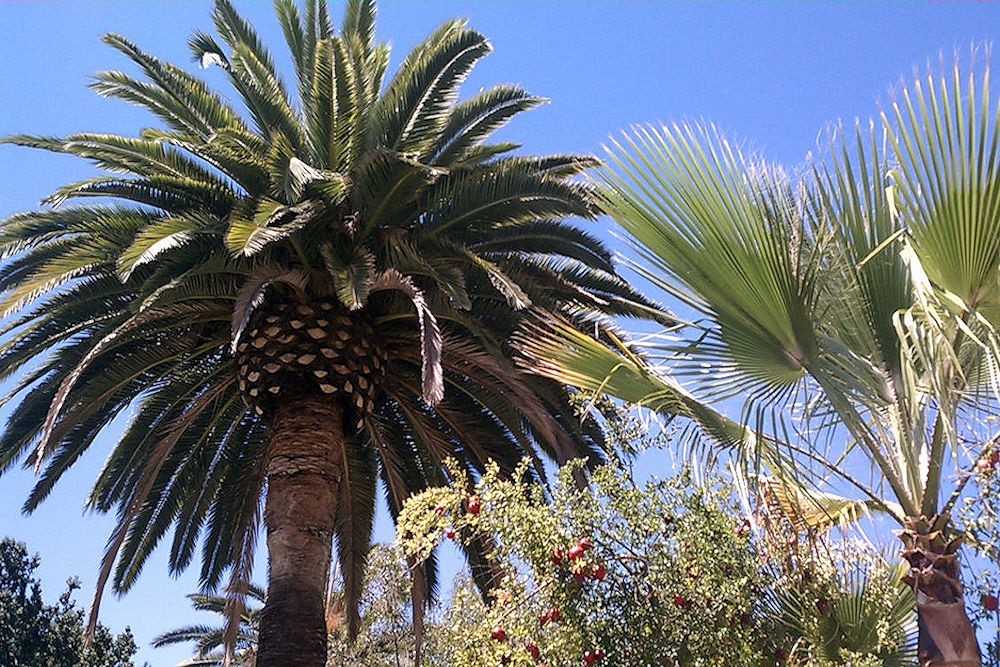
I loved the palm trees also.
We don't get these in our area back home, and we were immediately drawn to them.
And let's not forget those pomegranates.  The only time I have seen this pretty fruit is at our grocery market in the produce area.
We came across the large white stone cross in a section of the garden.
This is the bell from the Spanish King.
I am very glad we got the chance to visit the Mission. When we lived here all those years ago we never knew what we had missed, although I do remember visiting another in the area.
I am very happy we came back as tourists.  We got to see a lot for the first time.  It seemed we were busy with other priorities back in those days and we were much younger of course. With busy schedules, Gregg with his navy days in full swing, and me being a navy wife with many responsibilities, looking after a small child who was my biggest responsibility and wouldn't have had it any other way of course, I didn't realize we were missing so many beautiful places.  All the more reason to come back at an age where we not only had the time, but could appreciate them, and we certainly did.

Another place I would enjoy going back to one day.