The first two photos are of Witch Hazel. It is known by several names: American witch-hazel, Common witch hazel, Striped alder, Tobacco-wood, Spotted alder, Water-witch, Snapping Hazelnut, Winterblooms and Witchhazel Witch-hazel! Its botanical name is Hamamelis virginiana.

Witch hazel was used quite commonly in the 20th century for locating water sources. The practice, called dowsing or water witching, which is still occasionally used. You can read about the practice here. In dowsing, a forked stick of the witch hazel is held perpendicular to the ground and moved slowly over it. The belief is that when a water source is directly under the stick, it will dip or jump. I also wrote about Witch Hazel in my post at this link, along with other photos around the garden.

Next, the Star Magnolia (Botanical name: Magnolia stellata). It is also known as the Royal star magnolia.

I had a hard time choosing between the photos I took of this ornamental shrub, deciding to share several today.

It grows from 5 to 8 feet in height and can cope with cooler climates. It does, however, need a sunny spot in the garden, with some partial shade for protection during the summer months. In fact, it is advised to plant in an area that will protect the magnolia from winds and frost. Otherwise, the flowers may be discolored as the buds open before the leaves appear.

Star Magnolia is a small, slow-growing shrub native to Japan. As you can see, compared to other magnolias, it has much narrower petals resembling a star-like shape, hence the name.
 It has 3-4" fragrant white or pink flowers with dark green leaves and a gray bark. It certainly was lovely to see it blooming on our way into the garden.
The back of the house that I have always loved. Its history can be read here, but in part it was built in 1784 by John Moss.


Next you can see it from its side view. It is near one of the entrances near the parking lot.

More daffodils...

Hellebores which I wrote about yesterday.

We planted these in front of our own home and I am hoping they survived the winter.

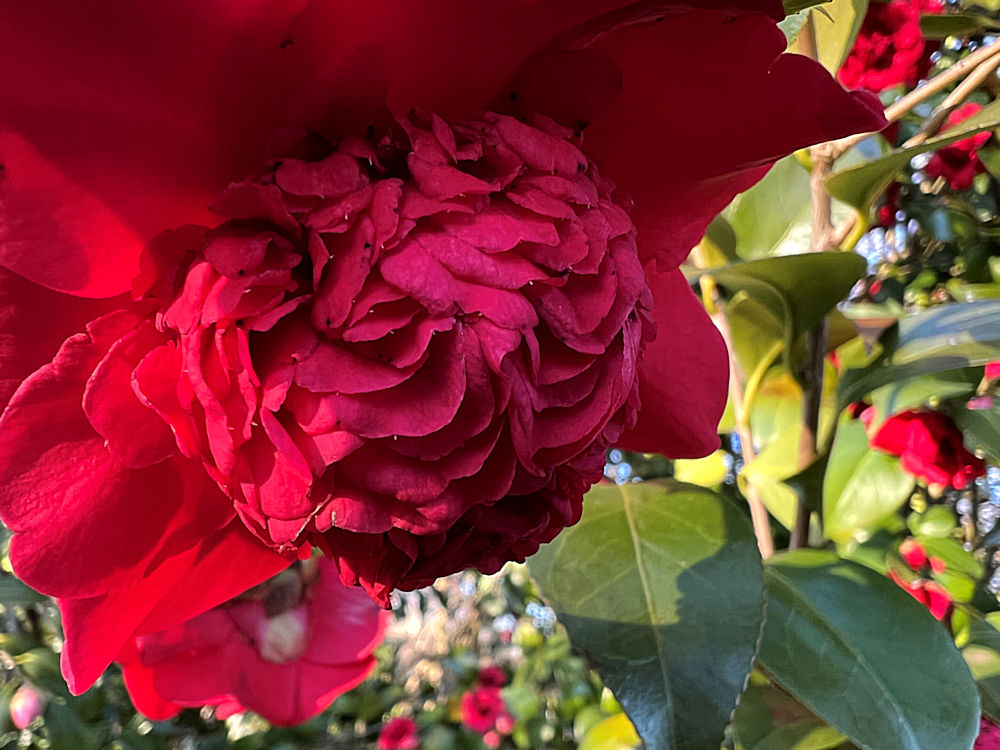
Lastly, the tree towered above me with a profusion of blooms. It is the Japanese camellia, botanical name Camellia japonica, and as the name would infer, it is native of Japan. Also known as Common camellia and Rose of Winter.

It can grow up to 49 feet and does best in partially shady spots with rich, well-drained soil. It also has very little fragrance. I read that it can be given coffee grounds as long as it is mixed into a well-prepared compost. Coffee grounds are rich in nitrogen, as well as some other micronutrients. Japanese camelia's have been known to live for over a century in the wild.

Many of the blooms were past their peak. Still very pretty though.
A small pink Japanese camelia was growing next to the larger tree, and those blooms were not quite as worn.

We had parked our car on the other side of the barrier at one of the entrances. Though people are welcome to stay in the garden until 6.00 p.m. after which it starts to get dark, the parking lot closes at 5.00 p.m. We didn't arrive until 4.40 p.m. and thought it wise to park outside on the road that leads into the garden.

