Showing posts with label San Diego_California. Show all posts

Wednesday, July 29, 2026

RANDOM PHOTO - A HUMMINGBIRD ON A CANNA LILY

Tiny but mighty, a phrase which I often hear used when describing the hummingbird. They are the only birds that can fly backwards and completely upside down. Their wings rotate in a figure-eight pattern, operating like helicopter rotors to allow stationary hovering. They can beat its wings 50 to 80 times per second. They glide at 30 miles per hour and reach 60 miles per hour during mating dives. They are among the most evolutionarily unique creatures in the animal kingdom. They are native exclusively to the Western Hemisphere, with over 300 distinct species distributed across North and South America. 

 I couldn't get a definite ID on this hummingbird. Two possible suggestions are an Anna's hummingbird or that of a Black-chinned hummingbird. If anyone can verify with certainty, please let me know. It is sipping the nectar from an African arrow/Indian root/Purple arrowroot/Edible canna or Canna lily. All names may apply. Both bird and flower were seen while walking around the San Diego Zoo in California. Another old one from 2013.

Thanks for looking and enjoy your day.


Thursday, September 5, 2024

RANDOM PHOTO - A KOOKABURRA, NO, A KINGFISHER BUT NOW A KOOKABURRA

 I realize my title is totally confusing! This beauty, the Kookaburra, no not a Kookaburra as I had originally ID’d it, but identified as a Kingfisher by Elephant Child as you can see in her comment. Thank you very much! I looked up the various Kingfishers and stretching myself out at the end of the limb, I found a Red-backed Kingfisher here. Please let me know if you think I am correct, or not. The rest of my writing will apply to the Kookaburra in my second photo. The bird I now know as a Kingfisher was seen at the San Diego Zoo in September 2010. I remember being enthralled, totally riveted. I am at a loss as to how I misidentified it back then. Perhaps there were other birds in the aviary that I didn’t see at the time and read the sign nearby.You can read about the kookaburra at this link. Our Australian friends may have personal knowledge of both extraordinary birds, which I would love to read in a comment, and thank you again Elephant Child for clearing this up for me. 


And now for the ‘real’ one. I have to say, the Kingfisher is still a gorgeous bird! I have provided several links that the website shared about the Kookaburra in the following paragraph. I read:

"Kookaburras are terrestrial tree kingfishers of the genus Dacelo native to Australia and New guinea, which grow to between 11 and 19 inches (28 and 47 cm) in length and weigh around 11 ounces (300 g). The name is a loanword from Wiradjuri, "guuguubarra", onomatopoeic of its call. The loud, distinctive call of the laughing kookaburra is widely used as a stock sound effect in situations that involve an Australian bushy setting or tropical jungle, especially in older movies. They are found in habitats ranging from humid forest to arid savannah, as well as in suburban areas with tall trees or near running water. Though they belong to the larger group known as "kingfishers", kookaburras are not closely associated with water."


Addition on the same day:

I found this on my old blog just now. It was quite a while after seeing the one above in San Diego on the west coast.  This was found at a small zoo in our general area (east coast).  I added it and also the poem.  

I am also adding a cute video of the Kookuburra song on YouTube here.

“I took a photo of this sweet bird at the Reston Zoo a few weeks ago (this was actually in 2010).  It is a dream to see one in its own habitat one day.”


The Kookaburra
~Frank Halliwell~

They congregate at break of day,
When night is almost done,
For a joyous benediction
To the rising of the sun.

And once again come evening,
When the western sky so bright,
Surrenders all its duties
To the velvet cloak of night.

I'd like someone to explain to me,
Before I turn to clay
'Cause I've never heard that cackle
In the middle of the day.

Why they sometimes start at 4 AM
And wake me with a fright,
To join with them, to celebrate
The middle of the night.


Thursday, July 28, 2022

THE LION SLEEPS TONIGHT...


The Lion Sleeps Tonight/Today, not in the mighty jungle but in the San Diego Zoo.  It must have been very hot there too.

It's been a long time since I thought about this song.  I still like it!  You can listen to it here.

The photo is with thanks to my son and daughter-in-law who spent a few hours at the zoo yesterday.


Wednesday, March 3, 2021

POLAR BEARS FROM SEA WORLD IN SAN DIEGO, CALIFORNIA

Before we moved to Virginia a little over 30 years ago, we used to live in San Diego.  One of our favorite places to go to was Sea World. Quite a while ago now, our son found an old photo album of the last trip we made.  I started cataloguing all the old photos and putting them on a portable hard drive.  Among the photos were the polar bears. That day they were very active and we thoroughly enjoyed their underwater antics. Our son took all the photos shared today.
We originally moved to San Diego from Virginia when our son was ten years' old. Hubs was still in the navy and on his very first day at his new job he dropped us off at Sea World. We arranged to meet him at the end of the day. It was the first time we had been there and the day was magical, the time just flew by. 
We walked over every square inch and so many shows and exhibits, so many things that first time and we couldn't wait to share our day with his Dad. We told him all about it on the ride home and it wasn't long afterwards that the three of us went back. 
There is a great link here designed for children, and it has a wonderful map of where polar bears live in their natural habitat.
The Polar Bear's scientific name is Ursus maritimus, and they live between 25 to 30 years.
A polar bear's skin is black and its fur is transparent with a hollow core that reflects and refracts light from the sun and off the snow, making it appear white.  This adaptation helps polar bears keep warm as their fur reflects heat from the sun down the hair shaft, so that it can be absorbed by their black skin.
I found that information here.
A polar bear asks another bear for something, such as food, through a nose-to-nose greeting.  The guest bear will approach slowly, circle around a carcass, then delicately touch the feeding bear's nose to ask for permission to share.  I found that information here.
Polar bears are the largest bear species in the world, growing to a maximum length of 8.5 feet (260 cm) and weight of 1,543 pounds (700 kg), with males growing about twice as large as females.  I came by that information here.
Polar bears clean themselves by rolling in the snow.  Staying clean also helps the insultating properties of their fur, so after feeding they will often freshen up by taking a swim or roll in the snow.  Rolling in the snow also helps cool them off when they get too hot.  That information I found at this site.
At the same website I learned that they are quick on their feet.  Polar bears can reach speeds of up to 25 mph (40km) on land.

Quite an amazing animal who are sadly endangered out in the wild.  The biggest threat to polar bears is shrinking sea-ice as climate change is causing it to melt earlier and forming later each year, which means the polar bears have less time to hunt on top of the sea-ice. 

I hope you have enjoyed these old photos of the polar bears.  Thanks for stopping by and have a great day.


Thursday, October 8, 2020

MISSION BASILICA SAN DIEGO DE ALCALA - PART 2

 Continuing our visit, this is California's first mission established in 1769.  There is a wealth of information on its history at this website.  Today we go into the gardens which are lovely.

Outside I read the following and I am repeating some of the information at the beginning of yesterday's post: "Padre Luis Jayme - Born Melchor Jayme on October 18, 1740 in the farming village of San Juan, Majorca, Spain. 
In 1760 he was received into the Franciscan Order and chose "Luis" as his religious name. Padre Jayme became pastor of the Mission San Diego in 1771 and was instrumental in moving the Mission inland from the Presidio to the present site in August of 1774. By December of that year, a number of adobe and thatch buildings were constructed. Crops were planted and many natives joined the mission life and were baptized as Christians.
Progress was being made until the early morning hours of November 5th, 1775, when hundreds of natives from surrounding rancherias set fire to the Mission buildings, pillaged the church and Padre Jayme was killed as he met them with his usual greeting, "jAmar a Dios, hijos - Love God my children!"
(This above photo and the cropped version below shows a statue of St. Francis)
"Padre Jayme became California's first Christian martyr because of his self-sacrifice, devotions, faith and love.  His remains are buried in the sanctuary of the church at Mission San Diego de Alcala."
(This is a statue of Father Junipero Serra)
A sign in the gardens tells us that "The Campanario is 46 feet high and holds the Mission bells. The crown-topped bell on the lower right is named Ave Maria Parisma - Immaculate Mary. It weighs 805 pounds and was cast in 1802. A crown-topped bell was usually supplied by the Spanish King and cast in the royal foundry in Barcelona at the King's expense or made in a country ruled by Spain. Ave Maria Parisma was in the vestibule of St. Joseph's church and was hung in the campanario after the reconstruction of Mission San Diego in 1931.
The bell on the lower left is called the Mater Dolorosa - Our Lady of Sorrows. It weighs 1200 pounds and was recast by the Standard Iron Works of San Diego in 1894 from bell fragments found in the vicinity of the Mission.
The bells played an important role in the everyday life of the Mission. A sequence of tones and rhythms was developed for each occasion. They were used to announce times for Mass, work, meals and siestas. The bells signaled danger, rang solemnly to honor the dead and pealed joyously to celebrate feast days, weddings and fiestas.


Gregg walking along the corridor.
These show a few of the Saints mentioned before, representing the other nine missions.  They were behind a grid of iron fencing, but I was able to capture five free of obstruction by placing my lens between the bars.
Just before we left, a group of young people arrived. You can just make out Gregg on the right as he waited for them to go into the Mission. I think what we were witnessing and felt privileged to see was a young girl's Quinceañera, a celebration when a girl reaches 15, a transition from childhood to young womanhood so I read. (Click on the name where you can learn more if interested.) The young lady wore a long, strapless, bright red gown, one of the young men, her escort I believe, wore a white tux. The couple looked very striking and at the time I remember thinking they must have only been about 15 or so.
This was the vehicle they arrived in.
Their arrival coincided with our departure, as we had looked around for some time and were ready to move on.  
Notice those bright red orbs?  They are from a pomegranate tree.  I have never seen a pomegranate tree before, and the one on the grounds was loaded with their fruit. 
One had fallen onto a stone bench so we couldn't resist taking a photo.
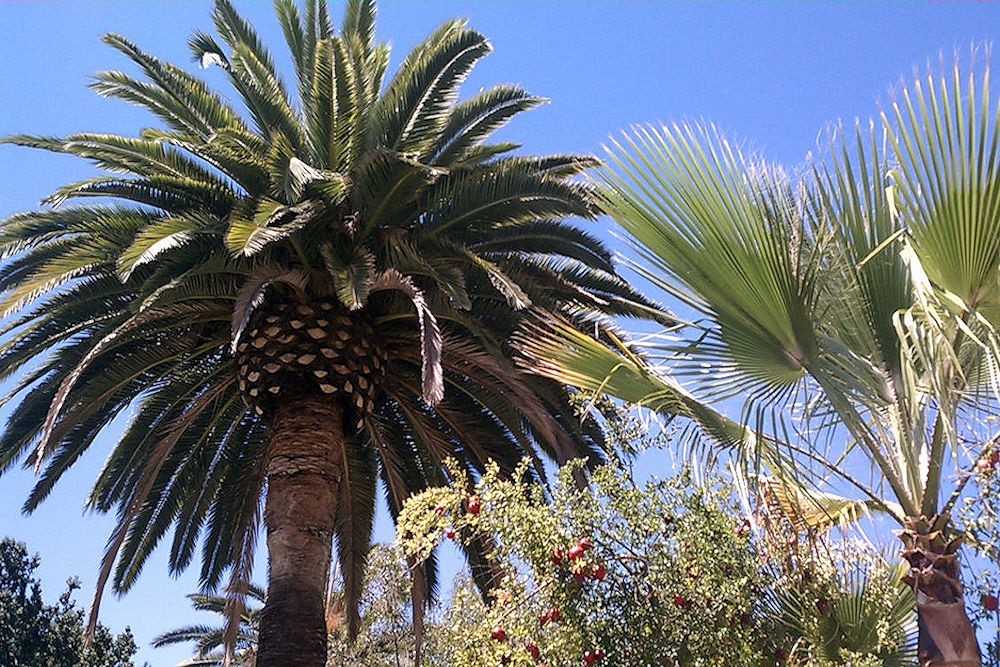
I loved the palm trees also.
We don't get these in our area back home, and we were immediately drawn to them.
And let's not forget those pomegranates.  The only time I have seen this pretty fruit is at our grocery market in the produce area.
We came across the large white stone cross in a section of the garden.
This is the bell from the Spanish King.
I am very glad we got the chance to visit the Mission. When we lived here all those years ago we never knew what we had missed, although I do remember visiting another in the area.
I am very happy we came back as tourists.  We got to see a lot for the first time.  It seemed we were busy with other priorities back in those days and we were much younger of course. With busy schedules, Gregg with his navy days in full swing, and me being a navy wife with many responsibilities, looking after a small child who was my biggest responsibility and wouldn't have had it any other way of course, I didn't realize we were missing so many beautiful places.  All the more reason to come back at an age where we not only had the time, but could appreciate them, and we certainly did.

Another place I would enjoy going back to one day. 


Wednesday, October 7, 2020

MISSION BASILICA SAN DIEGO DE ALCALA - PART 1

 This is from an old post several years ago.  We were on a road trip and stopped at the Mission Basilica San Diego de Alcala, California's first mission founded by Friar Junipero Serra on July 16th, 1769.

Friar Junipero Serra was a priest in the Franciscan order of the Catholic Church, and a driving force in the Spanish conquest and colonization of what is now the state of California.  He was born into a humble family on the Spanish island of Mallorca in the Mediterranean Ocean.  His parents sent him to a nearby Franciscan school, and his intellectual abilities soon caught the attention of his teachers.  At the age of fifteen he enrolled in a prominent Franciscan school in the nearby city of Palma.  The next year he became a novice in the Franciscan order, and shortly thereafter was ordained a priest.pero Serra.  I found the information above from his biography at this website, where there is a lot more information on his life.

You can read a full history of the Mission if you go here and an article written here.
A nearby marker told us about the façade. It read: "As a result of the Indian attack of 1775, Padre Serra returned during the summer of 1776 to initiate the reconstruction of Mission San Diego. The church and buildings were rebuilt and the Mission flourished for a number of years.

Earthquakes of the early 1800's destroyed most of the adobe buildings and church. The structures were rebuilt and the buttress wings were added in 1812 to strengthen the façade of the church. By the early 1920's, portions of the walls adjoining the buttresses, the campanario (bell tower) and the baptistry were the only walls that remained standing.
The doors are replicas made of redwood and the carvings are taken from actual designs that were on the original doors. The emblem over the door is the papal insignia and signifies that Mission San Diego is a minor basilica. This honor was bestowed on the Mission by Pope Paul VI in 1976.
The statues in the niches along the corridor (a few of those saints are shown in a mosaic further along the post) represent the nine missions founded by Padre Serra, in chronological order. 
Each statue represents the saint for whom that mission was named."
Inside I was struck by its beauty. As you can see we are looking towards the Altar....
and in the following photo we are looking in the opposite direction which shows where we entered.


Added note 10-11-20: I had a couple of comments from blogging friends asking about these photos of the Virgin Mary.  The first comment was from Sandi who asked about the head at the bottom of her feet.  The second comment came from Great-Granny Grandma. Their questions peaked my interest and I found this page online with more information.  I thought I should add it to my post.   Thank you to both Sandi and Great-Granny Grandma for sowing that seed for me to learn more.

What I learned was the head at her feet was actually an angel supporting her. You can read about the symbolism in the following link, which is a repeat of the one above.

http://www.olgaustin.org/symbolism.shtml

I also found a paragraph that reads:

"The angel supporting the Lady testifies to her royalty. To the Meso-American Indians only kings, queens and other dignitaries would be carried on the shoulders of someone. The angel is transporting the Lady to the people as a sign that a new age has come."

In my next post I will share the garden.