Showing posts with label Quiz Questions and Answers. Show all posts

Friday, December 3, 2021

DECEMBER QUIZ - ANSWERS TO YESTERDAY'S QUESTIONS


Okay, here we go!


Question: Who sent the very first photographic Christmas Card?

Answer: Annie Oakley
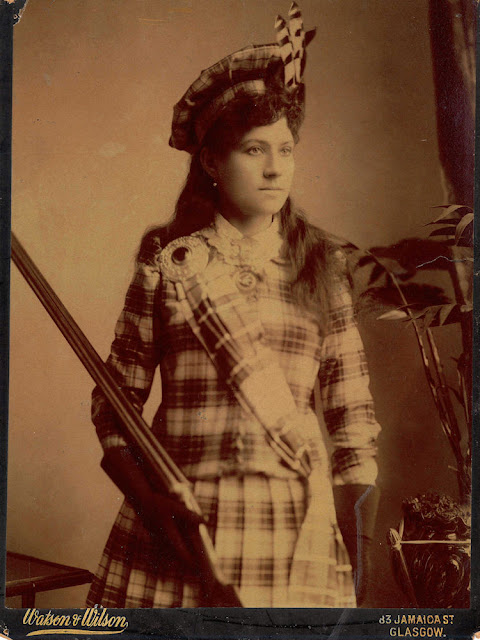
Annie Oakley, as many of you already know, was an American sharpshooter and trick-shot specialist, who toured with Buffalo Bill's Wild West Show.


On her first visit to Glasgow, Scotland in 1891, she had a special tartan outfit made and, as the show was in town over Christmas, she had herself photographed wearing it, at the Watson & Wilson Studios, in Jamaica Street.  She liked this photo so much that she had the photo turned into her own Christmas Card, sending it all over the world.  This card is acknowledged to be the world's first photographic Christmas Card.

My information came from this link, and Annie's biography can be read here

And the history of Christmas cards can be found here.

Question: Which country started the tradition of putting up a Christmas tree?

Answer: Germany

Germany is credited with starting the Christmas tree tradition as we now know it in the 16th century, when devout Christians brought decorated trees into their homes. Some built Christmas pyramids of wood and decorated them with evergreens and candles if wood was scarce. It is a widely held belief that Martin Luther, the 16th-century Protestant reformer, first added lighted candles to a tree. Walking toward his home one winter evening, composing a sermon, he was awed by the brilliance of stars twinkling amidst evergreens. To recapture the scene for his family, he erected a tree in the main room and wired its branches with lighted candles.

More information about the origins of the Christmas Tree can be found here.


Question: What's a baby rabbit called?

Answer: a kitten or kit

Rabbits can have up to 15 babies, but the average litter size is 7. The female rabbit is called a doe, giving birth is called kindling and baby rabbits are called kittens. Rabbit kits are born with their eyes and ears sealed shut, and completely furless.

Other names for baby animals?

A baby antelope is called a calf

A baby beaver is called a kit

A baby coyote is called a puppy

A baby eel is called an elver

A baby fish is called a fry

A baby pigeon is called a squab or a squeaker

A baby rat is called a pup

A baby spider is called a spiderling

A baby zebra is called a foal


Question: What is the smallest country in the world?

Answer: Vatican City

Vatican City is officially called the Vatican City State, an independent city state and enclave located within Rome, Italy. It became independent from Italy with the Lateran Treaty in 1929, and it is a distinct territory under "full ownership, exclusive dominion, and sovereign authority and jurisdiction" of the Holy See.  It covers an area of 49 hectares (121 acres), and is the smallest state in the world by both area and population, which is about 825, according to what I read on Wikipedia on 11-26-21.  

That information and much more came from here.


According to Greek mythology, who was the first woman on earth?

Answer: Pandora

In Greek mythology, Pandora was the first human woman created by Hephaestus on the instructions of Zeus.  Her other name - Anesidora - "she who sends up gifts" ('up' implying "from below" within the earth).  As Hesiod related it, each god cooperated by giving her unique gifts. 

Pandora's box I have known of since childhood, when I first became interested in Greek mythology, sometimes taught at school.  It is an artifact connected with the myth of Pandora in Hesiod's "Works and Days".  He reported that curiosity led her to open a container left in care of her husband, thus releasing physical and emotional curses upon mankind.  Stories are varied and have focused more on the contents than on Pandora herself.  "A present which seems valuable but which in reality is a curse."

My information came from this link.


Thanks so much for joining me today.  I hope you enjoyed the quiz.  Have a great weekend!



(The owls came from pixababy.com)


Thursday, December 2, 2021

DECEMBER QUIZ - QUESTIONS, WITH ANSWERS TOMORROW

I will always begin by saying that there is no pressure and this is only for fun.  I don't always know the answers.  Some I may have known but are long forgotten, and I enjoy the refresher, or learning something new.

As I am in the middle of writing Christmas Cards, I thought I would start off this month with a related question.


Question: Who sent the very first photographic Christmas Card?


Question: Which country started the tradition of putting up a Christmas tree?


Question: What is a baby rabbit called?


Question: What is the smallest country in the world?


According to Greek mythology, who was the first woman on earth?


Thanks so much for joining me today.  I will be posting the answers tomorrow.


(My illustrations came from pixababy.com)


Thursday, November 4, 2021

NOVEMBER QUIZ - ANSWERS TO YESTERDAY'S QUESTIONS


Question 1: The unicorn is the national animal of which country?

Answer: Scotland

When did Scotland adopt the unicorn?  The answer to that question lies in heraldry - the age-old practice of designing coats of arms or crests to distinguish between groups of people, armies or institutions.  Using heraldry as our guide, we can see that the unicorn was first introduced to the royal coat of arms of Scotland around the mid 1500s..

Prior to the Union of the Crowns in 1603, their coat of arms was supported by two unicorns. However, when King James VI of Scotland also became James I of England, he replaced one of the unicorns with the national animal of England, the lion, as a display of unity between the two countries. Of course, folklore fans will know that lions and unicorns have always been enemies, locked in a battle for the title of ‘king of beasts’.

More information can be found here.


Question 2: Who was the first woman to win a Nobel Prize (in 1903)?

Answer: Marie Curie, née Sklodowska

Madame Curie won the Nobel Prize in Physics, 1903.  She was also awarded the Nobel Prize in Chemistry in 1911.

She was born on November 7th, 1867 in Warsaw, Russian Empire (now Poland), and died on July 4th, 1934 in Sallanches, France.  Cause of death was aplastic anemia from exposure to radiation in the course of her scientific research, and in the course of her radiological work at field hospitals during World War I.

More interesting information can be found here.


Question 3: What is the only fruit that has its seeds on the outside.

Answer: Strawberry

Here are other facts for you about one of my favorite fruits.

Strawberries are the first fruit to ripen each spring.

There are 200 seeds on an average strawberry.

The seeds can grow into new strawberry plants, but most instead reproduce through runners.

Strawberries are considered members of the rose family, they give off a sweet fragrance as they grow on bushes.

Considered a perennial, strawberry plants will grow back year after year.

Although they don't always grow fruit immediately, once they do, the plants can last up to 5 years.

The lesser-known tabletop method of cultivation, where strawberries hang from the ceiling in containers, is gaining in popularity for its practicality. Keeping strawberries off the ground keeps them away from pests and soil-borne diseases.

Ancient Romans believed strawberries had medicinal powers. They were used to treat everything from depression to fever and sore throats.

Native Americans were also among the earliest people to eat strawberries. They introduced European settlers to the fruit.

There are three different types of strawberries: June-bearing, overbearing and day neutral. But June-bearing are the most flavorful berries.

Don't rinse cut strawberries under water until you're ready to eat them - it speeds up spoiling.

Strawberries are grown in every single U.S. state and Canadian province.

I got all my information from this link.


Question 4: Cirque du Soleil started in what country?

Answer: Canada

"At the dawn of the 1980’s, a troupe of performers founded by Gilles Ste-Croix took their talent to the streets of Baie-Saint-Paul, a charming village on the shores of the St. Laurent River near Quebec City. Known to the public as Les Échassiers de Baie-Saint-Paul (The Stiltwalkers of Baie-Saint-Paul), this group would form the core of what would grow into Cirque du Soleil. This crew had an eclectic show, highlighting jugglers, dancers, fire breathers, and musicians who pleased local fans with their act. Little did these early fans and performers know that these embryonic beginnings would lead to something magical, exciting, and revolutionary on a global scale."

I found this information at their website here.


Question 5: where is the largest volcano of the world?

Answer: Tamu Massif volcano is the largest. It is an extinct submarine shield volcano in the northwest Pacific Ocean with the characteristics of a hybrid between a mid-ocean ridge and a shield volcano.   On 5 September 2013, researchers announced that it could be a single volcano, a claim which, if corroborated, would make Tamu Massif the largest known volcano on Earth. Tamu Massif is located in the Shatsky Rise about 990 miles/1,600 km east of Japan. The volcano covers an area of about 214,000 sq mi/553,000 square kilometres. Its summit is about 6,500 ft./1,980m below the surface of the ocean, and its base extends to about 4.0 mi/6.4 km deep. The volcano is about 14,620 ft/4,460 metres tall.

This information came from this link.


I will be back next month with another quiz. I hope you found this interesting and fun.

Thanks for joining in, and have a great weekend.


Wednesday, November 3, 2021

NOVEMBER QUIZ - QUESTIONS

I will add this each month. There is no pressure and this is only for fun.  I don't always know the answers.  Some I may have known but long forgotten, and I enjoy the refresher, or learning something new.


Question 1: The unicorn is the national animal of which country?

Question 2:  Who was the first woman to win a Nobel Prize?

Question 3: What is the only fruit that has its seeds on the outside.

Question 4: Cirque du Soleil started in what country?

Question 5:  Where is the largest volcano of the world?


I will be posting the answers tomorrow.


Friday, October 8, 2021

OCTOBER QUIZ - ANSWERS TO YESTEREDAY'S QUESTIONS

Question: Who is this WWI Ambulance Driver?

Answer: The driver is Walt Disney.  A clue is perhaps the cartoon drawn on the side, though I could find no mention of it.  This photo was taken before Walt left Paris to return home.


When the United States entered the war in 1917, Walt Disney's older brothers enlisted but Walt, who was 16 years old at the time, was denied enlistment because of his age.  However, he was determined to join up and when a friend learned that the Red Cross Ambulance Corps accepted volunteers as young as 17, Walt used his artistic skills to alter the birth date on his passport application from 1901 to 1900.  He was accepted and reported for training at Camp Scott, a temporary encampment near the University of Chicago.  Yellow Cab Company mechanics taught recruits how to repair motors, assemble and disassemble vehicles, and drive over rough terrain.  

Because his departure to Europe was delayed while he recovered from influenza, Disney's unit sailed without him.  He then joined another company awaiting transport to France.  While that unit waited to be shipped out, the war ended with the armistice on November 11th, 1918.  Nevertheless, they shipped out 50 men the following day to aid in the occupation.  Disney was No. 50.
Because he hadn't left the United States until after the war ended, Walt never fulfilled his desire to be an official ambulance driver, and never experienced the danger and real horrors of war, but he did his duty and put in his fair share of driving.  Disney was first billeted in a chateau in St. Cyr.  Later he transferred to Evacuation Hospital No. 5 near Paris, where his duties included being a driver and mechanic for Red Cross supply trucks and providing taxi service for army officers.  

There is more to this very interesting story and you can read it at this link.


Question: Name the largest continent of the world?

Answer: Asia.

Asia ranks as the biggest continent and it occupies almost 29.1% of the Earth's landmass.  The continent extends for 176,139,445 square miles and is home to 4.1 billion people.  Some people regard Asia and Europe as being a single continent, thus making it the largest by far.

My information came from here.


How many bones are there in a human body?

Answer: 206 

Bones provide the structure for our bodies. The adult human skeleton is made up of 206 bones. These include the bones of the skull, spine (vertebrae), ribs, arms and legs. Bones are made of connective tissue reinforced with calcium and specialised bone cells. Most bones also contain bone marrow, where blood cells are made.

Bones work with muscles and joints to hold our body together and support freedom of movement. This is called the musculoskeletal system. The skeleton supports and shapes the body and protects delicate internal organs such as the brain, heart and lungs.

Bones contain most of our body’s calcium supply. The body is constantly building up and breaking down bone tissue as required. Healthy bone needs a balanced diet, regular weight-bearing exercise and the right levels of various hormones.

My information and more came from this link.


Which state in the U.S. is known as the Empire State?

Answer: New York State.

How did it get this name?  Signs commonly point to George Washington. Although other, unsubstantiated stories crediting Washington exist, the best documented source is a 1785 thank-you letter to the New York Common Council for bestowing upon him the Freedom of the City. In addition to praising New York's resilience in the war he describes the State of New York as "the Seat of the Empire."

My information came from here and even more information can be found here.


Who created Winnie the Pooh?

Answer: A.A. Milne.

Winnie-the-Pooh, also called Pooh Bear and Pooh, is a fictional teddy bear created by English author A. A. Milne and English Illustrator E. H. Shepard

The first collection of stories about the character was the book Winnie-the-Pooh (1926), and this was followed by The House at Pooh Corner (1928). Milne also included a poem about the bear in the children's verse book When We Were Very Young (1924) and many more in Now We Are Six (1927). All four volumes were illustrated by E. H. Shepard. 

The Pooh stories have been translated into many languages, including Alexander Lenard's Latin Translation, Winnie ill Pu, which was first published in 1958, and, in 1960, became the only Latin book ever to have been featured on The New York Times Best Seller list. 

In 1961, Walt Disney Productions licensed certain film and other rights of Milne's Winnie-the-Pooh stories from the estate of A. A. Milne and the licensing agent Stephen Slesinger, Inc., and adapted the Pooh stories, using the unhyphenated name "Winnie the Pooh", into a series of features that would eventually become one of its most successful franchises.

Christopher Milne had named his toy bear after Winnie, a Canadian black bear he often saw at London Zoo, and Pooh, a swan they had encountered while on holiday. 

A. A. Milne named the character Winnie-the-Pooh after a teddy bear owned by his son, Christopher Robin Milne, on whom the character Christopher Robin was based. 

This was Christopher in 1928

The rest of Christopher Milne's toys – Piglet, Eeyore, Kanga, Ro and Tigger were incorporated into Milne's stories.  Two more characters, Owl and Rabbit, were created by Milne's imagination, while Gopher was added to the Disney version. Christopher Robin's toy bear is on display at the Main Branch of the New York Public Library in New York City.

I could go on but more information can be found here.  It is a fascinating story.


How many days are there in a fortnight?

Answer: 14.

A fortnight is a unit of time equal to 14 days (2 weeks). The word derives from the Old English term fēowertyne niht, meaning "fourteen nights".  The word is rarely used in North America. I grew up using the term and hadn't thought of it in a long time until finding this for my monthly quiz.  The above snippet of information was found here.


I will be back next month with another quiz. I hope you found this interesting and fun.

Thanks for joining in, and have a great weekend.


Thursday, October 7, 2021

OCTOBER QUIZ - QUESTIONS - ANSWERS TOMORROW

I will add this each month as I want you to know there is no pressure and this is only for fun.  I don't always know the answers.  Some I may have known but long forgotten, and I enjoy the refresher, or learning something new.


Starting off with a photo.  

Question: Who is this WWI Ambulance Driver?


Question: Name the largest continent of the world?


Question: How many bones are there in a human body?


Question: Which state in the U.S. is known as the Empire State?


Question: Who created Winnie the Pooh?


Question: How many days are there in a fortnight?


I will be posting the answers tomorrow.

Thanks for looking and I hope your day is a great one.


Thursday, September 2, 2021

SEPTEMBER ANSWERS TO YESTERDAY'S QUESTIONS

(Blue Goose)


What is the national dish of Spain?

Paella

Paella is a rice dish originally from Valencia. For this reason, many non-Spaniards view it as Spain's national dish, but Spaniards almost unanimously consider it to be a dish from the Valencian Region. Valencians, in turn, regard paella as one of their identifying symbols. It is one of the best-known dishes in Spanish cuisine. The dish takes its name from the wide, shallow traditional pan used to cook the dish on an open fire, paella being the word for a frying pan in the Valencia's regional language.  As a dish it may have ancient roots, but in its modern form it is traced back to the mid-19th century, in the rural area around the Albufera lagoon adjacent to the city of Valencia, on the east coast of Spain.

Here are maps of Spain showing Valencia with the red pointer...

and another showing where Spain is located on a larger scale.

More information about this famous dish can be found here.  


Where is the Bermuda Triangle located?

In the western part of the North Atlantic Ocean, roughly bounded by Miami, Bermuda and Puerto Rico where dozens of ships and airplanes have disappeared.

(borrowed from the Wikipedia website)

Unexplained circumstances surround some of these disappearances, including one in which Flight 19, a squadron of five U.S. Navy bombers that became disoriented while flying over the area; the planes were never found. All 14 airman on the flight were lost, as were all 13 crew members of a navy flying boat which subsequently launched from Naval Air Station Banana River to search for Flight 19.

Other boats and planes have seemingly vanished from the area in good weather without even radioing distress messages.  

But although an extremely great number of fanciful theories have been proposed regarding the Bermuda Triangle, none of them prove that mysterious disappearances occur more frequently there than in other well-traveled sections of the ocean.  In fact, people navigate the area every day without incident.

The area referred to as the Bermuda Triangle, or Devil's Triangle, covers about 500,000 square miles of ocean off the southeastern tip of Florida.  When Christopher Columbus sailed through the area on his first voyage to the New World, he reported that a great flame of fire (probably a meteor) crashed into the sea one night, and that a strange light appeared in the distance a few weeks later.  He also wrote about erratic compass readings, perhaps because at that time a sliver of the Bermuda Triangle was one of the few places on Earth where true north and magnetic north lined up.

Another interesting story is that of 65 year old Joshua Slocum.  In 1909 and after gaining widespread fame as the first person to sail solo around the globe, Mr. Slocum disappeared in his 37 foot wooden sloop called "Spray".  He cast off from Martha's Vinyard in Massachussetts, as he had done hundreds of times before, and set sail for South America.  Besides being an experienced sailor, Mr. Slocum was also a world class author. Though it is unclear exactly what happened, many sources later attributed his death to the Bermuda Triangle.

My information came from here and also here.


This is for my Dad who was a big Tom and Jerry fan.  He has been gone many a year but I still remember his laughter watching that show.

Who developed the cartoon series of Tom and Jerry?

Answer: William Hanna and Joseph Barbera.  Hanna and Barbera also created Scooby Doo, Yogi Bear, The Flintstones, Top Cat and many more.

William Debney "Bill" Hanna, a native of Melrose, New Mexico.

Joseph Roland "Joe" Barbera, born of Italian heritage in New York City.  

This famous team first met at the Metro-Goldwyn-Mayer (MGM) studio in 1939.  Both had worked at other studios since the early 1930s, and the two became a partnership that would last for 60 years. Their first cartoon together, the Oscar-nominated Puss Gets the Boot, featuring a cat named Jasper and an unnamed mouse, was released in 1940 and served as the first entry in the long-running theatrical short subject series Tom and Jerry.  

They became the producers in charge of the MGM animation studio's output.  

The duo's cartoon firm officially opened for business in rented offices on the lot of Kling Studios (formerly Charlie Chaplin Studios) on July 7, 1957, one year after the MGM animation studio closed.

You can read more about this duo here.


If you were eating du Barry, what would you be eating?

Something with Cauliflower.  

"An easy, rich and creamy soup was named after Madame Jeanne Bécu, Comtesse du Barry, a famous French beauty who was the last official mistress of the ill-fated king, Louis XV. At the time, it was a common practice to recognize royalty and other public figures in the naming of new culinary creations, so whenever you see the term du Barry, you know the dish includes cauliflower." 

This is a link to where I found the information, and a recipe.


What do FM and AM stand for?

Answer: Frequency Modulation and Amplitude Modulation.

Differences in Spectrum Range

AM radio ranges from 535 to 1705 kilohertz, whereas FM ranges in a higher spectrum from 88 to 108 megahertz.  For AM radio, stations are possible every 10 kHz and FM stations are possible eveery 200 kHz.

AM method of audio transmission was first successfully carried out in the mid 1870s to produce quality radio over telephone lines and the original method used for audio radio transmissions. FM radio was developed in the United states mainly by Edwin Armstrong in the 1930s.

More information can be found here.


When was the first Calendar made?

8,000BC

British archaeology experts have discovered what they believe to be the world's oldest 'calendar', created by hunter-gatherer societies and dating back to around 8,000 BC.

The Mesolithic monument was originally excavated in Aberdeenshire, Scotland, by the National Trust for Scotland in 2004. Now analysis by a team led by the University of Birmingham, published today (July 15, 2013) in the journal Internet Archaeology, sheds remarkable new light on the luni-solar device, which pre-dates the first formal -measuring devices known to Man, found in the Near East, by nearly 5,000 years.

My information came from here.


Wednesday, September 1, 2021

SEPTEMBER QUIZ QUESTIONS

(Egyptian Goose)

I am repeating myself but I am still having fun putting these quizzes together and I hope you are too.  I will add this each month as I want you to know there is no pressure and this is only for fun.  I don't always know the answers.  Some I may have known but long forgotten, and I enjoy the refresher, or learning something new.


What is the national dish of Spain?


Where is the Bermuda Triangle located?


This is for my Dad who was a big Tom and Jerry fan.  I still remember his laughter watching that show.  

Who developed the cartoon series of Tom and Jerry?


If you were eating du Barry, what would you be eating?


What do FM and AM stand for?


When was the first Calendar made?


I will be posting the answers tomorrow.

Wishing you all a very happy first day of the month.


Thursday, August 5, 2021

AUGUST QUIZ - ANSWERS TO YESTERDAY'S QUESTIONS

(View over the church wall of my village in the UK, near my old home.)


Who is this WWI nurse?

Agatha Christie

Agatha Christie involved herself in the war effort as a member of the Voluntary Aid Detachment of the Red Cross. From October 1914 to May 1915, then from June 1916 to September 1918, she worked 3,400 hours in the Town Hall Red Cross Hospital, Torquay, first as a nurse (unpaid) then as a dispenser at £16 a year from 1917 (approximately equivalent to £900 in 2019) after qualifying as an apothecaries' assistant.

Born on September 15th, 1890, in Torquay, Devon, England, and died in Winterbrook House, Wallingford, Oxfordshire, England, on January 12th, 1976. 

According to Wikipedia, she was known for her 66 detective novels and 14 short story collections, particularly those revolving around fictional detectives Hercule Poirot and Miss Marple.  She also wrote the world's longest-running play, The Mousetrap, which was performed in the West End from 1952 to 2020, as well as six novels under the pseudonym Mary Westmacott.  Lots of other interesting information can be found here, which includes the explanation for her then famous and mysterious disappearance.


When was the first Dollar Coin made?

Answer: In 1794.

The following information was found here

"The one-dollar coin is the largest circulating coin; it represents 100 pennies. When you hear the word “dollar,” you might think of the basic unit of money in the United States, whether paper or golden coins. But our first dollars were coins made of silver. The word “dollar” comes from the German word “thaler,” which was a large silver German coin.

Because lots of people around the world used these silver "thalers", American colonists were used to using the Spanish dollar, a coin often used in the nearby lands that traded with the colonies.  So "dollar" was a pretty easy choice as a name for the brand-new currency of the United States.

The dollar was one of the first silver coins made in the United States back in 1794.  Over the years, there were times when dollar coins were not made, and people used other denominations.  But the dollar coin is back in production again, only it is no longer made of silver.  Kennedy Half-Dollars and dollar coins are produced as collectibles, not for everyday transactions.  However, they may still be used as legal tender.

The coin's golden color does not come from gold, but a special mixture of copper, zinc, manganese and nickel.  This mix not only looks golden to human eyes, but looks like the silver-colored Susan B. Anthony dollar to vending machines.  Despite their different color, both silvery and golden dollars have the same "electromagnetic signature", so they can both be "read by the same machines."


Who invented the computer?

Charles Babbage (26 December 1791 – 18 October 1871).

Charles Babbage was an English polymath.   A mathematician, philosopher, inventor and mechanical engineer, Babbage originated the concept of a digital programmable computer.

Babbage is considered by some to be "father of the computer", and is credited with inventing the first mechanical computerthe Difference Engine, that eventually led to more complex electronic designs, though all the essential ideas of modern computers are to be found in Babbage's Analytical Engine.  His varied work in other fields has led him to be described as "pre-eminent" among the many polymaths of his century.

Babbage, who died before the complete successful engineering of many of his designs, including his Difference Engine and Analytical Engine, remained a prominent figure in the ideating of computing. Parts of Babbage's incomplete mechanisms are on display in the Science Museum in London. In 1991, a functioning difference engine was constructed from Babbage's original plans. Built to tolerances achievable in the 19th century, the success of the finished engine indicated that Babbage's machine would have worked.

At this link you will find a timeline of the history of computers.


Which country did bagels originate from?

Poland.

A popular story is that it was invented in 1683 as a stirrup-shaped tribute to the Polish king Jan Sobieski, who saved the city of Vienna from Turkish conquest.  This has been discounted which you will see if you read the explanation at the link below.  Bagels are mentioned in written records from Krakow as early as 1610.

In the United States, bagels arrived with the Eastern European immigrants of the late 19th century, but didn't emerge from mostly Jewish markets into the general population until the 1970s.  Ethnic foods were becoming trendy, and it was also when a family named the Lenders began marketing their brand of frozen bagels.  These were called "the Jewish English muffin," and television advertising followed.

In 1984 Lender's Bagels were selling so well that Kraft Foods bought the company (Kraft also makes Philadelphia cream cheese).  

My information came from here.  As for today's bagel breakfast, ours came fresh from the bakery at our local supermarket.  It is a weekend treat and our choices are the plain, sesame or Adagio.  

Do you like bagels and if so, what is your favorite?


Which country has the highest rate of redheaded population?

Answer: Ireland.  

Ireland has the highest number of red-haired people per capita in the world, with the percentage of those with red hair at around 10 percent.

In 2019 Ireland proudly hosted a party celebrating the 10th annual Kiss A Ginger Day.  This event, founded by Canadian Derek Forgie, was established as an anti-bullying campaign to help redheaded children.  The 10th anniversary celebration for Kiss A Ginger Day was held in Phoenix Park in Dublin, and the founder himself attended.  Many redheaded celebrities including Conan O'Brien and Ed Sheeran have expressed their support for the campaign through the years.

My information came from this link.


I will be back next month with another quiz.  Thanks for joining in, and have a great weekend.  


Wednesday, August 4, 2021

THIS MONTHS QUIZ QUESTIONS - ANSWERS TOMORROW


(Photo of an old tractor found at a local farm.)

Here we go again, another quiz!  I am still having  fun putting them together and I hope you are too. As I always mention, no pressure and only for fun.  I don't always know the answers.  Some I may have known but now forgotten, and I enjoy the refresher, or learning something new.


For a change I am starting off with a photo question.


Who is this nurse?


When was the first Dollar Coin made?


Who invented the computer?


Which country did bagels originate from?


Which country has the highest rate redheaded population?


I will be back with the answers tomorrow.