Showing posts with label Meadowlark Gardens_Vienna_VA_9-14-23. Show all posts

Friday, September 29, 2023

MEADOLARK GARDENS CONTINUED - 9/14/23

The garden is starting to look like it is going to sleep for the winter, a little less manicured.  This is not a criticism, just an observation.  We still get the enjoyment of walking around this beautiful garden as we ever have.

There are still plenty of Brown-eyed susan's blooming. There was a sign at the visitor center wanting to hire people for the light show set up.  That opens in November. 

The Gazebo on Lake Caroline was quiet, but we didn't stop this time.  We were heading to one of our favorite areas, our viewing spot on Lake Lina.  Next we can see the pods from a Swamp rose mallow plant.

Other names for the rose mallow are Crimsoneyed rose-mallow, Rose-mallow and Eastern rose-mallow, with a botanical name of Hibiscus moscheutos.


This plant is called Joe-pye weed, also known as Hollow Joe-pye weed, Queen of the meadows, Hollow-stemmed Joe-pye-weed and Purple thoroughwort. Botanical name Butrochium fistulosum.


Next you can see the Globe amaranth blooms, interesting other names are Common globe amaranth, Devil's clover, Red globe everlasting, Makhmali, Vadamallli, Common Globe-Amaranth, Globe Flower, St. Francis' Cord, Bachelor's button, and Thousand Day Red with a botanical name of Gomphrena globosa.  I share these names because everything fascinates me about every flower I can identify.  


This pretty blue is the Flossflower, also known as Bluemink, Blue billygoatweed and Blueweed to name a few.  Its botanical name is Ageratum houstonianum.
Next is the Zinnia, also known as Common Zinnia, Elegant zinnia, Youth-and-age, Garden Zinnia, Youth-and-Old Age, Young Helleborine and Wild Zinnia.  Botanical name Zinnia elegans.


Spider flower, also known as Pink queen, Grandfather's whiskers, Spider plant and Spider legs.  Botanical name Tarenaya hassleriana.

There are certain flowers I can't stop taking photos of.  This is one of them.  It is a native of South America.  


These always fascinate me at this stage.  They are Cardoon, also known as Artichoke thistle, Globe artichoke, Prickly artichoke and Cardy.  Its botanical name is Cynara cardunculus.


The following is the Castor bean, also known as Castor oil plant, Mole bean plant and Ricinus to name a few.  Its botanical name is Ricinus communis.
The following is called a Floss flower, also known by the names Bluemink, Blue billygoatweed, Blueweed, to name a few.
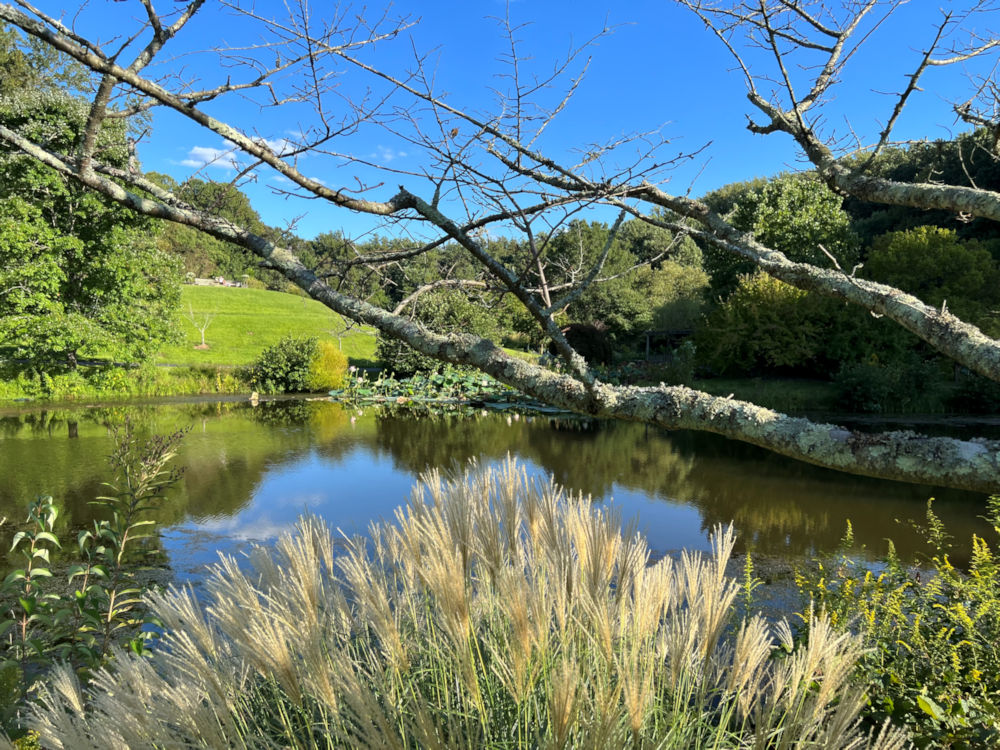
Below is the area we like to sit.  There are Adirondack chairs that are very comfortable on one side, on a platform overlooking the pond.  


One of the many benches available. 


and another for those who have little ones.


My last photos from this trip's visit, done of the collage of plants and blooms we saw that day.


One last visual, a map of the garden.


Thursday, September 21, 2023

MORE FROM MEADOWLARK GARDENS, IN VIENNA, VIRGINIA - 9/14/23 - RED SPIDER LILIES

This is the first time I remember seeing a Red Spider Lily, only being familiar with the pink ones. Its other names are Spider Lily, Equinox flower, Naked Lily, Red surprise lily, Hurricane lily, Resurrection lily, Lily and Red magic lily.  Botanical name Lycoris radiata (phonetic spelling LY-kor-iss ray-dee-AY-tuh).I found them not too far from the gazebo.  They were growing next to the lake, a small group of them as you can see in the photo below.

It is a flower that is resistant to deer and rodents.  However, its roots are poisonous, albeit on the low side if I read correctly.  (You can see what I mean on the website link I provided at the end of my post.  Scroll down to the bottom of the page, on the right.)  Many flowers we see have a certain toxicity, so people should be aware if they enjoy gardening, especially when children or pets in the family.  I may be overly cautious, but I would rather know than not.  I hasten to add that if there is anyone out there more knowledgeable than I am, who has even more information, whether it is yay or nay, I always welcome their opinion.
It is native to China, Japan, Korea, and Nepal. Usually found in shady, moist areas along slopes and rocky areas near stream banks.  We can all probably guess why it is called a Spider lily, because its stamens resemble spider legs.  They bloom in late summer and Fall.
The species name radiata is Latin for "spoke" referring to the flower tepals that spread out like the spokes on a wheel. The common name hurricane lily is derived from the fact that the plants bloom during hurricane season.

I found my information and a lot more at this website.


Wednesday, September 20, 2023

MEADOWLARK GARDENS, IN VIENNA, VIRGINIA - 9/14/23

First of all, a wedding scene. I blurred the faces and we were quite a distance away.  What I did want to see was this young bride's wedding dress, which I thought was charming.  I also liked the lady's outfit (groom's mother I'm assuming).  When we have been to the garden in the past, we have often seen a bride and groom having their photos taken.  Later as we walked back to the visitor center, the wedding party had moved on and we focused on the large chess set. This is a new addition since we last visited. 

The small pom-pom flowers are Globe amaranth but for the moment I am concentrating on the little bird I saw resting on the wooden framework, which I shared in yesterday’s post.
I didn't know until later in life how many kinds of sparrows there were.  I think perhaps this is a House Sparrow?  
I was able to take several photos and she was still resting when we continued our walk.
I took another photo of the Globe amaranth before we moved on.  It is very delicate.
The Panicled Hydrangeas were a bit passed their peak... 
but still very pretty...
with a few in full bloom.
and then there were the Red spider lilies, but more on them next time.
When we got home I noticed a Goldfinch making use of the bird bath.
The birds - and squirrels - seem to be enjoying it, not all at once thankfully.
The bird bath is a relatively new purchase.  It came as a kit with a fountain feature.  Once our feathered friends got used to the water shooting up in the air, I could see they were enjoying it.  They drink, they bathe, and sometimes they just like to perch to keep an eye on their surroundings.  It is solar.  When the sun is on the attachment, the fountain shoots water almost two feet up in the air.  If clouds appear it gets lower and finally when the sun goes in, it stops completely.  It gets cleaned and refilled daily.  
The birds are not the only ones it keeps entertained.  The woman inside with the camera has a lot of fun too.

More from the garden very soon.

Thank you for stopping by, and I wish you all 
A Very Happy Wednesday!