Thursday, August 24, 2023
THE HAWK FROM YESTERDAY
Wednesday, February 15, 2023
A VISITOR...
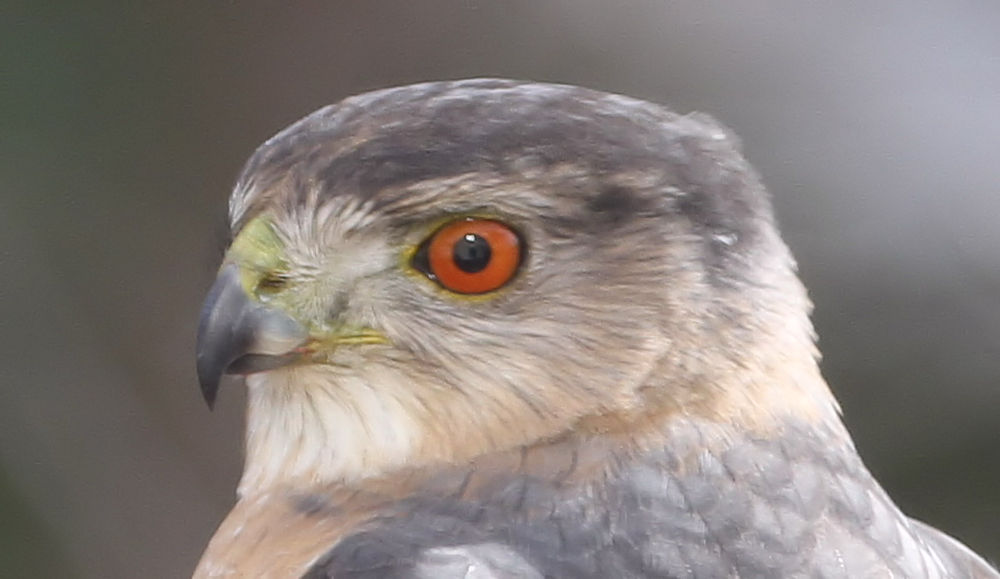
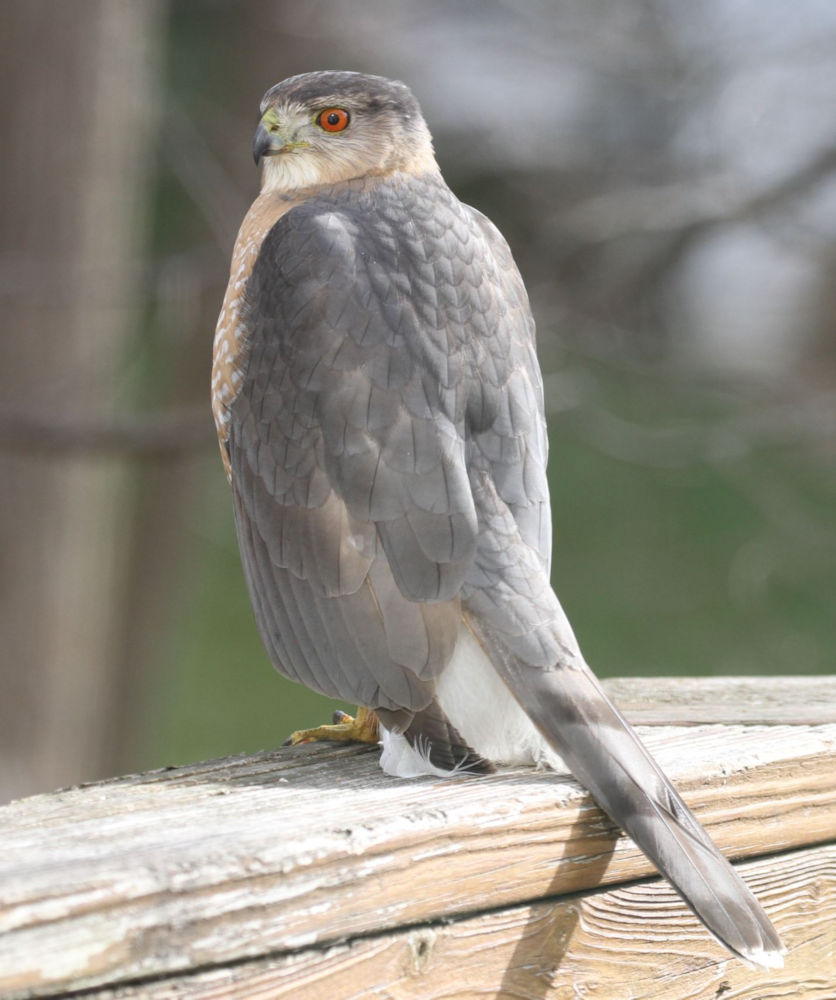
A surprise visitor as though I have seen them flying from one neighbor's yard to another occasionally, one hasn't settled on the deck rail for a while. I was walking by the patio door from family room to kitchen, to put the kettle on for a cup of tea, when I was aware that my peripheral vision had seen a larger shape than usual. I quietly took two steps back and there it was, head turned away, thankfully. It gave me time to grab my camera (kept on a table right by the door for such occasions) and was able to snap a few photos. I was spotted and with wings spread it flew to the next garden, through the trees and out of sight.
I checked with my Google ID and two birds came up, a Cooper's Hawk and a Sharp-shinned Hawk, they are very similar. You can click here to read an article about that. A little while later I had a quick chat with Gregg's sister after sending her the first photo. She takes amazing shots of birds in her area, and we are very happy when she shares them with us. After checking her Merlin app she thought it was a Sharp-shinned Hawk. I am not an expert and am always grateful for help with ID's. I really do need to download the Merlin app. 
A thought came that it was a good job we were late replenishing the birdseed. I know these birds of prey have to survive and this one looked like it was on the hunt. However, I was happy it was all quiet out there. I kept watch outside after he had left and when I saw birds and squirrels in the trees again, the birdseed was put out, the smaller birds arrived and all was quiet and safe, at least until the next visit. Another thought came, I prefer nature's gifts far better than diamonds around my neck, true! Also...
Wednesday, November 2, 2022
HAWK IN WILLIAMSBURG
Thursday, May 12, 2022
HUNTLEY MEADOWS - WEDNESDAY - 4-25-22 - THE RED-SHOULDERED HAWK
We walked further today and that was a good decision. The walkway ends, which is normally where we do our loop and turn back, but if we continue there is another wooded area. This one is closer to the water's edge which we can see from the path. The photo below is on the main walk where you can see the level of water is extremely low. Further along it isn't quite as dry, and this changes on every visit.
We reached another walkway, a shorter one, across another marshy pond. As always happens we see a couple of people looking intently across, and like a moth to the flame we joined them. A lady told us there was a hawk. I am saying it is a Red-shouldered Hawk because I went to the Huntley Meadow's Facebook page, and someone had taken photos of what looked like the same bird and identified it. (At the time of writing there is a brilliant header shot of the Hooded Merganser family from yesterday's post. I am not sure how long it will be there). Once again, if you think that is an incorrect ID, I would appreciate you letting me know. On the Facebook page, people share marvelous photos, and do identify some, but not always.) This is the scene we were looking at.
There is a crow and I see that first. The hawk is harder to find, but with the help of the lady, there it was.
We were surprised to see the crow and the hawk so close together. I understand that crows can mob hawks but nothing of that nature seemed to be going on at the time. They were just sharing the same space. I added arrows to the same photo below. The crow is quite visible but the hawk not so much, as he was foraging in the grass.
I know that smaller birds tend to mob larger ones if they are in the vicinity of their nesting sites. Years ago I watched such a scene when I stepped out my front door. I noticed the noise at first and could hear that the birds were definitely agitated. I looked up and a Great Blue Heron was flying through our area and the smaller birds didn't stop surrounding and chasing it until it was well away.
While Red-shouldered hawks have been reported to live for up to 20 years in the wild, few survive in the wild beyond two and a half years. They are, however, on the 'least concerned list'. According to the powers-that-be, the global breeding population of red-shouldered hawks is 1.1 million. The breeding season is between April and July, with the same nest being used each year. Refurbishing of the nest with twigs, leaves, bark, and sticks is done in spring by males and females. Females usually lay two to five eggs in the nest over two to three days. The nesting period is 42-49 days while the incubation period is usually 33 days.
The hatched nestlings are brooded by the mother for a week, during which time, the male brings food for the nest. The nestling stage lasts for six weeks. While chicks leave the nest at six weeks of age, they are still given food by the parents for another 8-10 weeks. They become independent at 17-19 weeks old.
Friday, July 16, 2021
AN UNEXPECTED VISITOR ...
I was about to sit down to dinner yesterday when I walked by the patio door and saw this beauty. It was not too long after 6.00 p.m. He was perched on the top of the deck rail. I was totally mesmerized, so close!
We stared at each other for a while. I thought my sudden appearance would have frightened it off, but it seemed as though it stayed for almost 15 minutes and I was rooted in the spot.
He wasn't the only one with an open mouth. After I shook myself out of my own open-mouthed stupor, I grabbed the camera and started snapping away.
I kept taking photos because I thought beauty here would be gone. I have no idea how long it had been there before I walked by.
I didn't want to leave but after dozens of photo opportunities I thanked beauty for this early evening gift. I had been feeling that because of the loss of our two main trees, wildlife would be sparse but there it was to prove me wrong. Gorgeous bird!
Beauty's potential dinner was in hiding. What I have noticed in the past is that our backyard wildlife is very good making themselves scarce when one of these is around. They have to survive and long may they do so, but I was glad I didn't have to see it catch its dinner, as much as I like and admire them.
Wednesday, August 19, 2020
BROAD-WINGED HAWK - DEMONSTRATION CONTINUED
Another post from a demonstration put on by The Raptor Conservancy of Virginia. Please note that this post was written several years ago, and information may have changed. All the birds seen were injured and unable to be released to the wild. They are looked after and shared in their educational program.
This is a Broad-winged Hawk. You can hear what it sounds like if you click here.
It is described as a small, stocky bird with a body size from 13 to 17 inches (34 to 44 centimetres) in length, and weighing anywhere from 9.3 to 20 ozs. (265 to 560 grams). As with most raptors, females are slightly larger than males. Broad-winged Hawks have relatively short and broad wings, pointed at the end, which have a tapered appearance unique to the species. It can grow a wingspan of 32 to 39 inches (81 to 100 centimetres).
Adult bodies are a dark brown with a white belly and chest containing horizontal barring. While their tail can be a dark grey-black with white lines along the middle, base and tip. The young hawks have a slightly different coloring with more white and longitudinal barring instead of horizontal barring.
There are two types of coloration, a dark morph with fewer white areas and a light morph that is more pale overall. The light morph of this bird is most likely to be confused with the Red-shouldered Hawk, but they have a longer, more heavily barred tail and wings, with a solid rufous color in the adult which are usually distinctive. Rare dark morphs are a darker brown on both upperparts. Drk-morph Short-tailed Hawks are similar but are whitish under the tail, with a single subterminal band.
The Broad-winged Hawk (Buteo platypterus) is a small hawk of the genus Buteo. During the summer some subspecies are distributed over eastern North America, as far west as British Columbia and Texas. They then migrate south to winter in the neotropics from Mexico down to southern Brazil. Other subspecies are all-year residents on Caribbean islands.
Although the Broad-winged Hawk's numbers are relatively stable, populations are declining in some parts of its breeding range because of forest fragmentation. They will have only one mate during the breeding season, possibly because the male also helps a small amount with the upbringing of the chicks. They will breed anywhere between April and August starting when they are two years old. To attract and court females the males will do a flight display including cartwheels, dives and other aerial acrobatics. The birds meet in the air hooked together by their talons and spiral down together. They will also compete and fight with other males for the chance to mate with a female. If one of the males is successful, the mating pair will have only one brood per season consisting of one to four eggs.
Chicks will have rapid body growth until they are almost at adult body size, at which time they are capable of walking, flying and eating without parental help. While in the nest the female gives most of the parental care, protecting and taking care of the chicks. It is not unusual to have the male provide some food for the female and offspring, but his visits are short lived. Once a prey item is obtained for the nest, the female will tear off pieces and will feed the chicks till they are able to rip meat off on their own. Often the chicks will fight for possession of the offered morsel, the younger ones usually losing and not getting enough. Broad-winged Hawks will protect their nests in a show of agression (i.e. diving and chasing) towards any suspected threat, but they generally will not make physical contact. Predators of eggs and nestlings includes raccoons, crows, porcupines and American Black Bears, and adults have been known to fall to Great Horned Owls and Bald Eagles. It will take the hatchlings five to six weeks before they are able to leave the nest. Some young even after that time will remain in the area of the nest for several weeks moreI hope you have enjoyed another post from when I attended this very interesting demonstration, several years ago now.