Fir tree with pinecone (taken 200 hundred smiles south, still in Virginia). I tried to find out what type it was, but the closest ID was an Eastern White Pine. They were found along a wooded pathway next to water near the coast.
Last one - a large embedded tile in the wall of a seafood restaurant. It was torn down and in its place, a storage facility. I hope someone had the good sense to save that tile. I thought it was a lovely work of art.
That's about it for my favorites. I hope you have enjoyed them.
These are an archive continuation from our trip to the Everglades in January 2014. One of the many reasons I enjoy Florida is because of the abundance of birdlife. You can get up relatively close to them, especially when we were in the Everglades.
The following extraordinary-looking bird is a Purple Gallinule. Look at those feet? Its long toes help it to walk on floating vegetation like lilypads.
This is the entrance to the park looking from where we leave our car. There is a metal box on the right-hand side for donations. We leave a few dollars but it's not compulsory, and if we find ourselves without any cash, then we get them next time. If families are on a tight budget, even those without families, it is free to all. A great place to bring children and introduce them to nature. There are classes advertised, though I am not sure if they hold them in the winter months. Definitely in the summer during school breaks, but information on this would be at their website (link at the bottom of this post).
I always search for deer at the park but there have been none for a long time. It's always a joy to see these beautiful animals and their soulful faces, and graceful style. I always feel so blessed to be around them. Always stretching my neck to see if I can spot one but not today. We saw more birdlife than we normally do. As soon as we reached the boardwalk across the marsh, there were dozens of Canada Geese on both sides of the walk.
I have always been a fan. At other times of the year, they have been paired up or in small families. This is my first experience of seeing this many at one time.We saw more bird life than we normally do. Time of year, a cloudy day, time of the day, all of the above, or were we just plain lucky? Next, we saw the Great Blue Heron.Great Blue Herons possess excellent vision. To put it simply, their eyes possess binocular vision that also gives them excellent depth perception. Their eyesight is about three times more detailed than humans. They can see great at nighttime, almost as well as they can see in the day. This benefits them greatly during their annual migration, as they typically start flying at night. I love what I find out online! We often find that when we are staring into the trees, obviously looking for something, someone walking from the opposite direction will more often than not tell us what they have seen and where to look. I have mentioned this a few times before, and in this case it was the Belted Kingfisher.A lady told me that she had seen one and pointed us in its direction. I saw other photographers and bird watchers with binoculars, standing in one spot along the boardwalk a hundred yards away. We joined them, though giving them their space. After looking for some time, we spotted the bird high on a tree branch. Too far away for a decent photo but I could make out its shape and distinctive color…and then he flew down onto a nesting box where I was able to get a better photo. Thankfully this was before my battery went dead. Looking on my computer later, I read, "Belted Kingfishers are one of the few bird species where the female is more colorful than the male, sporting a chestnut or rust-colored band across her chest. Males are all blue-gray and white. If you are looking for one, you can listen to their distinct and loud rattling or chattering call. It is typical to hear the sound before you see the bird.” If you scroll down to the bottom right of this website, you will be able to hear its call. It was very exciting for me. I have never seen one other than in other people's photos or on nature shows.
After the disappointment of finding out about the battery, I was happy to come across a couple of photos that I had taken of the Hooded Mergansers before the camera failed. Another delightful bird, it is distinguished by its long black bill and a rather grand crest of feathers - or hood - on its head. The male is black and white with tawny brown sides and flanks. A large fanlike crest surrounded by black atop its head is its dominant characteristic. The male also has a black bill, bright yellow eyes and dull yellow feet. Thankfully I was able to crop another photo, and it was a nice surprise to find as I blanked out the fact that I had taken them right before the battery issue. Those line patterns in my photos are made by the wake of the other mergansers.
The females have russet-brown heads with a backward slanted crest that is considerably smaller than the males. They have dusky brown backs with gray chests and sides. The female has a black upper bill edged with orange. The lower bill is yellow, the eyes are brown and the feet are green. They live in forested wetlands throughout the eastern half of North America and the Pacific Northwest. They are the only ducks that specialize in eating fish and have a third 'eyelid' that acts like a goggle to help them see prey under the water.
One more sighting of movement high up in a tree. This was actually taken at the beginning just as we reached the boardwalk. A Red-bellied woodpecker about to bodge an acorn into the tree, perhaps having pecked a hole out first, unless he has an old nesting cavity that he stuffs them into. Do they do that? Gregg took this photo. You can read more about him here.
Our last birds of the day were a total surprise. We were making our way through the wood back to the car. My eagle-eye husband spotted movement on the right of the path.
This is the first time we have seen them at the park in the 30 plus years we have been visiting, and our first sighting up close ever. They were taken with my cell phone. I zoomed in a bit as we didn't want to get too close. We treat them as we do all wild things, with a whole lot of caution. It’s a common myth that turkeys can’t fly (most likely because they feed on the ground), but wild turkeys have been known to fly up to 55 mph in short bursts. One very interesting fact is that the bird really is named after the country of Turkey. Early European visitors to the Americas saw the bird and it reminded them of one they were familiar with back home, known as a “Turkey bird.” It seems that the African guinea fowl made it to Europe in the Middle Ages via Turkey, and the similarity to the American bird gave it the name. We thought it was lovely seeing them as our walk was ending.
If you click on this link it will take you to the park’s website. It is where I found the map.
That's all for today's post. I have more as you can guess. I always seem to be late visiting you back lately, but thank you for the comments you leave. Always very much appreciated. I will be stopping by in the next day or so.
I won’t be visiting over the next few days, as I will not have a lot of computer time. I have my posts set up daily, so thanks in advance for leaving any comments. I will catch up with you next week.
This is a repeat share from 2015.
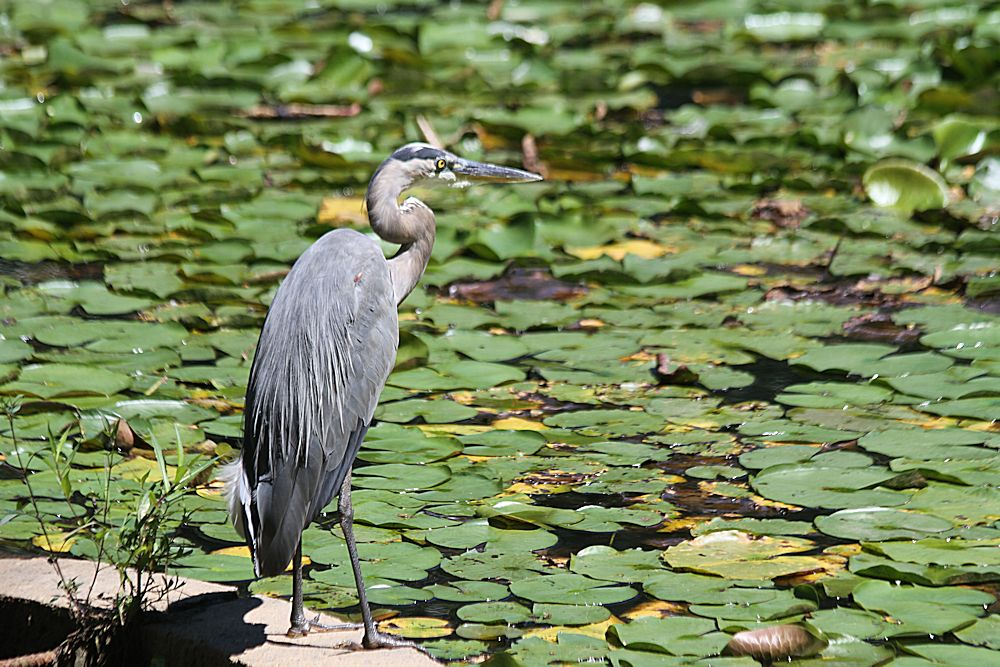
This is the first time we had seen a Great Blue Heron on our walk to one of our favorite spots in the garden. We felt we lucked out to be there at the same time.
He was so focused!
Did you know herons spend 90% of their waking hours stalking for food?
There are five subspecies of Great Blue Herons.
Their colonies can consist of 500 or more individual nests, with multiple nests per tree built 100 or more feet up in the air.
They also will nest on the ground, on bushes, in mangroves, and on structures such as duck blinds, channel markers or artificial nest platforms.
They typically lay 2 to 6 pale bluish eggs, measuring around 2 x 3 inches. During incubation, the eggs fade to white.
Still focused on catching dinner. Great blue herons can hunt for food during both the daylight hours as well as during the night.
He got tired of waiting at that fishing spot...
as he took off...
and relocated...
to the other side of the pond.
We left him to continue our walk, having sat on a bench for some time observing him. Nature truly is a marvelous part of our surroundings.


.jpg)
.jpg) and then he flew down onto a nesting box where I was able to get a better photo. Thankfully this was before my battery went dead. Looking on my computer later, I read, "Belted Kingfishers are one of the few bird species where the female is more colorful than the male, sporting a chestnut or rust-colored band across her chest. Males are all blue-gray and white. If you are looking for one, you can listen to their distinct and loud rattling or chattering call. It is typical to hear the sound before you see the bird.” If you scroll down to the bottom right of
and then he flew down onto a nesting box where I was able to get a better photo. Thankfully this was before my battery went dead. Looking on my computer later, I read, "Belted Kingfishers are one of the few bird species where the female is more colorful than the male, sporting a chestnut or rust-colored band across her chest. Males are all blue-gray and white. If you are looking for one, you can listen to their distinct and loud rattling or chattering call. It is typical to hear the sound before you see the bird.” If you scroll down to the bottom right of