Showing posts with label Countryside. Show all posts

Wednesday, July 3, 2024

A SHORT RIDE ALONG SNICKERSVILLE TURNPIKE

Before my blogging break, a few weeks ago Gregg said he would like to go for a drive along the Snickersville Turnpike. I always enjoy that area. We did a shorter version this time and I only took a few photos. The weather was sunny and in the mid 70s. 

There were bales of hay in the fields, always a pretty sight in the countryside.

Forever curious I did a search on them. At one place I read that “bales are often wrapped in plastic and stored out in the fields until needed for livestock. The outside edge of a hay bale may be damaged by the weather, but the interior of the bale will stay suitable for animal food. Outdoor storage has reduced the costs of building and maintaining hay barns, so the classic wooden barns are slowly disappearing.” When I read this I thought well, that makes sense but I would be sad to see those old wooden barns disappear completely.
On another website I read that these round bales can weigh from 600 to 2000 pounds. They are either left in the field until they are used or may be moved to a covered storage area. Also, sheep and goats will not eat trampled hay. Horses and cattle are not so picky. I also read that hay is the largest field crop in Virginia.
We drove along the fence line of this property, and it went on for quite a distance. There were small US. flags attached to each post, and banners on the gate as you can see.
I have mentioned before but I often wonder who lives at the end of these driveways.
Some gates had an intercom. I'm just snapping pictures as we drive along. Even on country roads there always seem to be cars behind us, with not many opportunities to stop. Just as well for the nosey parkers who like to take photos on drive-bys from the passenger seat, of stone pillars with planters on top of them!  When the opportunity arises, we will pull over to allow the cars following us to pass. And then we travel at a more leisurely pace, until the next car arrives. These are narrower country roads than those nearer the freeways, and generally these followers live here and probably know all the twists and turns, and go faster than we are prepared to.  
I can't remember the name of this small town, but I was interested in the mailboxes that had a small roof over them. Each mailbox belongs to a different home, this info in case you are living outside of the States. People come to their individual box and get their mail, as the mailman doesn’t deliver them through a slot in the door. This may change in the bigger cities. Everyone in my community has an individual mailbox at the end of their driveway, attached to the top of a wooden post, waist high.
I enjoyed these pretty flowers climbing over the wall.
Shortly afterwards we turned off the turnpike and headed back. It was a nice ride, although shorter than usual, but even the short ones are very enjoyable. If you ever want to visit the area I found this website with vacation rentals and Airbnbs. They were fun to look at too. Here is a photo looking beyond an old stone wall…
and a historical marker showing local history.

We stopped off at Wendy's not too far from home, and deciding to have a fast-food meal instead of putting one together ourselves. We were both feeling a bit tired. It was a nice change as we rarely go to Wendy's. We ordered the same thing, a baked potato and small container of chili. They were very good and piping hot.

Waffling over with! Thanks for stopping by. Hopefully you're having good weather where you are. I have missed visiting but I am catching up ever so slowly. I am eager to see all your photos and writings.

Enjoy the rest of your week. 


Friday, August 25, 2023

THE SNICKERSVILLE TURNPIKE SCENIC ROUTE 7-22-23

 A month ago we went for another drive along the Snickersville Turnpike.  The previous one we had to cut short because of a warning light that appeared on the car's dashboard.  This day was once again sunny, not too hot and perfect weather.

An historical marker reads:
"Originally an Iroquois hunting trail, it became by 1786 the first recorded operating turnpike in America, praised by Thomas Jefferson.  In 1810 the Virginia Assembly chartered the Snickers Gap Turnpike Company, authorizing three toll gates between Aldie and Snickers Gap: horse 3 cents, 20 cattle 12-1/2 cents, four-wheel carriage 12-1/2 cents. 
A toll booth operated on the Blue Ridge Mountain until 1915.  The Turnpike today is a Virginia Byway overlooking the same landscape George Washington traveled between 1748 and 1788, where he often stopping at West's Ordinary near Aldie and Edward Snicker's inn and ferry on the Shenandoah River." (An Ordinary is an inn, tavern, etc. where ordinary meals were served).
A lot of old farms...
and houses, all of which I thoroughly enjoy taking photos of.  Some were in the process of getting a little tender loving care.
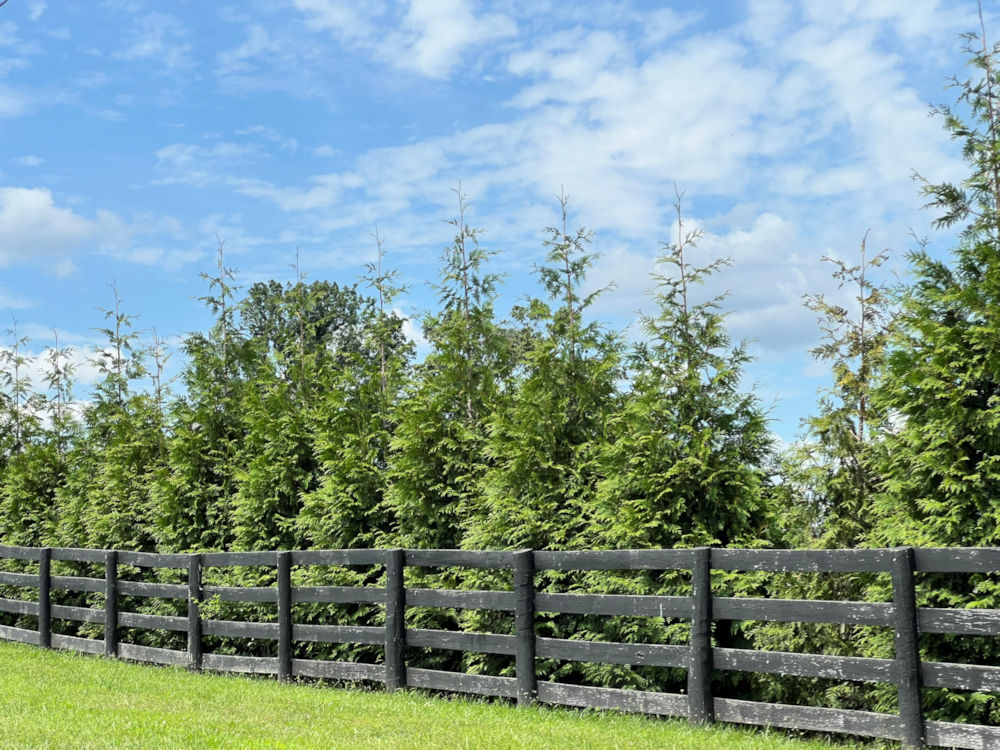
I have noticed for some time now that the fences we see in the countryside are painted black instead of white.  
It took me a while to get used to, but I rather like them now.
You can pass miles and miles of these fences.
There are also new homes being built and we saw sales signs...
but then there were the old, abandoned homes...
and what stories they could tell.
We saw many old barns still in use...
and more houses.
This is another scene shared before but I saw the mural again and took another photo.
It is where we saw this beauty, a photo I captured by sheer luck and posted on my blog a few weeks ago.  It was the only deer we saw that day and I thought was worth a repeat.
And here is the red barn that I shared as a painting two days ago. 
I found some interesting information about why these barns were painted red.  It goes back to the late 18th century, with New England farmers applying a protective varnish to barn surfaces. The varnish usually contained a mixture of linseed oil, lime or iron oxide, which under the sun would then turn to the red ochre hue that we have become so familiar with. 
Eventually, as red paint became available, many people stuck to the color tradition. Red paint is also one of the cheapest colors available to purchase (this is because the large amount of iron and oxygen compounds in the paint are plentiful in the Earth).
Apparently red barns can be in seen in other parts of the world.  In Sweden for instance, the red color has appeared in barns and other buildings since the Middle Ages.  Iron oxide was used from the mining tracts of Falun (Sweden).  Even today the color is called Faluröd. Although iron oxide has been used for thousands of years as a paint pigment, in Sweden it was apparently an attempt by the noblemen of the 16th century to mimic the brick and terracotta of European buildings.  This information was given by someone from Sweden.  
Here is a map of our drive.

I have more photos and I will share them another time.

Thanks for looking everyone and
I hope your day is a great one.


Wednesday, August 23, 2023

AN OLD RED BARN


Through the ample open door of the peaceful country barn,
A sunlight pasture field with cattle and horses feeding,
And haze and vista, and the far horizon fading away.

~Walt Whitman, Jr. - A Farm Picture~


This, as you might know, is another photo turned into art with my ArtCard app on my iPad.  I haven’t gotten tired of it yet and I hope you haven’t either.  The original photo I will share soon.  We went on another drive along the Snickersville Turnpike scenic route after having to curtail our last trip due to a car problem.  It was a very enjoyable ride and once again the weather was perfect.  We saw a lot of old barns and pretty homes.  Even the places that had been abandoned had their own beauty.  These red barns look incredible against the blue of the sky.

We had an unexpected visitor today.  A very regal looking hawk rested on the deck rail.   The neighborhood crows set up quite a racket.  They were warning other birds to stay clear and were sitting on other branches quite near it.  Gregg read that Blue Jays mimic the call of a hawk to warn other birds also.  The hawk flew up into a tree when it realized we were staring just beyond the glass.  After a few minutes of the crows loudly squawking it took off, with the crows in hot pursuit.  Gregg took a photo and tomorrow I will share it if it came out.  It all happened so fast.  I don’t know my hawks well enough to tell which kind.  Others I have identified as Coopers Hawks.  


Walt Whitman Jr. (May 31, 1819 – March 26, 1892) was an American poet, essayist, and journalist. He is considered one of the most influential poets in American history. Whitman incorporated both transcendentalism and realism in his writings and is often called the father of free verse.  His work was controversial in his time, particularly his 1855 poetry collection Leaves of Grass. Whitman was born in Huntington on Long Island, and lived in Brooklyn.  You can click on his name for more info.


Wednesday, May 17, 2023

A DRIVE ALONG THE SNICKERSVILLE TURNPIKE, VIRGINIA - FRIDAY, MAY 5TH, 2023 - PART 4

 I am taking a couple of days off.  I have left my comments on but will be very slow answering them.  However, I will answer all eventually.  Luckily I had a few posts already done and scheduled, which included this coming Saturday and Monday posts.  Hopefully I will be feeling better by next Tuesday, but if you don't see anything then, you'll know I am just resting up.  Gregg and I have Covid but we are being well taken care of.

We are looking across land that once belonged to the Phillips Family, dating back to about 1798.  It is part of The Waterford Foundation and a self-guided tour can be found here.

According to what I read on one of the signs, it said those line of trees are the Osage orange (also called hedgeapple) which were planted by farmers to create a natural hedge.  The signs I have included below may be difficult to read even when enlarged, so I will repeat the info as I go along, as well as adding other information I found, plus links if interested.  This is what an Osage orange looks like (all photos showing the fruits, including the bow, were found online).

When I read about them, I found that Native American tribes in the Plains quickly discovered that its strong yet flexible wood made superior-quality bows.  According to legend, a bow made from the Osage orange was worth as much as a horse and blanket for Native American traders.  Shown in the photo is obviously a modern-day one but made with that particular wood.
The fruits are 4 to 5 inches in diameter.  The surface is deeply grooved and rough, covered in wiry hairs.  Underneath the ridged surface, the flesh is dense, cream-colored to pale green, and contains 200 to 300 oblong, light brown, edible seeds. When the flesh is sliced, it releases a sticky, white liquid that can be irritating to the skin and may cause a rash. 
As read: "Osage oranges have a green, bitter flavor with a hint of cucumber and a fruity, citrus-like aroma. The flavor is generally unpleasant, unpalatable, and some may feel ill after ingesting the bitter fruit, causing many to deem it inedible." There is more here.
One last bit of information, its wood withstands rot and decay, making them ideal for fence posts. After the widespread introduction of barbed wire fencing, Osage orange remained the go-to tree for fencing use, but this time it was for the rot-resistant wood that could be fashioned into fence posts to hold the newly invented barbed wire. And my snowball rolling down hill is taking effect because I also found this interesting page on the history of barbed wire.  There is none used for fence posts showing the barbed wire below.  Well, enough of the Osage orange!
The Phillips family had an annual yield of 500 bushels of wheat, 400 lbs. of butter, 65 lbs. of wool and 60 lbs. of honey and beeswax.

Thomas and Rachel Phillips were Quakers and were against slavery and secession, which in this case meant the withdrawal of eleven southern states from the Union in 1860, leading to the Civil War.  More history on that subject can be found at this website.  The following photo is cropped from the one above.  It shows some of the artifacts found.
One of the facts I found very interesting was that the Phillips Farm is "a registered Monarch waystation.  Monarchs on their annual migration to and from Mexico, find nectar and host plants here.  Bees also thrive and produce honey just as they did centuries ago" and "Today, more than 200 years after Thomas Phillips began farming here, his practices of haymaking and beekeeping, continue on the farm."
Unfortunately, I didn't see the Belted Kingfisher.  There was no path or gateway that we could see. The Kingfishers and other birds can no doubt be seen along the creek amongst the trees.  (I found out later there is a trail that can be taken.)
I found the above photo at pixabay.com

Others mentioned were the Eastern Bluebird, the Great Blue Heron, Red-winged Blackbird and the Red-Tailed Hawk.

That's all for today.  I have another post after this, of Waterford Village.  It will be my last from our trip along the turnpike, and will be posted next week.


Friday, May 12, 2023

A DRIVE ALONG THE SNICKERSVILLE TURNPIKE, VIRGINIA - FRIDAY, MAY 5TH, 2023 - PART 2

Continuing from yesterday’s post here, and thanks to Ginny’s question in her comment the same day, and also Linda's comment when she replied to her question saying, "It is named for the town of Snickersville, which is now Bluemont. That and Snickers Gap were named for a Mr. Snickers who operated a ferry, probably across the Shenandoah." Thank you ladies!  I searched online to learn that the village of Snickersville was named after Captain Edward Snickers who ran a ferry across the nearby Shenandoah River in the 1760’s. It grew quickly, and in the 1840's a General Store opened for business to serve the local population and travelers.  I am assuming the turnpike was also named after him. You can read the full history at this link
I am sharing a few of the properties we saw.
We passed several wineries.   I have noticed more of them over the last few years, but wine has been produced in Virginia as early as the 17th century.  
This was the only mural I saw that day.


There are also very old-looking log cabins still standing.  
Another view of the one above.
And then there are places such as the following.


All different styles of architecture.


I enjoyed looking at the pretty homes, including the old log cabins and think of how it must have been for them way back when.  Such stories those old walls could tell.

I still have photos to share from our mini road trip.  More next time!