Showing posts with label Witch Hazel. Show all posts

Friday, March 7, 2025

GREEN SPRING GARDENS - LATEST TRIP ON 2-26-25 - PART 2

This is the road sign where we turn, and it is a short drive to reach the entrance at the end of the road.


One of the first photos taken is of the Witch hazel (botanical name Hamamelis virginiana. Other names are American witch-hazel, Striped alder, Tobacco-wood, Spotted alder, Water-witch, Snapping Hazelnut, Winterbloom and Witchhazel Witch-hazel. 


This is the plant that was used in the 20th century for locating water sources. You can read more about that here towards the end of the article. Added note on 3-7-25 at 1.46 p.m. I add a photo below I borrowed from the previous website, of a map showing where witch hazel grows in the USA.


I am looking forward to seeing the planting beds bloom around the Moon Gate.


It was a very nice surprise to see the Snowdrops blooming. Their botanical name is Galanthus nivalis and other common names are Common snowdrop, Fair maids of February, Little sister of the snows, Purification flower, Candlemas bells, Candlemas lily and Common bells. These flowers have been noted throughout history, with references going as far back as the fourth century.


One last photo of a little dog who was enjoying all the smells as he scurried along. I wasn't fast enough to get a front view, but he was a cute little dog.


That's all from this visit to the garden.


Sunday, February 11, 2024

HAPPY SUNDAY EVERYONE!

Thank you for all the well wishes here, in texts and in my e-mails.  I am feeling almost back to normal after my short break. I love our blogging community for the kind and thoughtful people you are. I will be answering your comments and visiting your blogs over the next few days. I have missed doing that and look forward to catching up with you all.

It was good to get out today.  The temperature was 63 degrees, cloudy skies but perfect walking weather.  We drove to Meadowlark Gardens.  Our last visit was in September of last year.  I will be sharing more photos this coming week, but today I show one of favorites.  I was delighted to see the Witch Hazel blooming.


I have shared it before and may be repeating myself. The Haverford College website is a wealth of interesting information. Click here to read more.


"Witch hazel is a winter-blooming shrub. It can reach a height of 12 to 15 feet and is considered either a large shrub or a small tree.  It is a hardy perennial with fragrant, wispy yellow to orange flowers and are from the family Hamamelidaceae. 

Native to eastern North America, it may be found growing along woodland margins and stream banks from Canada to Mexico. The genus name Hamamelis comes from the Greek word hama for ‘at the same time’ and melon, which means fruit and refers to the fact that the plant can have both flowers and fruits appear at the same time, a somewhat rare feature. The species name virginiana means the plant is from Virginia.

 A year after blooming, the fruit capsules mature and eventually split open to release seeds.  Once dry, the witch hazel's capsules can catapult the small seeds as far as 30 feet.  This is the only tree in North America to have flowers, fruit and next year's leaf buds all at once. You will see it brightening up the forest throughout the autumn and the winter months, providing a source of food for birds, deer and other small mammals that eat its fruit capsules and seeds.

Witch hazel has a long history and has been used by people for centuries. Widely known for its medicinal and cosmetic uses, the extract from the leaves, bark and twigs of witch hazel have been used as an astringent to treat irritated skin and inflamed tissues for hundreds of years. Native Americans used the plant to treat the common cold, eye and liver conditions and other illnesses. Early settlers also used the leaves to make tea for various medicinal purposes. Today, witch hazel is used in a variety of products, including ointments, soaps and lotions. 

The name "witch hazel" also originates from folk history.  Natives and early settlers used the witch hazel to find sources of water underground.  As they walked over the ground that they were surveying, they would carry a forked or bent witch hazel branch, which was used as a divining road.  If the branch twisted or dipped, which they believed signaled that they had found water.  This practice was called "water-witching" and led to the plant's common name, witch hazel."


Wednesday, March 8, 2023

LAST SATURDAY WE WENT OUT FOR A WALK - PART 2

 The first two photos are of Witch Hazel.  It is known by several names: American witch-hazel, Common witch hazel, Striped alder, Tobacco-wood, Spotted alder, Water-witch, Snapping Hazelnut, Winterblooms and Witchhazel Witch-hazel!  Its botanical name is Hamamelis virginiana.


Witch hazel was used quite commonly in the 20th century for locating water sources.  The practice, called dowsing or water witching, which is still occasionally used.  You can read about the practice here.  In dowsing, a forked stick of the witch hazel is held perpendicular to the ground and moved slowly over it.  The belief is that when a water source is directly under the stick, it will dip or jump.  I also wrote about Witch Hazel in my post at this link, along with other photos around the garden.


Next, the Star Magnolia (Botanical name: Magnolia stellata).  It is also known as the Royal star magnolia.


I had a hard time choosing between the photos I took of this ornamental shrub, deciding to share several today.  


It grows from 5 to 8 feet in height and can cope with cooler climates.  It does, however, need a sunny spot in the garden, with some partial shade for protection during the summer months. In fact, it is advised to plant in an area that will protect the magnolia from winds and frost.  Otherwise, the flowers may be discolored as the buds open before the leaves appear.   


Star Magnolia is a small, slow-growing shrub native to Japan.  As you can see, compared to other magnolias, it has much narrower petals resembling a star-like shape, hence the name.

It has 3-4" fragrant white or pink flowers with dark green leaves and a gray bark.  It certainly was lovely to see it blooming on our way into the garden.  


The back of the house that I have always loved.  Its history can be read here, but in part it was built in 1784 by John Moss.   


As it used to be back then, the front of the house courtesy of the Fairfax County Park Authority and found on the above website.


Next you can see it from its side view.  It is near one of the entrances near the parking lot.


More daffodils...


Hellebores which I wrote about yesterday.


We planted these in front of our own home and I am hoping they survived the winter.


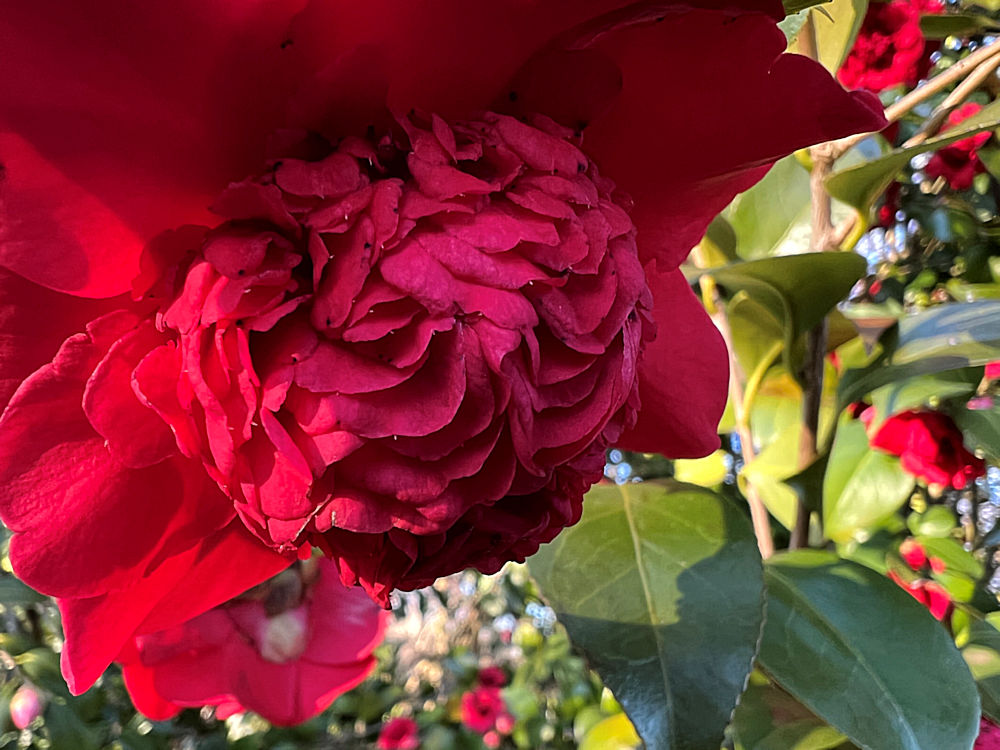
Lastly, the tree towered above me with a profusion of  blooms.  It is the Japanese camellia, botanical name Camellia japonica, and as the name would infer, it is native of Japan.  Also known as Common camellia and Rose of Winter.


It can grow up to 49 feet and does best in partially shady spots with rich, well-drained soil.  It also has very little fragrance.  I read that it can be given coffee grounds as long as it is mixed into a well-prepared compost.  Coffee grounds are rich in nitrogen, as well as some other micronutrients.  Japanese camelia's have been known to live for over a century in the wild.  


Many of the blooms were past their peak.  Still very pretty though.


A small pink Japanese camelia was growing next to the larger tree, and those blooms were not quite as worn.

We had parked our car on the other side of the barrier at one of the entrances. Though people are welcome to stay in the garden until 6.00 p.m. after which it starts to get dark, the parking lot closes at 5.00 p.m.  We didn't arrive until 4.40 p.m. and thought it wise to park outside on the road that leads into the garden.


Tuesday, July 5, 2022

MASON NECK STATE PARK - PART 1 - VISITOR CENTER

We haven't been here in many years.  I don't know why.  It's not as if it is any further than some of the places we have been to.  I said as much the day we decided to go when Gregg suggested it.  I was interested in how it got its name, and you can read that history here.

It was hot and humid but not so bad really, I have felt worse.  We managed a couple of hours walking before we decided to go.
But first, time to enjoy the park.  A statue of an eagle was outside.  This is one I took and below is Gregg's photo, which I used for my 4th of July post.  We took a few photos of the statue and Gregg took the one below.  It is my favorite.  

 I had fun with it later, removing objects to make it look like the Bald Eagle was flying.  I made him free-floating in Paint Shop Pro, and also used my ArtCard app.  I will share those eventually.

Below is the plaque about this beautiful piece.  I did a search and found a website for historical markers, and this was featured.  You can look at them at this link.  If you are searching for another historical marker, this would be a good source of information.  The sculptor's home page, sharing other pieces of his, can be found here.  He is exceptionally talented.
The plants were in front of the visitor center. I realized when I got home and looked at our photos, I didn't have many of flowers, except for these few.
I am always drawn to Coneflowers...
but can't remember seeing yellow ones.
There was also a Common buttonbush on our walk later on, and a couple of leaf photos (those will be part of my next post).  
The visitor center was impressive, and we enjoyed browsing.  On the floor is an area map and we are in the darker section, on the State Park side.  We are looking forward to exploring the wildlife refuge another time.
There is an interactive map where you can remove the buttons at the bottom, and place them where you have seen that particular wildlife, if you end up here after a walk.
A clever idea. Fun for little kids and big kids alike.  
There were birds on display.
I missed taking a photo of the ID of the gull above, but I believe this is a Glossy Ibis...

Another display showing, a Bald Eagle and a Juvenile Bald Eagle...
with explanation.  Enlarging my photos helps with reading.


On one wall a TV screen, and then there are wooden decoys, a punt gun for duck hunting, arrowheads, a page from the will of George Mason who is one of the Founding Fathers of the United States, old bricks, a recreation of a woolly mammoth tooth, petrified wood, and an old still.
Not for the faint of heart if you are not a hunter, but for many it was a way of life, to put food on the table for their families, and an income to put a roof over their heads.


A casting of a Mastodon Tooth.


We found a back room with terrariums.  In one we met Myrtle the Turtle.  This area looks like it is a classroom for young people.  We headed for the back door but first we had a look around. Myrtle was very curious and stared back at us through the glass.
Myrtle is a Red-eared Slider and you can read the information about her below and again, enlarging the photo will allow you to better read the information.
I also came across this cute frog.
I have never heard of a Fowler's Toad before.

A poster of various songbirds found at the park.
And that is about it for the visitor center.  We found a door open at the back of the building and went outside.  A follow-up post will be shared as soon as I can put one together.

Thanks for looking and have a great day.