I will start off by providing a link to a YouTube video, that tells you all about the garden, including its history of how it came to be. It is a wonderful video. It was especially nice to see the daffodils blooming.
For me, this is very true! And there is a nostalgia element here, as next to Calla Lilies, daffodils were my Mother's favorite flower and I always think of her when I see them.
Next is one of Gregg's photos.
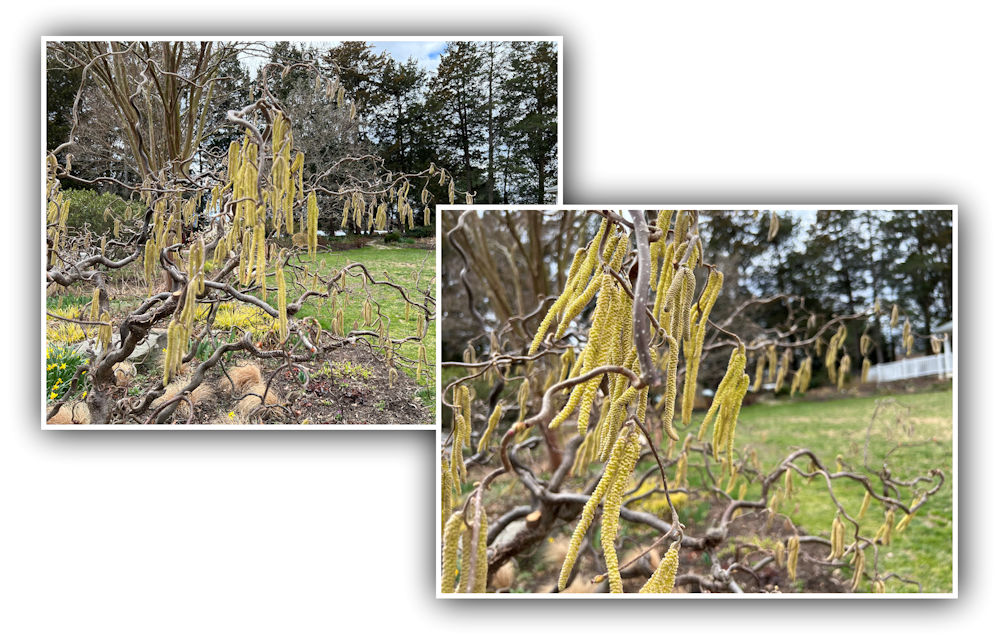
My plant app gave me two ID's this time. It said it was either a Black Alder or an American Hazelnut? I love my plant app but it is not 100 percent sure on this one. The small tree was about my height and the branches were like a corkscrew. Would you please tell me if you know the correct ID? I am always grateful for those who have more knowledge about these things than me. I just had another thought, I could email the garden and ask, but would still be grateful for some help from more-in-the-know blogging friends. Added note on 3-31-22 at 4.00 p.m. Sandra at Madsnapper found the ID for me. It is a Corkscrew Hazel. Thanks Sandra :) 
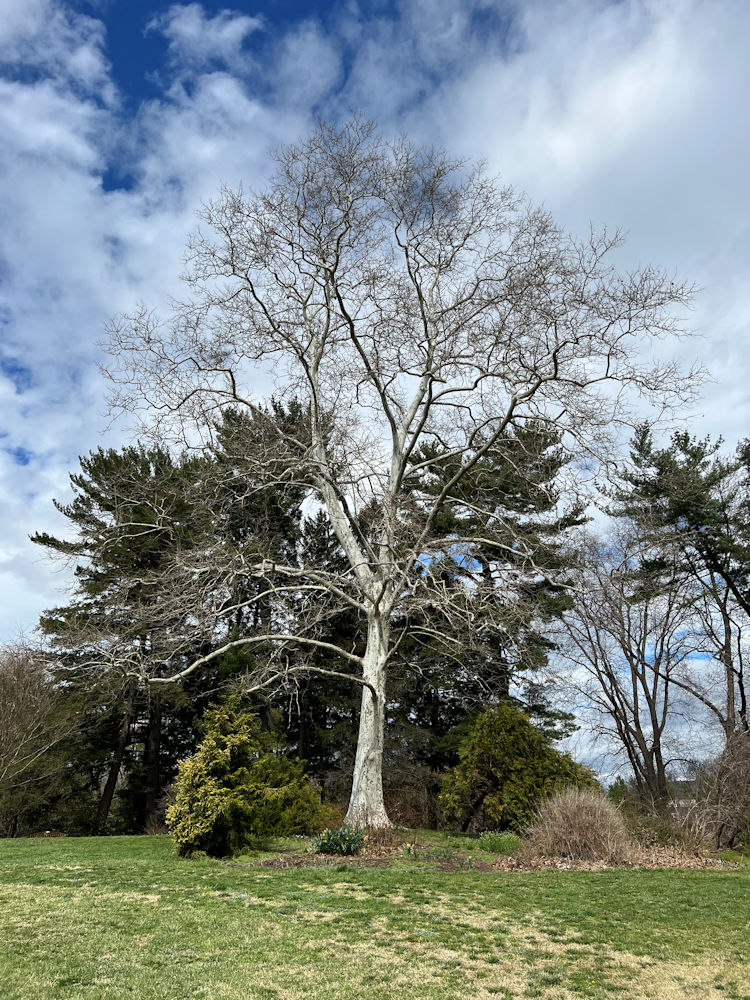
The next photo shows a favorite tree, not too far from the house. The leaves are starting to show. It has a light bark and is another I would like to ask the garden about when I email them. I found this interesting website with information on the kind of trees that have that color bark. Here again if you know what it is, please let me know, always appreciative of any help.
There were also Crocus. I always enjoy seeing them bloom. These are native to the Alps, southern Europe, the Mediterranean area, Northern Africa and the Middle East, and across Central Asia to Xinjiang Province in western China. 
I mentioned the herb Saffron when talking about them before. I read that saffron comes from, "...one in particular, called Saffron Crocus (Crocus sativus, and this blooms in the fall. It is native to Greece and Southwest Asia. The plant is cultivated for the production of the spice saffron, especially in Iran, and it is known to have numerous medicinal properties. Also a famous medicinal herb with a long history of effective use. Saffron acts as an antioxidant, sedative, an immune system booster and is also known as an anti-carcinogenic. It is also used in cosmetics and in perfumes. One more fact about this particular crocus, Saffron-based pigments adorned a Prehistoric cave. 50,000 year old depictions of prehistoric beasts have been found in today's Iraq (north-west of Persian Empire)."

This is called the Spring starflower (botanical name Ipheion uniflorum). It also goes by the names of Springstar, Mexican Star and Starlikes, and is native to Argentina and Uruguay. This star-like flower appears early in the spring and lasts for about two weeks. "Uniflorum" means 'single flower', referring to the fact that each stem bears only one flower. It is a member of the onion family, so although the flowers have a sweet and slightly spicy scent, the leaves when crushed smell of onion or garlic. 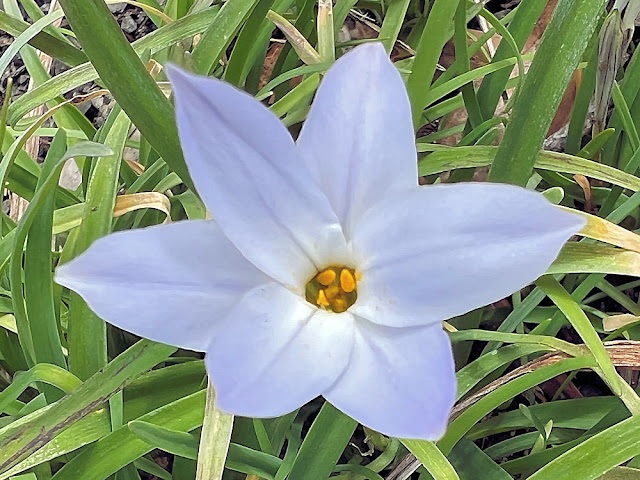
Next we have
Glory of the Snow, botanical name Scilla luciliae (more up-close pictures can be seen at the link). Its common name is Boissier's glory-of-the-snow, blooms in the spring and is a perennial. Native to western Turkey, it sounds like quite a hardy plant, being deer and critter resistant and is described as virtually disease and trouble free. It can grow up to 4 to 6 inches tall (10 to 20 cm), and easily grows in average, medium, well-drained soils in full sun to part shade. Lots more information at the website above.
The following bloom many of you will recognize as the Hyacinth. Its botanical name is Hyacinthus orientalis. Other names are Common hyacinth, Garden hyacinth, Dutch hyacinths and Dutch hyacint. It is a perennial and likes full sun but will grow in part shade. The word 'Hyacinth' has also surfaced in an ancient language called 'Thracopelasgian', which was spoken 4,000 years ago. The wild Hyacinth is a native of Turkey and the Middle East, along the eastern shores of the Mediterranean. Hyacinths were grown in Europe in the time of the Greeks and Romans. Both Homer and Virgil noted its sweet fragrance. After this, the Hyacinth faded from history and did not reappear until the 16th century when it was reintroduced into Western Europe from Turkey and Iran. Leonhardt Rauwolf, (a German doctor) collected some Hyacinths when he visited Turkey in 1573.

Next is the Helibore. It is also called the Lenten Rose, or Christmas rose (not related to roses at all), and its botanical name is Helleborus orientalis. It is a type of flowering plant that belongs to the buttercup family. There are around 20 species of hellebore that originated from Europe and Asia. It was used extensively as an herbal remedy in the past, but due to a high content of toxic substances, they are mostly cultivated for ornamental purposes today. Historians believe that hellebore was one of the plants (part of herbal mixture) responsible for the death of Alexander the Great.
Another one of Gregg's photos below. This is a Callery pear, also known as a Bradford pear. Its botantical name is Pyrus calleryana. It is named after a Frenchman, Joseph Marie Callery, who brought the plant from China to Europe. It has a lifespan anywhere from 20 to 150 years, and can grow to an average height of 25 to 30 feet. It produces sterile fruit because they do not self-pollinate. They have been widely planted throughout the United States since the early 1900s as an ornamental. More information on this can be found here.
That's all from our latest walk around the garden. I am always looking forward to what will be blooming next time, and will probably be back in a couple of weeks.
Our weather turned very chilly and we were very surprised we got a snow shower a few days ago. It lasted all of five minutes! Messages from blogging friends told me that some of you had a lot more. I hope it didn't hang around too long. I am looking forward to our next walk and it won't be long before the temperatures start rising again, hopefully. I haven't checked our ten-day weather forecast yet.
Have a great day everyone.