Showing posts with label Milkweed. Show all posts

Friday, July 17, 2026

BEAUTY AND THE BEAST IN ONE NEAT LITTLE PACKAGE

When we went on a walk the other day, ending up at the Walney Visitor Center, what I was looking for were butterflies. I didn't see one unfortunately, not even skippers, but there were lots of bees, a few milkweed bugs and an interesting, pretty little creature that you can see in my next photo. I found it on a milkweed plant. I thought to myself what a little beauty. When I got home, I found that this was Beauty and the Beast in one neat little package.


What I read surprised me and I was disheartened by my find. It is an Invasive Spotted Lanternfly nymph. What strikes me is that they are the most beautiful insect but horribly destructive to crops. Because they are an invasive pest in Virginia, local agricultural departments strongly encourage residents to destroy them.


These nymphs go through four developmental stages (instars) and I am getting all this from Google). The first three are black with bright white spots, while the final stage turns bright red with black stripes and white spots. They are wingless, powerful jumpers and feed on plant sap, excreting a sticky substance called honeydew.

These are their four distinct stages: nymphs hatch from over-wintered egg masses in late April or early May. They grow through molting stages (instars) before transforming into adults in mid-to-late July.

1st to 3rd Instar: very small about 1/4 inch wingless and black with distinctive white spots.

4th Instar: larger (about 1/2 inch) and bright red with black stripes and white spots. This seems to be the one I found.

Diet and Damage: nymphs use straw-like mouthparts to pierce the tender stems and foliage of over 70 plant species, extracting nutrient-rich sap. While feeding, they excrete excess sugary fluid called "honeydew", mentioned earlier. 

Sooty Mold Threat: the excreted honeydew coats surrounding plants and surfaces, promoting the growth of a thick black "sooty mold" that blocks sunlight and can harm or kill the host plants.

Jumping ability: because they don't have wings yet, nymphs can't fly but they have strong hind legs and will jump and hop rabidly when disturbed.

Here's a YouTube on how we can take steps to get rid of them and there is plenty of other information online if you have found them in your area. 

The following photos were on Wikipedia here and where you can see the adult. Quite beautiful as you can see from the middle photo at the bottom.


According to a study done by Penn State, this YouTuber says they have caused $50,000,000 worth of damage, and the loss of 500 jobs per year.

This was only my second introduction to the Spotted Lanternfly. The last one I saw was an adult in a Winchester shopping center three years ago. I had no clue as to what it was but I remember thinking it was one of the most beautiful moths I had ever seen. However, it isn't a moth despite its moth-like wings. It is actually an invasive planthopper that belongs to the order Hemptera (which includes true bugs, cicadas and aphids). Moths belong to the order Lepidoptera. And now I know.

Have you seen them in your area?


Thanks for looking and hope you are all staying cool in all this heat. To those of you on the other side, hope you are staying warm.


Friday, October 10, 2025

MILKWEED PODS AND SEEDS AT WALNEY VISITOR CENTER

 In the front garden bed in front of the old house, now the visitor center, there are several Milkweed plants. There is an initiative to plant Milkweed throughout North America, to help save the Monarch Butterfly. This simple looking plant could be key to saving our much-treasured Monarch. 


The Milkweed is vital to the survival of Monarch butterflies. They lay their eggs on milkweed and the caterpillars feed on the leaves, making it the only food source for them. There are over 100 species of Milkweed in North America and while the plant is toxic, some insects can tolerate its sap and benefit from its defenses. 


I was happy to see the milkweed floss that had escaped from the pods. I haven't seen it in this stage in I can't remember when. They were a beautiful sight to see, especially with the sunlight on them. 


Milkweed has a history of helping humans also, from weaving to medicine, and its fluffy seeds provided fiber for life preservers. Another interesting website on medicinal benefits can be found here


Milkweed seeds are attached to the silky hairs, forming fluffy parachutes that allow them to be carried by the wind for dispersal. 


The large pods are called follicles. These are stuffed with tiny seeds, each bearing a bunch of silken, fluffy hairs called the coma. When the follicles ripen, they split open and the seeds are carried off in the wind by their plumes of fluffy hairs. 


The pappus, the fluffy hairs making up the coma, are hypoallergenic and super soft. They can be used for making allergy-free pillow stuffing and blankets. 


They were also used in life preservers during World War II when the makers were no longer able to get the material from the Kpok Tree.


That's all for today's post. It has been interesting for me to find out more about this plant.


Thanks for visiting and 
I hope your week has gone well.


Thursday, July 18, 2024

BEAUTY IS IN...

"Beauty is in the eye of the beholder."
~Margaret Wolfe Hungerford~


After a lot of searching, I still can't say with absolute certainty, but I think this may be a milkweed nymph? Anyone out there who knows for sure and has its true identity, would you please let me know what you think? Thank you! It was on a milkweed plant. I have seen adult milkweed bugs but this one leaves me a little puzzled, as I know there is also a milkweed assassin bug but they are two different insects. The old saying popped in my head when looking at it. I think it is a lovely little bug but I daresay a lot of people out there wouldn't agree with me.

Added note Saturday, July 20th, 2024: thank you to those of you who offered ID’s.  David of Travel with Birds identified it as a Red Milkweed Beetle (Tetraopes tetrophthalmus). I found a wonderful page with a very good profile at this link. It was extremely interesting reading about it. Thank you very much David!

David also has a marvelous post with extremely enjoyable photos of insects. You can see those plus much more at this link.


I got this information about the quote online: "It is believed to have first appeared in English in the 19th century. Margaret Wolfe Hungerford (nee Hamilton) is widely credited with coining the saying in its current form. Hungerford wrote many books often under the pseudonym of 'The Duchess'. In the 1878 novel Molly Bawn, there's the line "It is an old axiom, and well said, that 'beauty is in the eye of the beholder'".

Margaret (Apr 27 1855 - Jan 24 1897) was an Irish novelist whose light romantic fiction was popular throughout the English-speaking world in the late 19th century. She was born in County Cork, Ireland. As a child she enjoyed creating stories and she won prizes for her writing at school. Later she supported herself and her three daughters by writing books. Her first novel "Phyllis" was very successful. All my information came from Wikipedia. You can click here if you are interested in reading more.


A change of pace today as I don't often find a bug to take a photo of, but thought this was interesting.


Thanks so much for looking 

and have a great day!


Wednesday, October 25, 2023

GREEN SPRING GARDENS 10-1-23 CONTINUED...

 I was very happy to see the Monarch Butterflies on our last visit.  They seemed to like these orange flowers particularly.  They are Mexican Sunflowers and I will have more information about them in another post.  This time I am concentrating on the butterflies.  I haven't had any luck taking photos of butterflies this past summer. I haven't seen many at all, whether this was because of bad timing I'm not sure. I know they are another that has been put on the endangered list, and that is troubling. The following information came from this website.  I read: "Each Fall millions of monarch butterflies migrate to overwintering sites in Mexico and to a scattering of locations along the coast of California. In the spring monarchs return to breeding areas and the cycle begins again: a two-way migration that is one of the most spectacular on the planet. Yet, this migration appears to be declining. Some theories include: 

Loss of milkweed needed for monarch caterpillars to grow and develop, due to habitat conversion and adverse land management.
Drought conditions in California and other areas in the western U.S., resulting in lower milkweed biomass, and reduced availability of milkweed late in the summer.
Insecticide and herbicide use to control insects and weeds, with unintended consequences for monarchs.
Overwintering habitat loss and degradation in California, due to development within and adjacent to overwintering groves, and decay of overwintering trees as they age.  
Habitat loss in overwintering sites in Mexico due to illegal logging.”
There are suggestions on how we can help.
"The monarch migration occurs twice every year.  Nectar from flowers provides the fuel monarchs need to fly. If there are not any blooming plants to collect nectar from when the monarchs stop, they will not have any energy to continue. Planting monarch flowers that bloom when they will be passing will help the monarchs reach their destination. Creating more monarch habitat will help work to reverse their decline."
Plant milkweed! Monarch caterpillars need milkweed to grow and develop. There are 100 milkweed species that are native to North America, many of which are used by monarchs. To learn which species to plant in your region, and how to plant them, visit Bring Back the Monarchs Campaign (click on their name will take you to their website.
Plant butterfly nectar plants! Monarchs need nectar to provide energy as they breed, for their migratory journey, and to build reserves for the long winter.  Include butterfly plants in your garden and avoid using pesticides.
If you click on this link you will be able to download the free Monarch Plant List in PDF format.
From this link I read: 
The adult monarch butterfly typically only lives for a few weeks, unless it is lucky enough to be the last generation born in late August. The last generation is the migratory generation and can delay reproduction to live 8-9 months. They migrate south to warmer weather, because monarchs cannot survive Midwest winters. These migratory monarchs must make the journey to their overwintering grounds in central Mexico. For Nebraska monarchs, that means a 1,500 mile one-way trip; but for some Canadian monarchs, it can be over 3,000 miles!" The information on this website is from The Nebraska Games and Parks, on which you can read a lot more information. 
The explanation/photos on the difference between the male and female monarch, came from this website.
  In the next photo you will see the orange-red and black insect which is a milkweed bug, Oncopeltus fasciatusIt feeds on the seeds, leaves and stems of milkweed (Asclepias). It is found in small groups on milkweed often on the stems, leaves and on the seed pods. The bodies of milkweed bugs contain toxic compounds derived from the sap which they suck from milkweed. Milkweed bugs are true bugs (Hemiptera). Milkweed bugs are more of a nuisance than a threat to milkweed plants. They feed on the seeds by piercing the seed pod and can be found in all stages of growth on the plants in mid to late summer.In the above photo we found these milkweed plants at the garden. There is a great link here explaining all about the milkweed.  In the photo above you can see several milkweed plants. These were taken at another time when visiting Big Meadows on Skyline Drive.
Lastly but most definitely not least, I remember seeing one of Debbie's posts from 'It's All About Purple.' She was giving Monarchs a safe haven, allowing them to go through their life stages until they could be released. You can see her post here.  You can do a search on Monarchs at her blog. She has taken the most beautiful photos of them.
There will be more photos from Green Spring Gardens in a future post. I am spacing them out a bit, so as not to overload on photos.


Friday, November 12, 2021

CONTINUING OUR WALK AROUND MEADOWLARK GARDENS ON 10-27-21 - PART 5

There are several Adirondack chairs throughout the garden, in addition to the benches.  I like the look of them very much.  They were originally called the Westport Chair and there is an interesting history of its origins at this link.

Gregg takes a lot of photos that I share and there are several in these garden posts.  He spotted the bird in the tree, which turned out to be an Eastern BluebirdBluebirds are found throughout North America including the Eastern, Western and Mountain Bluebirds. Nesting occurs from March through August. Only the female incubates the 4-6 eggs which she maintains at a temperature of 98 to 100ºF.  All bluebirds are cavity nesters and will use an artificial nest box. Habitat and nest cavities had been disappearing for many years, but bluebirds have made an incredible come back due to thousands of bluebird nest boxes being installed across the country.
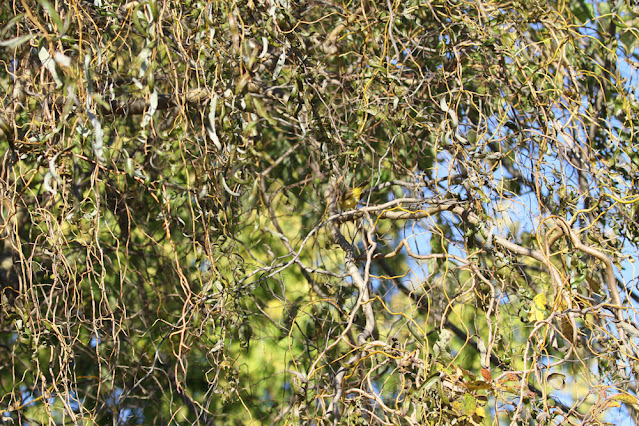
The next one my Dear Other Half found is the American Goldfinch.  Very hard for me to see and I am always glad for his sharp eyesight.  It was resting among all those tangled branches.  The American Goldfinch is a common sight at backyard feeders. The small birds are found across most of North America, though they do avoid thick forests. The American Goldfinch is also the state bird of Iowa, New Jersey, and Washington.
The American Goldfinch is the only finch species that molt twice a year. The first time is in the spring when the males get their bright yellow feathers, and the second is at the end of summer when the darker feathers grow in.  A female Goldfinch typically lays between 2 to 7 eggs. The eggs are either greenish-blue or light blue. It takes twelve days for the eggs to hatch, and another 12 days before the hatchlings fledge.   
The following shows the Milkweed plant with its pod split exposing the seeds.  You can read about it at this link.   
The seeds are equipped with hairy filaments which facilitate dispersal by wind.  
During windy days, seeds often travel 25 to 100 feet away from the mother plant. 
When Milkweed splits open they reveal 50-100 seeds, each with a white, fluffy coma ("parachute") that allows wind dispersal, as mentioned above. 
Common milkweed is Nature's mega food market for insects. Over 450 insects are known to feed on some portion of the plant, and must not forget the plant's importance to the Monarch Butterfly.  The ones I found on this one are called Milkweed Bugs (Oncopeltus fasciatus).  If you click on this link it will take you to a page with more information.
An Oxeye daisy, botanical name Leucanthemum vulgare.  Also known as Ox-eye daisy, Dog daisy, Moon daisy, White daisy and Marguerite.
Oxeye daisy is a small perennial and our largest native member of the daisy family. It is a widespread flowering plant native to Europe and the temperate regions of Asia, and an introduced plant to North America, Australia and New Zealand.
These are called the Aromatic aster, botanical name Symphyotrichum oblongifolium.  Its other names are Fall aster, Oblong-leaf aster and Oblong-leaved aster.  The Armomatic aster is native to parts of eastern and central United States. 
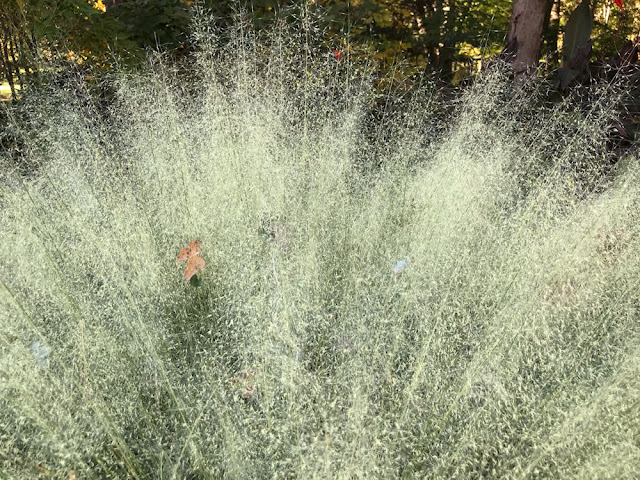
The plant below is called the Hair-awn muhly, botanical name Muhlenbergia capillaris.  Also known as Hairy-awn muhly, Muhly grass, Hair grass, Pink muhly and Gulf muhly.  It is a perennial, sedge-like plant.  It likes a lot of sunlight.  It attracts beneficial insect species and is also considered an excellent wildlife habitat plant that provides great cover.
The grass was named after Heinrich Ludwig Muehlenberg (1753-1815), German educated Lutheran minister and first president of what is now Franklin and Marshall College, Lancaster, Pennsylvania.  
He was America's first outstanding botanist who published Index Flora Lancastriensis in 1785.
This pretty orange flower is the Sulfur cosmos botanical name Cosmos sulphureus.  Other names are Klondike cosmos, Yellow cosmos and Orange cosmos. It is native to Mexico, Central America and northern South America, and naturalized in other parts of North and South America, as well as Europe, Asia and Australia.  The flowers of all Cosmos attract birds and butterflies, including the Monarch butterfly.  You can read more at this link.
This is the dried leaf from thee Pin Oak, botanical name Swamp Spanish oak or Swamp oak.  My plant app told me "Your plant is dried out, suggesting it is dormant or dead."  It doesn't realize I see the beauty in dried leaves that I find on the ground, but I'm happy it identifies even these.  It is a deciduous tree native to North America.  The Pin Oak has favorable growing qualities and is one of the most common oak species used in landscaping.
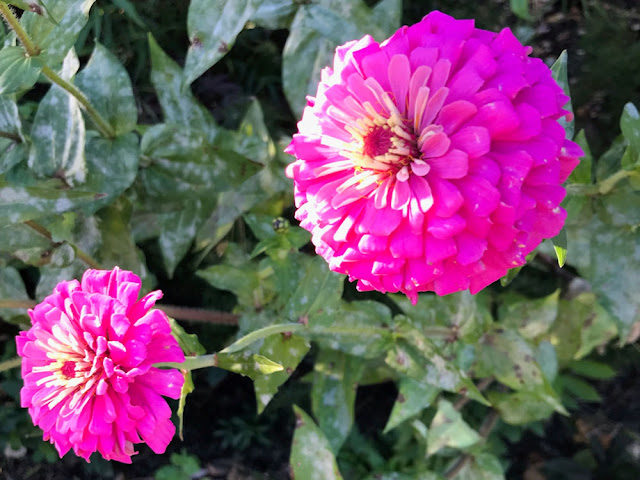
I saw several Common zinnias blooming but these were the only ones that were not totally past it.  The others were a little straggly.  Botanical name Zinnia elegans.  Also known as Zinnia, Elegant zinnia, Youth-and-age and Wild zinnia. The name was given to the plant in memory of another German botanist Johann Gotfried Zinn.  It also symbolizes friendship in the language of flowers.  You can learn more about it if you click on this link.
Next is a Purple coneflower and I certainly wasn't expecting any at this time of the year, but then this is where I get my education walking around these gardens.  Botanical name Echinacea purpurea.  Also known as Eastern purple coneflower and Hedgehog coneflower.  It is native to the eastern United States, and purple coneflower is found in many flower gardens.
There is a very nice website called "Fun in Fairfax Virginia".  This link is about the garden. There is quite a lot of advertising but the photos are wonderful and will give you more insight into Meadowlark.
And last of all my dear little flying pig.  Did you know that The Flying Pig has origins in Greek mythology, legend and folklore?  The original flying pig was a winged boar named Chrysaor, the offspring of the Gorgon Medusa and the Greek sea god Poseidon.  The winged horse Pegasis was his brother.  And as for its meaning of following a story someone might tell you that you can't quite believe, followed by you perhaps saying, "and pigs might fly." I read, "Flying pigs appeared in print in the UK quite often throughout the rest of the 19th century. The Illustrated Times referred to them in an issue in August 1855: "...pigs might fly.  An elephant, too, might dance on the tight-rope."  Always amazes me what I can find online.
We started in the fairy garden and we are ending there as this little pig is keeping company with the remaining fairies.  I have known it for years.  The next time we meet, hopefully, will be when we come back for their Winter Walk of Lights.
In the meantime it hopes you have enjoyed your walk around the garden.  Thank you for joining us and have a great weekend.