Showing posts with label Fungi. Show all posts

Thursday, September 11, 2025

PRETTY TO PHOTOGRAPH BUT...


not the kind of mushroom you want to add to your meals! According to Google, and this website, it is called the Death Cap. Need I say more?

I haven't been too far this week so I went into my archives and when I found the photo, I realized I knew nothing about fungi.

I enjoy taking photos of them. Mushrooms are one my favorite veggies also, but I obviously only get them from the store. Do any of you forage for them? That would be very interesting to do but I think I will stick to the supermarket. My expertise is zero, but at least I know about these. I wouldn't even want to touch the things.


Thanks for the visit and 

I hope your day is going great.


Wednesday, December 13, 2023

HUNTLEY MEADOWS PARK IN ALEXANDRIA, VIRGINIA 12-5-23 WHAT I NOTICE IN THE WOOD

Before starting our walk we always stop at the signs to see what is going on at the park.

I am concentrating more on the trees and plants today as we walked through the wooded area, but the first thing I saw was a squirrel running up the side of a very tall tree trunk about 30 feet high. We don't see squirrels very often here, but we saw a lot of things today that we don't normally see.
He's eating something, perhaps a tasty acorn. I was surprised to find they were omnivores.  If I knew that originally, I have since forgotten. Aside from eating mostly nuts and acorns from oak, beech, walnut and hickory trees, as well as seeds, fruits, bulbs and flowers from other plants and trees, I read that they will also eat frogs, insects, bird eggs and farm crops such as corn and wheat.  And, of course, my daily feast of whatever I buy for the bird-feeding table!  They don't seem to be fussy eaters.
I am one of those people who enjoys looking at all the dead leaves as we walk by, to see what I can identify. The bright green leaf with all the veins drew me in. I identified it as English Ivy. European colonists introduced it as early as 1727 according to this website. Its origins are Europe, Western Asia and Northern Africa. There is a lot more information at the link. 
The smaller, lighter green leaf is Japanese Honeysuckle.  One little snippet I read at the previous link is that it was "introduced to Long Island, New York, in 1806, for ornamental, erosion control and wildlife uses."  I'm wondering if the plant app identified it correctly as I read further "It is a fast-growing vine that twines around stems of shrubs, herbaceous plants and other vertical supports.  In full sun it forms large tangles that smother and kill vegetation.  It can kill shrubs and saplings by girdling."  
It certainly looks like the kind we had in our garden years ago, but it didn't last and died off.  I was thinking I would plant more next growing season but the suggestion is to use native alternatives, "Coral honeysuckle, hairy honeysuckle, crossvine and trumpet creeper."  
I will be coming back to read this before I take a trip to the garden nursery. I remember the scent being incredible and I noticed it especially when the weather was warm.  Before it got too hot it was lovely to sit on the deck and just breathe it in.  I loved its scent, still do when I see it elsewhere.  
The Coral honeysuckle is what we had in our planter.  I don't remember any scent but then I didn't stick my nose too close to it and I couldn't detect any otherwise.  I think it was definitely Japanese honeysuckle growing in our garden, after looking at all the photos online.  If any of you are growing it, or have grown it, what do you think?  Would you plant it and can it be controlled with a lot of tender loving care?


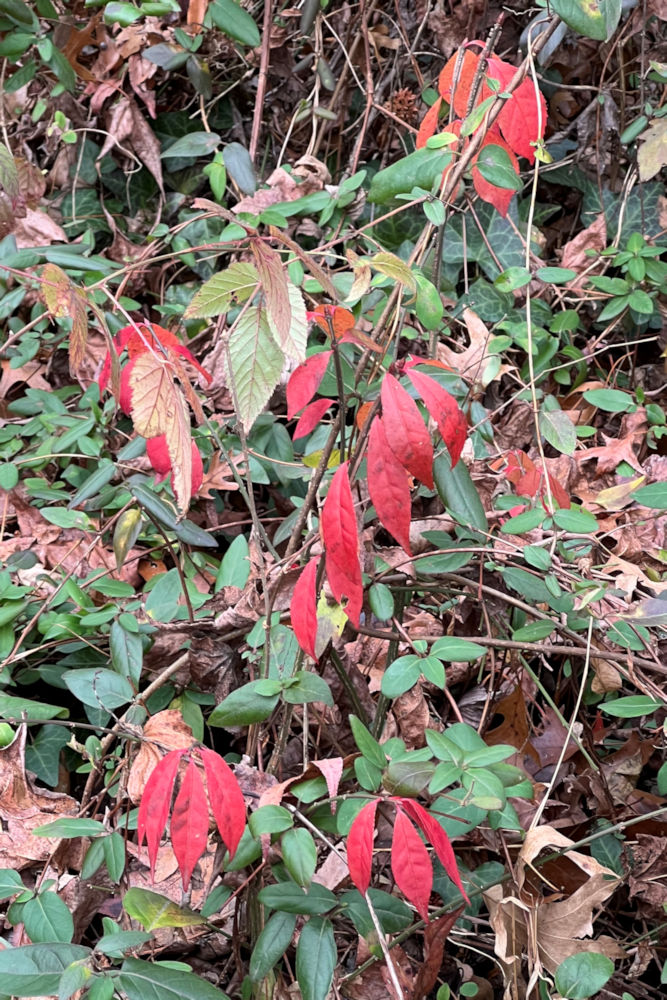
"The red-leafed plant coming up is called the Burning Bush. It is native to northeastern Asia and was brought to North America around 1860 as an ornamental shrub.  It has been widely cultivated and planted through the eastern United States and Midwest.  Soon after its introduction, it escaped into the wild and has now naturalized in 25 states, including Pennsylvania and Delaware."  More at the link above.

Another pretty red leaf found was Arrowwood virburnum, botanical name Viburnum dentatum. It is native to the Eastern United States and Canada, to regions from New Brunswick to Minnesota and south to Georgia.  The name was inspired by Native Americans because of their use of the strong shoots which developed from the roots, for shafts of their arrows.

This is the time of year we see all the interesting fungus growing on dead logs. The one below is called Birch mazegill, botanical name Lenzites betulina
It is commonly found on decaying coniferous or deciduous woods. While its natural color is a yellowish brown, it may sometimes appear to be green due to its propensity to host algae.  It is said to be inedible because of its touch and leathery texture.  I found very similar photos of the following fungi that looked like the above photo, but my plant app kept identifying this as Turkey tail, botanical name Trametes versicolor.
Its meaning 'of several colors', versicolor in its Latin name reliably describes this fungus that displays different colors.  
Because its shape and multiple colors are similar to those of a wild turkey, it is commonly called Turkey Tail. 
Next we have a plant called Winterberry, botanical name Ilex verticillata. These bright red splashes of color were everywhere.  The berries were used for medicinal purposes by Native Americans, especially during fevers, so it is also called Fever bush.

Though I have several more photos from the park, I'll finish here for now with two photos of the Canada Goose.
They were all very quiet this time.  I hardly heard a honk!

Thanks for looking and I hope the weather is treating you well in your part of the world.