Showing posts with label Facts. Show all posts

Sunday, September 28, 2025

HAPPY SUNDAY EVERYONE - SHARING A BLUE JAY TAKEN BY...

our son on a walk near where he lives. I am always grateful to him for sending his photos as I haven't taken any birds lately. I share some facts about them below.

They are known for their intelligent, noisy nature and are important for planting oak trees by burying acorns, many of which they forget, helping to spread and plant oak trees. 

Their striking blue color is an illusion created by the feather structure scattering light, not pigment, a phenomenon known as light interference. 

 Many notice that Blue Jays, who are fairly quiet during the spring and summer, are noisy little neighbors during the fall. In spring and early summer, when they are nesting, they tend to be more secretive. Come fall, when they are scavenging for food and hawks are more present, they communicate a variety of information and warnings through their calls. Blue Jays can also mimic the calls of other birds, including hawks.

They use their crests to communicate mood and aggression, with a flattened crest indicating relaxation and a raised one signaling stress or threat. 

They develop strong social networks and have complex social behaviors. 


You can't tell the difference between a male and female Blue Jay, they look identical. 

They eat a variety of foods, including nuts, seeds, insects and even the eggs and nestlings of other birds.

They prefer deciduous or mixed forests but can also be found in suburban areas and city parks, especially those with oak or beach trees. 

Blue Jays can live for a long time; the oldest known wild Blue Jay was almost 27 years old.

Blue Jays have been known to chip at and hoard light-coloured paint, probably to stockpile a source of calcium for the spring. If Blue Jays are chipping away at the paint on your house, try providing an alternate source of calcium like crushed egg shells – this usually stops the unwanted behavior.


More information can be found at this link.


Thanks for looking and with thanks to my dear son who provided the photos for today's blog post.

Have a great day everyone!


Thursday, October 19, 2023

NORTHERN CARDINAL

 A few photos of a regular visitor who liked to perch on top of the hanger before hopping down to feed.  His mate usually arrived first and he would follow soon after.

A few facts.
The bird’s scientific name is Cardinalis cardinalis, but cardinals have had many colloquial names depending on their region, including: Common Cardinal, Cardinal Grosbeak, Red-bird, Cardinal-bird, Cardinal Redbird, Crested Redbird, Top-knot Redbird, Virginia Redbird, and Virginia Nightingale.
Cardinals get their trademark red plumage from their food. While they are mostly granivorous, or grain and seed eating, cardinals also eat insects and a wide variety of fruits like wild grapes, dogwood berries, and mulberries. These fruits contain carotenoids that can create the reds, oranges, yellows, and pinks found in avian feathers.
 There are currently 19 Northern Cardinal subspecies recognized by the IOC World Bird List, with 14 of them being found south of the United States in Mexico and the far north of Brazil and Guatemala. Researchers have proposed making some of the subspecies in the southwest their own species but so far, the AOS has rejected the idea without more supporting data.
If you ever see a bald Northern Cardinal, do not worry: Though the bird might look sickly, it’s actually just molting. Every year birds replace their worn-out feathers for fresh ones, typically replacing a few feathers at a time. But cardinals can often lose all their head feathers at once, giving them a decidedly punk-inspired look in late summer after breeding. 
All my information and more can be found at this website.


Thanks for the visit and 
I hope your week is going great.


Friday, May 5, 2023

AMERICAN BALD EAGLE FOUND SEVERAL YEARS AGO AT...


Hopefully I haven't shared this beautiful Eagle on my 2016 blog before.  I may have of another bird/animal from the same park and apologies if this is a repeat.  

I started on this post by saying:

I would obviously rather see these magnificent birds in the wild, but when we visited this rather amazing park, we were able to see a pair of Bald Eagles close up.  They had been taken there after being injured.  The staff try very hard to release them back into the wild once rehabilitated but I am not sure if these were set free.  I truly hope so.


 This park is a rehabilitation center not only for manatees but for all kinds of birds and if they are not able to be released, they will be given a home here for the rest of their natural lives.

 
 To be in such close proximity to them was a real privilege and one I will always be grateful for.


They are one of the world's largest raptors.  Bald Eagles can weigh up to 15 lbs and are between 28-38 inches in size. Their wingspan can reach up to 7.5 feet. (For comparison: an osprey’s wingspan reaches up to 6 feet, and a red-tailed hawk’s up to 4.8 feet). This expansive wingspan is ideal for soaring, keeping Bald Eagles aloft for longer periods without flapping their wings.


Their impressive wingspan is more than decorative: it allows them to fly at dizzying heights! Bald eagles soar 10,000 feet or more into the air, using thermal air currents to support their glide. This allows them to conserve energy for more important activities, like looking for prey and migrating long distances.


We call a person an “eagle eye” if they have 20/20 vision, but Bald Eagles have much sharper eyesight.  In fact, they typically have 20/40 or 20/50 vision, making them expert hunters. Not only can they spot a small animal two miles away with amazing clarity, but they have a 340-degree field of view, with even better peripheral vision than owls!


Bald Eagles aren't actually bald as their name would imply.  They have a white head of feathers. Where did the name “bald” come from? It is actually a translation of the old English word “piebald,” meaning “white” or “white-headed.”  Its head doesn’t become completely white until they are 4 or 5 years, with about four stages of feather shedding before that.   


Bald Eagles are said to have a grip 10 times stronger than a human. This comes in handy when they use their talons to pick up fish (their favorite meal) from a lake and keep hold of it while gliding through the air. It also allows them to snatch another bird’s prey midair (after hassling the bird to drop its meal).


Known for their dramatic "sky dances", Bald Eagle males will court females with a series of impressive feats.  From high-speed chases to tumbling together, talons locks from great heights as they hurtle towards the ground.  Less active courtship behaviors include sitting shoulder to shoulder, preening and even nest building.  And not only new couples engage in these activities.  Some mated couples perform these rituals to strengthen their bond.


Bald Eagle couples typically mate for life, meaning they can be coupled monogamously for 30 years. The mated pair breeds year after year, producing around 1-3 eggs each time. These eggs are incubated for about 35 days, during which time both the male and female of the couple will share the duty of keeping the eggs warm.  I found all my information at this website and if you would like to see more, click on this link.


Last night, once again, I had a dream
About an eagle in the blue,
And just like all the other dreams,
Right above my head it flew.

In every dream of it I had,
It landed somewhere close by,
And each time, I was so excited
For the beauty that caught my eye.

Our national emblem gracing the sky
For so long I yearned to see,
And envied those fortunate enough
To see him on the wing, being free.

When I awoke from the glorious dreams,
Some disappointment I did feel.
But then I overcame with happiness,
For the dreams had seemed so real.

Majestic Dreams
by
Stacy Smith


Wednesday, March 22, 2023

THE EASTERN BLUEBIRDS VISIT DAILY.

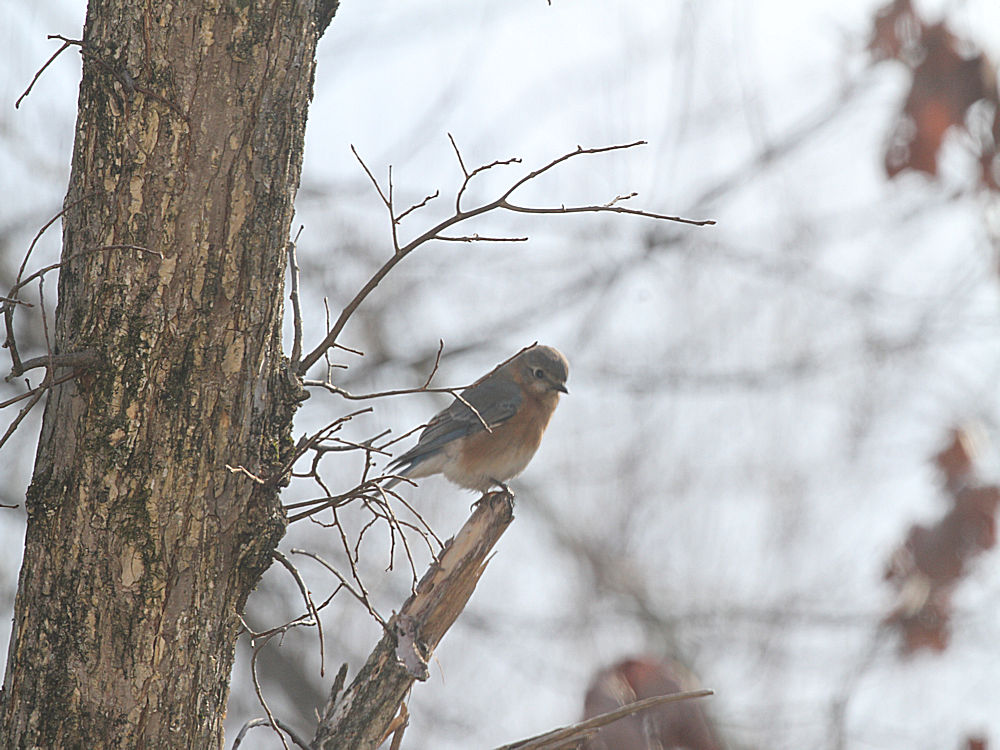
 It wasn't so long ago that we rarely got to see an Eastern Bluebird.  There were rare glimpses in other places but not in our garden.  I was delighted the first time my trail cam (or as I prefer to call it now, my bird cam) started taking photos of what I thought couldn't be.  But yes, they started being regular visitors about a year-and-a-half year ago.  I haven't gotten over this yet, it is still a novelty and I suspect always will be.  My photos were taken with our regular camera on a bit of a dull day and weren't as sharp as I would like.  They were high in the tree and even my zoom lens was struggling, but it's a good photo memory.

Here are a few facts about them.  Eastern Bluebirds live in most of the United States east of the Rocky Mountains, and in parts of Southern Canada. There are also native populations of Eastern Bluebirds living in Mexico and Central America. Those that survive to adulthood can live for 6-10 years. That’s unusually long for a wild bird to live, but sadly most bluebirds do not survive their first year of life.  Once they have mated and built their nest, a female bluebird will lay between three to five eggs.  The female incubates them while the male brings her food.  It takes about two months for Eastern Bluebirds to become fully independent.  After about 22 days the chicks will be fledged, meaning they will have lost their downy feathers.  That's when they begin to learn how to fly, but it takes a while longer for them to learn all the skills they need to survive on their own. 

Females will never turn bright blue, instead staying a dull blue-gray their whole lives. Males will begin to develop bright blue feathers when they are around 13-14 days old, but it may be several days after that before they begin to show adult coloration over their whole body.  Eastern Bluebirds are small and have trouble creating their own nests. They prefer to find old nests made by other species and reuse them, rather than building one. Old woodpecker holes are favorite nesting sites, and they prefer their nests to be near open fields and meadows, and often like to nest high off the ground.  Because their preference is to find nesting sites made by other birds, they will readily take to birdhouses. They like to nest in tight, snug spaces, so smaller birdhouses are more likely to attract them. In some places people have built “bluebird trails”, areas with large numbers of nesting boxes for bluebirds to create ideal bird watching conditions.

Do Eastern Bluebirds migrate?  Yes and no!  In most of their range, Eastern Bluebirds don't migrate.  However, there are large areas where they do.  In the northernmost areas of their range in the United States, Eastern Bluebirds are present during the breeding season only, and in large portions of Texas, New Mexico and Northern Mexico are wintering grounds for these migrating bluebirds.  In the southeastern US, Central Mexico and Central America they do not migrate.

I hope you have enjoyed these facts about one of my favorite birds.  I had an enjoyable time finding out about them and am always up for a refresher course as I do forget certain things after a while.

Happy Wednesday everyone and thank you for stopping by.


Wednesday, February 9, 2022

WALL OF DOGS

Our son came over for one of his visits last Sunday.  Always enjoyable and a few hours goes far too quickly, and am always grateful for them, never taking them for granted.  One of the very best gifts can be the giving of your time, whether it's with a loved one or a friend, don't you think?  

He shared these photos he had just taken, as he had stopped off at our local coffee shop to pick up a coffee for me (his Dad is not a coffee drinker). These were posted on the wall and he knew we would enjoy these dogs.  He was correct and I asked if I could share them today.  Thank you son!

“Scratch a dog and you’ll find a permanent job.” 

~Franklin P. Jones(humourist)


As usually happens when I see a photo, whether I take one myself or as in this case those from our son, my curiosity goes down a very long tunnel.  This one led me to finding out about the history of dogs.

The following shares are from various articles I found over a few days.

Domestic wolves, it was originally believed, appeared around 15,000 years ago in the Middle East. New evidence, however, suggests it was much earlier than that. Swedish geneticist Pontus Skoglund published a study in 2015, in the journal Current Biology, describing his findings of a 35,000-year-old Siberian wolf bone. He concluded that canine domestication may have happened 27,000 to 40,000 years ago.

Archaeological evidence and DNA analysis make the Bonn-Oberkassel dog the first undisputed example of a dog. The remains, a right mandible (jaw), were discovered during basalt quarrying in Oberkassel, Germany in 1914. First mistakenly classified as a wolf, the Bonn-Oberkassel dog was buried with two humans around 14,220 years ago.

According to genetic studies, modern day domesticated dogs originated in China, the Middle East and Eastern Europe. According to Greger Larson, an archeologist and geneticist, gray wolves were domesticated by humans somewhere in western Eurasia. He surmises people in the East were also domesticating wolves at the same time.

Scientists believe wolves were first attracted to human camps to scavenge for leftover food. Over time, some wolves started traveling with the nomadic humans and a sort of natural selection for domestication occurred, Dr. Stephen L. Zawistowski, science adviser emeritus to the American Society for the Prevention of Cruelty to Animals (ASPCA), told ABC News. Women may have been the first to make these wolves a pet, according to Katherine M. Rogers, professor emerita of English from Brooklyn College, in her book "First Friend." It takes six to eight generations to domesticate a canine, according to a 40-year experiment that began in the late 1950s by Russian researcher Dmitri K. Belyaev."

Additional evidence suggests that around 15,000 years ago, early dogs moved out of Southern and Central Asia and dispersed around the world, following humans as they migrated.


When did dogs first become pets? There’s even more dispute about the timeline of the history of dogs and humans. What most scientists and canine geneticists agree on is that dogs were first tamed by hunter-gatherers between 9,000 and 34,000 years ago, which is such a wide timeframe that it’s hardly useful.

More recent studies suggest humans may have first domesticated dogs some 6,400-14,000 years ago when an initial wolf population split into East and West Eurasian wolves, which were domesticated independently of each other and gave birth to 2 distinct dog populations before going extinct."

A few more interesting facts:

Service and assistance dogs have proved for centuries that dogs are good for more than hunting and protecting property. In the 1750s, dogs started to undergo instruction as guides for the visually impaired in a Paris hospital for the blind.

Greyhounds win the prize for being the fastest dogs on Earth: they are able to run at speeds up to 45 miles per hour. Interestingly, there are indications in tombs that Greyhounds were kept by the Ancient Egyptians.

Every Dog Has a Unique Nose Print.  One of the most fascinating dog facts reveals that a dog’s nose print is as unique a pattern as a human’s fingerprint. If you take a magnifying glass and look closely at a dog’s nose, you will see a series of bumps and ridges that are completely different than any other pet. (Cats also display this unique characteristic.)

The largest breed of dog is the Irish Wolfhound which can grow to a minimum of 105 pounds (sometimes up to 180 pounds), and stands at least 2 feet, 6 inches tall. The smallest breed, on the other hand, is the Chihuahua, which is closer to the size of a cuddly toy. They typically weigh between 2 and 6 pounds and can be around 6 to 9 inches tall. A more average-sized dog weighs between 20 and 60 pounds. Their height ranges between eight inches and 27 inches.  I borrowed my photo below.

Dogs are descended from a 15-Million-Year-Old Species.  It is thought that all the different types of dogs on Earth are descended from a species called Tomarctus that lived 15 million years ago. The oldest known specific breed was called Saluki. These dogs were pets belonging to the Ancient Egyptians. The earliest dogs are thought to have emerged at around  the same time as human hunter gatherers.

The dog's scientific name is Canis Lupis Familiaris, which means friendly dog wolf.  This makes reference to the fact that dogs are actually descended from wolves, as mentioned before.

The Norwegian Lundehund is the only dog that has 6 toes on each foot. 

A Border Collie named Chaser has the largest vocabulary of any other known dog. Chaser has been taught over 1022 names of items and can recognize and categorize them according to function and shape. Something a human learns to do around the age of 3. 
The fastest breed is the Greyhound. They have been known to hit record speeds of 44 miles per hour. 

The oldest dog breed is the Saluki. Just like the oldest Cat breed, the Saluki originated in Ancient Egypt around 329. B.C.E. 

Dalmatians are born completely white. As they age they start to develop the spots that make the breed so famous. 

The Basenji is known as the 'Barkless Dog'. While they don't bark they have been known to yodel.

Walt Disney's Dog, Sunnee was the inspiration behind Lady and The Tramp.

The most successful search and rescue dog was a St. Bernard named Barry. Born in 1800, he saved around 40 people in his 12 years and has become a Swiss National Hero! 

I hope you have found these facts interesting.  


Thursday, October 17, 2019

GULLS AND DUCK...

...the 'Duck' being the town of Duck, North Carolina, in the Outer Banks.  

Here are two maps showing its location.
I am continuing our walk along the boardwalk from several posts ago.  At one point there was a small docking area where gulls were resting.  I am always drawn to gulls.


Every time I see one now, I am reminded of a man I met who gave nature talks on gulls.  My whole life I had called them seagulls.  When we were looking at one such 'seagull', he told me that there are no 'seagulls', just gulls.  He seemed to know what he was talking about so I took him at his word...
and yet everywhere I go on the internet, they are known as 'Seagulls", even by Ogden Nash in one of his short poems.
The Sea-Gull
by Ogden Nash

Hark to the whimper of the sea-gull;
He weeps because he is not an ea-gull.
Suppose you were, you silly sea-gull.
Could you explain it to your she-gull?

I know they are not the most popular bird with some, but I have always loved them.  My experiences have never been as some I have heard, and I have read some real horror stories out there.  However, my whole life I remember them fondly,  so I suppose this is why I enjoy them on the rare occasion we are in each other's company.

"Seagulls...slim yachts of the element."
~Robinson Jeffers~ 

And here are some facts I found.

There are approximately 50 species of gulls found throughout the world.

Their lifespan depends on the species.  Most gulls have a lifespan from 10 to 15 years in the wild.

Gulls live in colonies that consist of few pairs of birds, or a couple of thousand birds.

Gulls are monogamous that mate for life.

They are devoted to their chicks and co-parent.
Most gulls breed once a year and have predictable breeding seasons lasting for three to five months.

Nest building is also part of the pair-bonding.  Most species of gull build their nests on the ground, while other species build their nests on elevated areas, such as cliffs or trees.

The clutch size is generally three eggs.

Both male and female take turns incubating eggs, with incubation lasting 26 days.

Young chicks are brooded by their parents for about one or two weeks, and often at least one parent remains with them until they fledge, to guard them.

Both parents feed the chicks, although early on in the rearing period, the male does most of the feeding and the female most of the brooding and guarding.

They can drink fresh water or salt water, though they prefer fresh.

That being said, being marine birds, gulls are often far from sources of fresh water.  Because of this they have special bill adaptations that allow them to filter the salt out of the water and make it drinkable.

Case in point, many of the world's species of gulls are the type we see all the time and display normal behavior, but there are also many who have evolved to suit their environs.  The lava gull for instance has adapted to volcanic islands and is black from bill to wingtip.  The swallow-tailed gull, native to the Galapagos Islands, is actually nocturnal, and specializes in hunting squid, swooping down in the moonlight to capture its prey.

Seagulls have existed on the earth for at least 30 to 33 million years.

In many cultures, seagulls are symbolic of freedom, versatility and a carefree lifestyle.

All gulls belong to the Laridae bird family, along with terns, kittiwakes, skimmers and noddies.  Noddies?  Click here to find out what those are.

And bingo!  This next bit refers to what I mentioned at the beginning of my post.  Despite the universal use of the general term "seagull" these birds are not associated just with pelagic, marine or coastal environments, and in fact there are no birds officially named seagulls.

At least one species is found on every continent, including Antarctica, and many gulls have widespread ranges that make them familiar to birders from vastly different regions.  This makes gulls one of the most widespread families of birds in the world.

A flock of gulls is called a colony, squabble, flotilla or scavenging.

Gulls are opportunistic feeders and yes, they will swoop down and steal a bag of fish and chips right out of your hands, and anything else they can get a hold of in the way of food.  I've never actually experienced this but have seen on several occasions people voluntarily feeding them for the fun of it, to watch them descending by the dozens.  When we were little and on holiday in a caravan (camping trailer to us over here), my father would open the small window in the roof and feed the gulls stale bread, and we delighted in feeling them peck our fingers as a whole flock grabbed all the bread they could before it ran out. Amazingly they never drew blood, and whether this was due to fast reflexes I don't remember.  I might add that I learned long ago now, that to feed any wildlife human food is most definitely not what we should do, however tempting.  It can be harmful to them, and to us, for so many reasons.

As far as gulls go, the California gull is quite smart.  Unlike many gulls, this species favors inland environments for nesting, and often migrate through farmland.  In these environments, insects are a preferred diet of choice.  Which leads to the following.

The California gull (Larus californicus) is the State Bird of Utah.  Not only is this the only gull to be an officially designated state bird, but it is also the only bird to be a symbolic icon for one state even though it is named after another state.  The reason is that in 1848 a great crop of gulls once saved the people of Utah by eating up hordes of crickets that were destroying the crops.  All day long they ate the crickets, and kept eating until these insects were gone, and then they returned to the lake islands from where they originated.  And the people of Utah were saved.  What a wonderful way to become a State Bird.

The Seagull Monument on Temple Square in Salt Lake City honors the gull.  Two sculptured gulls stand atop the monument which was unveiled in 1913.  Mahonri MacKintosh Young sculpted the monument.

The size of a gull varies widely.  The little gull (Hydrocoloeus minutus) is the smallest at just 11-12 inches long, a wingspan of 24 inches, and weighing just 3-4 ounces.  The Great black-backed gull (Larus marinus) is the largest gull at 28-30 inches long, with a 60-inch wing span and a weight of 3-4 pounds.

The smallest gull species in most of North America is a small bird with a black head, white body and red bill and legs.  It is called the Bonaparte's gull, named after Charles Lucien Bonaparte, the illegitimate cousin of Napoleon Bonaparte.  I have no idea how that came about but this History site tells us how many family members of Napoleon ended up in America.  And isn't it interesting how research on Gulls can send you in so many different directions?  Well, learning is fun, and I have had fun doing this post.
I bounced all over the internet last night, from one website to another.  Unfortunately I wasn't very careful taking note of their addresses, even though I was fascinated with all these facts I was reading.  I was up late and though my fingers were moving fast, my brain wasn't quite on the same pace.  That's the way I roll on a sleepless night at three in the morning.  I got caught up in the enjoyment of finding all about one of my favorite critters, and I didn't realize how late it.  I am having an early night!

So, I hope you've enjoyed all these interesting facts, and my apologies if it is a bit too long.  I wanted to get everything on record so that I could go back whenever I wanted, to re-read and maybe do more research while remembering to make a note of where I got my information from.  From childhood I have always had a curious mind on just about everything.