As St. Patrick's Day is next Thursday, I am sharing this recipe from 'Cook and Be Merry', hosted by Lynne. The last recipe she posted was in August 2016. As I type this her blog is still open, and there are lots of delicious recipes to see. I am grateful and would like to thank her for keeping it open. You can find the original recipe at this link.
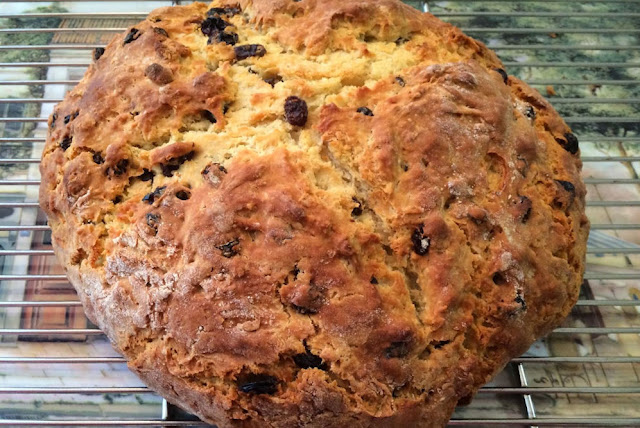
Irish Soda Bread - makes 1 loaf
4 cups all-purpose flour
2 tablespoons sugar
1 teaspoon Kosher salt
1 teaspoon baking soda
4 tablespoons cold salted butter, in thin slices
1 cup raisins
1 egg, lightly beaten
2 cups buttermilk
Preheat oven to 425 degrees F. Line a baking sheet with parchment paper and lightly coat with cooking spray.
In a large mixing bowl whisk together the flour, sugar, salt and baking soda.
Using a pastry cutter or two knives, cut butter into flour mixture until it resembles coarse meal. Stir in raisins.
Make a well in flour mixture and pour in beaten egg and buttermilk. Mix with a wooden spoon until all flour is mixed in with the buttermilk.
Liberally dust work surface with flour. Transfer dough to surface and sprinkle with flour.
2 tablespoons sugar
1 teaspoon Kosher salt
1 teaspoon baking soda
4 tablespoons cold salted butter, in thin slices
1 cup raisins
1 egg, lightly beaten
2 cups buttermilk
Preheat oven to 425 degrees F. Line a baking sheet with parchment paper and lightly coat with cooking spray.
In a large mixing bowl whisk together the flour, sugar, salt and baking soda.
Using a pastry cutter or two knives, cut butter into flour mixture until it resembles coarse meal. Stir in raisins.
Make a well in flour mixture and pour in beaten egg and buttermilk. Mix with a wooden spoon until all flour is mixed in with the buttermilk.
Liberally dust work surface with flour. Transfer dough to surface and sprinkle with flour.
With flour dusted hands, form the dough into a ball that is relatively smooth.
Place baking sheet next to the dough work surface and place dough ball on sheet. (Dough is very soft so use hands to scoop up and surround ball to transfer to the baking sheet.)
Using a serrated knife, score top of dough with an x-shape half an inch deep.
Bake about 40 minutes or until bread is golden and bottom sounds hollow when tapped with a knife.
Transfer bread to rack to let cool briefly.
Place baking sheet next to the dough work surface and place dough ball on sheet. (Dough is very soft so use hands to scoop up and surround ball to transfer to the baking sheet.)
Using a serrated knife, score top of dough with an x-shape half an inch deep.
Bake about 40 minutes or until bread is golden and bottom sounds hollow when tapped with a knife.
Transfer bread to rack to let cool briefly.
Serve bread warm or at room temperature, with lots of butter. To stay in with the Irish theme I use Kerrigold, which as many may already know is an Irish butter. Kerrigold was a staple in our home when growing and I love its taste, but obviously any butter of choice would do.
There will be left-overs and I am thinking it would a) make great toast, b) great French toast or c) bread and butter pudding.

There will be left-overs and I am thinking it would a) make great toast, b) great French toast or c) bread and butter pudding.
What did we think of this recipe?
I was surprised how soft the dough was. You really do need to flour your hands well, and also have that board next to the prepared pan to transfer it, as Lynne mentioned in her recipe. I had to finagle the dough mixture a bit as mine turned out very sticky. I think it was because when I cut in the butter, I couldn't get it to look like coarse meal, so I added three extra tablespoons of butter. I don't think I needed that at all. However, after adding a little more flour it was fine, and I was delighted when it turned out looking just like it should but above all, tasted great!

