
Unusual for us we decided to go to the garden on a Saturday. Normally we go in the middle of the week. Because it was hot we left later in the day. We also knew it would be a better light for taking photos.

We expected it to be crowded and many of the parking spots had been taken. The gates are closed at 5.00 p.m. (it's the kind of barrier that you get at some of the train crossings, a single pole that is pulled down across the road. It was already 4.15 p.m. No cars would be able to go in or out, but people would be able to leave once they had taken their walk around the garden. We parked beyond the pole on the side of the road. The photo below shows an old shell of a building and there is no identifying information nearby. At this link you will read: "Nestled into the hillside, the thirteen-foot square, four-chambered structure is mortared cobblestone and brick with a thin coat of concrete. We’ve long referred to it as the “fermentation tank” because descendants of Fountain Beattie, who lived and farmed at Green Spring from 1878 to the early 1900s, described its use as a tank to ferment the juices of fruits grown on the farm."
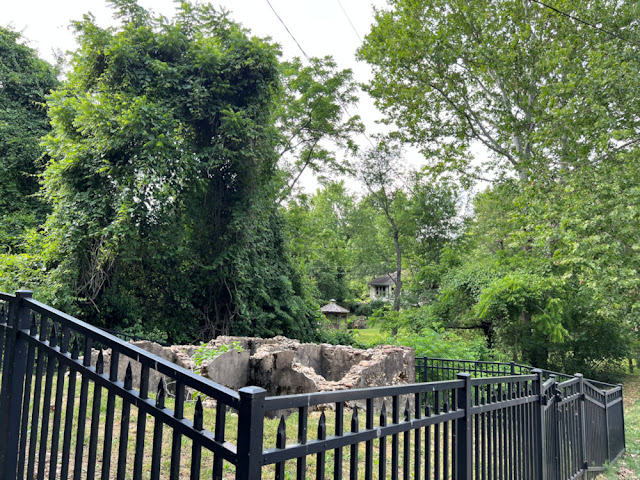
Beyond the fenced off structure you can just make out a gazebo and part of a house. This is a private home with a large garden and it is just across from a path that takes you past two ponds on Green Spring property. The road is little more than a narrow lane, and we came down a slight hill from the main entrance. This part is blocked off from traffic and only for pedestrians, and the occasional garden maintenance vehicle. The opposite end of the lane that leads up to a larger road, is blocked off to thru-traffic. The only ones that I could see allowed on that part of the road, would be the homeowners, and their visitors, and maybe a few people making wrong turns. Otherwise, the lane is very quiet except for foot traffic going down to the ponds. I never usually covet places like this, but I thought how splendid it would be to live within a stone's throw of the public garden. I would be there every day.
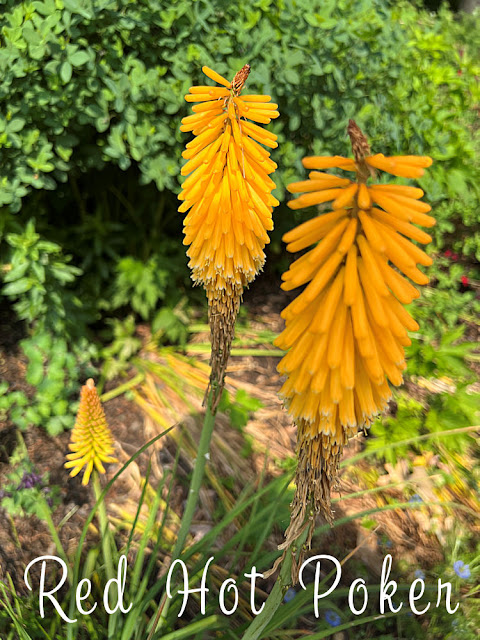
The garden didn't feel crowded at all. We saw more people than normal, but it was very pleasant, and no one was in each other's space. There are several benches in various spots. We were sitting on one overlooking the second pond. It was warm but there was a very nice cool breeze blowing through the whole time we were at the garden. It couldn't have been a more perfect day for a walk.
And there were dogs. These two were the first we came across. A gentleman saw our interest and came over to say hello. We asked what kind they were because neither of us recognized them. He was happy to stop and chat for a while. He told us that they were Mexican Hairless Dogs. I could tell immediately they had very sweet natures, lovely personalities. They were also happy to have us make a fuss of them. Truthfully, I could have adopted them on the spot.
We were told their names but I am still rather heady from the you-know-what, and am as deaf as a doorpost. (My hearing will come back eventually, as it always has over the years. I have had ear problems off and on since childhood.) Anyhow, Gregg didn't catch the names either. What I did hear after asking him to repeat, was that they were Aztec names. I didn't feel like I could whip my notebook out and asking him to write them down. The first thing I saw when they were quite aways off when approaching us, were their ears. One of the dogs in particular, his stood very tall, taller than any I have ever seen, which includes the Doberman.
So, I went online and found a couple of Aztec names for them. For the sake of my story, meet Izel (which means Unique), and Yolotli (which means Heart). 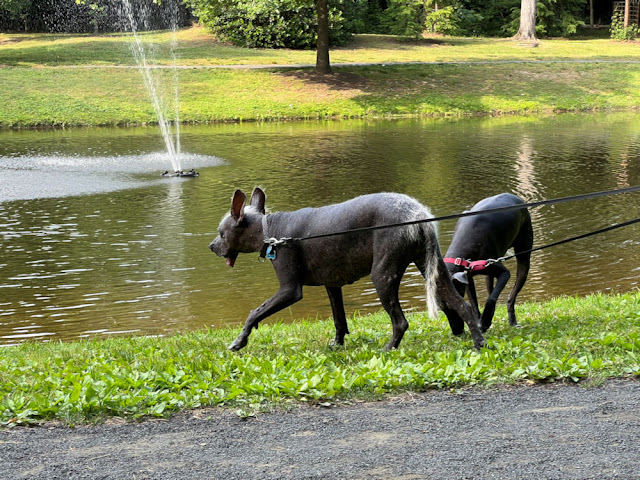
If I ever bump into them again, out will come the notebook!
We learned that this dear little dog was born with a deformity. He has a shortened jaw which can only accommodate half the bottom teeth he would normally have. This led to his tongue hanging out all the time.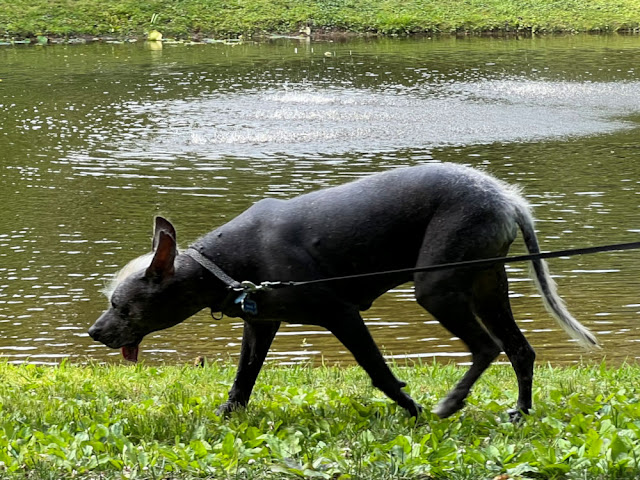
The dogs proper breed name is Xoloitzcuintli, otherwise known as the Mexican hairless dog. If you would like to hear its pronunciation, there is a YouTube at this link you can listen to. It is a 1 minute 5 second video. Also… It is one of the most ancient breeds and has been in existence for over 3,000 years. Their name is derived from the Nahuatl language. Xolotl is the Aztec god of
life and death, and the term “itzcuintli” literally means “dog”. Because these pooches are known to be ‘spirit guides’, they can be widely seen in Mexico parading the streets on Día de Muertos, Day of the Dead.
At this link I read more info. They mentioned that in the latest Pixar film ‘Coco’, there is a dog called Dante. He had the role of a stray spirit guide pup that was adopted by the protagonist, Miguel. Dante is
actually a Xoloitzcuintli, or Xolo for short. In the photo they included at the website, at the beginning of the page, Dante has his tongue hanging out just like our sweet dog here. I seem to remember the man we met at the garden telling us that it is a deformity that happens in this breed of dog, but I haven't checked my facts completely.
These dogs were considered sacred by ancient Aztecs and Mayans, and were believed to be guides for the dead to Mictlan, the underworld. Xolos, their name for short, originated in Mexico, and is the national icon and cultural symbol. Today they are still popular home and hunting companions. When pre-Hispanic art had a major revival in Mexico, Xolos were frequently featured in artifacts and art pieces. Many Mexican artists, like Frida Kahlo and Diego Rivera, kept Xolos. They were also the loyal companions of famous Italian voyager, Christopher Columbus. When Christopher arrived in the Caribbean in 1492, his journal entries noted the presence of strange hairless dogs, that were revealed to be Xolos. 
Similar
in appearance to a Pharaoh Hound, with a sleek body, almond-shaped eyes, large
bat-like ears and a long neck, the breed’s most distinguishable feature is
their lack of fur, which is said to be because of a hereditary genetic
malformation of the skin. Our new friends were 13 and 14 years' old respectively. Because of their age they have a special lotion rubbed on their backs to keep from drying out. (The hairlessness of the breed may have helped in the hot climate they came from.) They have a lifespan of 13 to 18 years and are said to be loyal and mellow. They make excellent watchdogs but are said to be extremely wary of strangers.
Xolos
come in three different sizes: Toy, miniature, and standard, and they weigh approximately between 9 lbs. to 44 lbs. They are mostly black or blue-ish gray in color.
And that's some of what I learned about these delightful dogs. It was fun meeting them and their kind human. We appreciated the fact that he stopped to chat and tell us all about his furless-family. Our visit talking about them was at least 15 minutes long and was the start of a lovely walk. I have more photos from other areas of the garden and will share them as soon as I can put a post together.


