Showing posts with label Egrets. Show all posts

Friday, August 6, 2021

HUNTLEY MEADOWS, LAST PHOTOS...

until the next time we visit.

Usually this whole area is covered with water.  I have never seen any grass growing here.  I found it interesting that all was left of the water, apart from that seen in the background, was the small stream that split in two directions.  In the photo below you can just make out the two Roseate Spoonbills, one just off-center left and the other further left by the stream.  This is the one I concentrated on, which you can see in a previous post.  There is a flock of Canada geese in this photo also.

Below you can just make out those cute ducks, off center left, with a couple of geese to the right. My previous post about the ducks is here

As for the photo below, we didn't go this far today.  We can carry on to reach this boardwalk, when the first one ends and takes us through trees.  We come to a two-story visitor overlook and then the boardwalk is extended for a little further.  These people were on that part of the walk.

This is a Silky dogwood, also called Silky cornel, Kinnikinnik or Red willow.  Its botanical name is Cornus amomum.
In the following collage, the top two photos are Lizard's tail.  Botanical name is Saururus ceruus.  The two photos below are Orange jewelweed.  Botanical name Impatiens capensis.
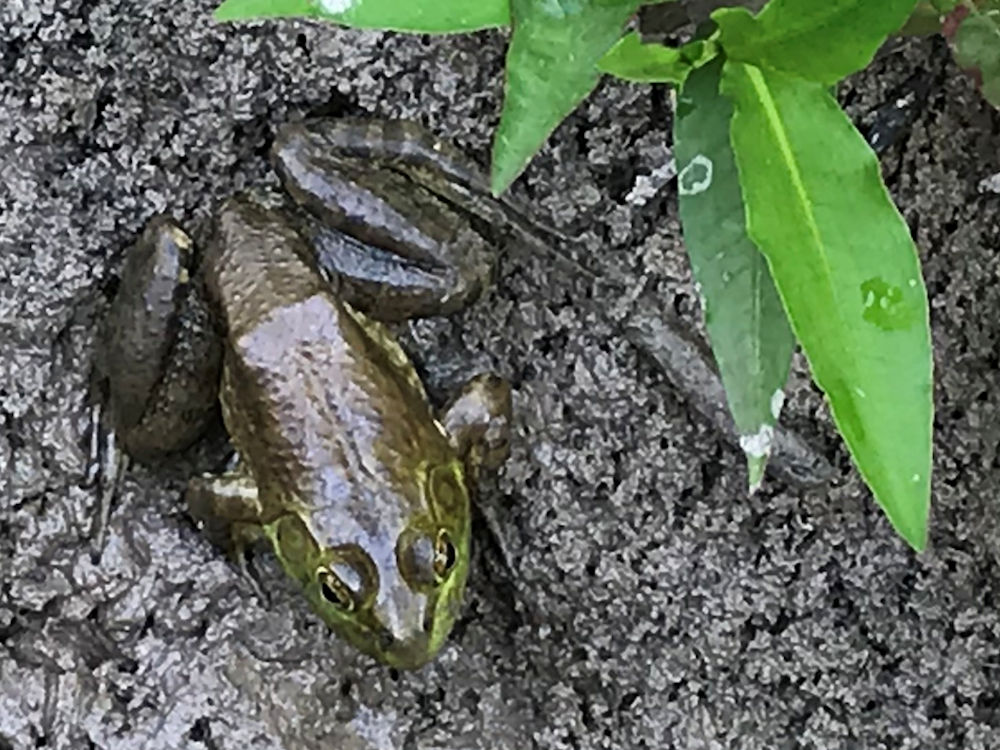
There were American bullfrogs.  They weren't as noisy as they usually are but you could still hear a 'ribbit' here and there.
This is a male Blue Dasher.  You can read all about him here.
Incoming!
I added my photo (above) because I wanted to share the unexpected visitor. I found it in the enlarged version on my laptop later that day.  Do you see it?  There is something of the marvelous with these unexpected tiny sightings.
The plant with the pink flower is called Joe pyeweed.  I have always been curious about its name and found one explanation.  There was once a Native American medicine man called Joe Pye.  He used concoctions from a wild plant found growing in the nearby woods to cure typhoid fever.  His brew is said to have halted an epidemic that raged in Colonial Massachusetts.  Hence this local plant became forever known as Joe-pye weed.
In the collage below, top left photo are the leaves from a Black willow, next to it is the Joe pyeweed.  Below left is Floating pennywort. I couldn't identify the plant in the bottom right photo, guessing it was a type of ivy, but it's just a guess.
Next you can just about make out the egrets roosting in the trees.  Unfortunately they were too far away for a good look, but I liked the photo anyway.
These are getting towards the end of the marsh as we backtrack to the woods.
When we were here before, the stump sticking up out of the water in the next collage, left top photo, showed the work of a beaver and then had only recently been cut down.  The rest of the tree had been dragged off to make a dam probably.  I was happy to see the stump had sprouted new leaves.  Where there's a will there's a way.  Something of the marvelous in nature, as I have said before.  Top right photo shows a frog just below center.
We are almost back to the path at the beginning of the woods.
As we left the boardwalk we sat on a bench for a few minutes, enjoying our surroundings.  We looked back to see others going in the direction we had just come from.... 
and another who was making her way back to the parking lot.  We were seated as she fast-trotted by us.  Yes, my camera is always at the ready.  Along with everything else, I love to take photos of the dogs I see.  Her expression said, "Can't stop, can't stop.  It's hot, it's hot and I want to curl up when I get home, and go to sleep in a nice cool place."  We had something in common, by that time I was feeling the same way.  When I got home I had a nap in my own nice cool place!
It felt good to be back among the trees, and their cooling shade was welcome.
But, I never miss an opportunity to look at the fauna. Below shows the Common mugwort, botanical name Artemsia vulgaris.
Not sure what this ivy is called.  I just thought it made a pretty picture wrapping itself around the tree.
I was starting to feel the heat and we are always glad for the flask of water that I remembered to put in my backpack.  It seems a longer walk back to the car, a little hotter, a little more tired, but what a day!  We have the memory of seeing the Roseate Spoonbills that brought us here in the first place.  And I will not forget every other part of nature we saw, and that we do see quite regularly on every visit.  A trip to the park is ever perfect.  There is always something different, something new to see.
I wonder how long our Roseate Spoonbills will be here?


Thanks for looking and I hope your day is a great one.


(It's a fun hobby for me to try to identify everything that takes my interest.  I downloaded an app called "PictureThis" several months ago and it is mostly accurate.  It has trouble when my photos aren't the best. I also have a very thick flower and plant book that I enjoy browsing through, and then there is the Internet.   Even with all this help, there are  still times that I can't find an ID.  If you think I have mislabeled anything, please let me know.  I would much rather have the correct identification and am always grateful for expert help.)

Thursday, June 17, 2021

WALK AT HUNTLEY MEADOWS PARK, ALEXANDRIA, VIRGINIA ON 5-22-21 - PART 2

A sign greeted us along our walk.  I included this as I think it will be of interest in the years ahead.  Fortunately at the time of putting this post together, we are seeing signs of a return to normal life, and the mask mandate was cancelled the day we went to the park.  I hope the world is seeing a light at the end of the tunnel, though I know we still have a very long road.  It will be interesting to see what the history books make of all of this.

Just to warn you, several photos down there is a close up of a snake.  I say this just in case you have an aversion to them.
This is the Multiflora rose, an ornamental climbing shrub that grows wild here.  
Next is the Arrowwood viburnum, a plant native to regions from New Brunswick to Minnesota, and south to Georgia.  The name arrowwood is inspired by the Native Americans for using the strong shoots which developed from the roots for the shafts of their arrows. 
One of my favorites below, the Honeysuckle.  When we first moved into our home 30 years ago it grew wild in the back garden.
Its scent was intoxicating.  It needs full sun.  Over the years after the trees grew tall and created more shade, it slowly died out.
This is the second part of our walk and is an area often covered with a larger area of water.  I wouldn't be surprised if the North American Beavers have worked their magic.  I once asked someone in the visitor center and they told me this was the case.  For the most part they leave them alone to build their dams and let the natural order run its course.
I finally found out what this is.  I thought it was something to do with nesting and I found information at this website.  It has very interesting videos with information on what they are and another on how to build them.  Ostensibly a site for hunters.  However, there is no hunting allowed here so the ducks can nest in safety.  
The Snapping Turtle stayed under the water and though I saw its head pop up before I turned to take its photo, it submerged again.  I stayed there for a while but eventually the boardwalk called to me and I was on my way.  You can click on its name above which will take you to great information on these prehistoric-looking amphibians.
This is Floating pennywort, also known as Floating marshpennywort or Water pennywort.   It is a perennial and native to North and South America and parts of Africa.  
I have never been here at the right time to see it blooming, but apparently they do have small flowers.  In some parts of North and South America, this aquatic plant is listed as a threatened species.  However, "in the UK, Belgium and the Netherlands it is considered an invasive species.  It was brought into the UK in the aquatic nursery trade and was first found in the wild in Britain in 1990 at a site in Essex.  Since then it has spread rapidly and is proving to be particularly invasive in Norfolk.  Since 2014 it has been banned from sale and it is illegal to plant or cause this species to grow in the wild."  If you click on this link it will take you to where I found this information and more. 
So, what did we see next while looking at this very interesting plant?  If you don't like snakes fast forward! Gregg is a good spotter.  We saw several that day.  I am not sure of its ID but I looked at those found at this website - Virginia Herpetological Society From looking at the differences, I thought perhaps it wasn't venomous.  We were were making our way along the board walk that takes us over the marshy area, high up enough and safely away from contact.  
I have never had an aversion to reptiles but like all wild things I keep a respectful distance, for their benefit as well as my own.  Gregg was using our larger camera with the zoom lens.  
Perhaps one of you dear blogging friends will be able to ID this beauty for sure.
These two photos were taken with my cell phone.  At least it will give you more of an idea of how far up we were. The snake can be seen just coming out of the reflection of the sun.
We took the short route today and didn't go any further than this large open area, leaving the smaller ponds for another day.  This is the only Egret we saw.
The following photos show some of the frogs we came across.  Gregg took close-ups of them also and I used my cell phone.
This is an American Bullfrog.


Here are Gregg's photos.


A Damsel Fly, what kind I'm not sure.  There seem to be very similar ones at this website.  Another photo taken by Gregg.
There are several of these information stands, which I never get tired of reading.  Always a good refresher during our visit.
This is a mother duck.  We watched her with several ducklings behind her, and she saw to it that they all huddled in the bush on the left.  I wish I had time to take a photo of them waddling into the undergrowth.  They were so cute!  But it became apparent that they were going to stay longer than I was prepared to wait.  And I did wait but decided no photo op of her little darlings were forthcoming.  You can see my shadow on the right.
The ducklings were well and truly hidden.
Mum was doing a good job at keeping them safe.


A photo showing the boardwalk we used.
We were now walking through the wood, but made use of one of several benches available.  We tend to sit down and take everything in at different spots in the park.  This little dog stopped to say hello.  Her name is Kiko.  She is an Ikita Inu and is considered a national treasure in Japan where these dogs originated. While sitting on one of those benches, she and her owners walked by and started chatting. Kiko came over for a fuss and that was enough to start a conversation.  The lady told me she was a rescue dog from a puppy mill.  Thankfully she is leading the best kind of life now, and is receiving a lot of love from her humans.  I'm glad she found a happy, loving home. In Japan the Akita Inu symbolizes good health, happiness and longevity.  Often the Japanese people will gift a small Akita-shaped statue to friends and family as a "Get Well Soon" token, or if someone has just had a baby.  The statue is considered a way to tell loved ones that you wish them good health in the future.  What a wonderful tradition!  You can learn more about these dogs here.
The bird watchers were out and about...
but I was also looking down at my feet and found a Sweetgum pod on the ground.  
One last photo of an interesting bug.  It landed on Gregg's hat and he automatically brushed it off and landed at my feet.  It is called an Eastern-eyed Click Beetle. It gets its name from the sound they make when they flip themselves upright. The loud noise is made when it snaps a 'spine' under its thorax.  This propels the beetle into the air and helps turn it right-side up if it is on its back.  And now we know.  I don't remember ever seeing one before so I was very interested in finding out what it was.

And that's all now from our trip to Huntley Meadows.  Thank you so much for coming along with us and enjoy your day.